En este video doy respuesta a los queridos amigos que a lo largo de los años fui invitando a mi sesenta y cinco cumpleaños dentro del proyecto “If Alive”, y que estas últimas semanas han preguntado por detalles acerca del acontecimiento. El video es el cierre final de la obra.
In this video (English subtitles included), I respond to my dear friends whom I invited to my sixty-fifth birthday party over the years as part of the ‘If Alive’ project, and who have been asking me for details about the event in recent weeks. The video is the final conclusion of the project.
Los nacionalistas son unos vagos. Sentirte orgulloso de ser lo que te ha tocado ser simplemente por nacer en el lugar que te ha tocado no requiere ningún esfuerzo, ni ninguna imaginación. Los que salen a la calle a cantar el “Viva España” con sus pancartas y sus banderas son unos vagos. Pero son más vagos, todavía, los que se emocionan con el equipo de fútbol que lleva un cartel en el que pone “selección española”, o con los que sienten un secreto placer cuando ven sucursales del Santander o de Zara en ciudades de otros países. Los que se emocionan con eso son vagos, no se exigen mucho a sí mismos. Pero cuidado, tampoco se puede llamar diligentes a aquellos que critican a su país sin parar. Criticar a tu país sin parar es tan nacionalista, o más, que el alabarlo. Si no paras de decir lo sectario, lo corrupto o lo zafio que es tu país, si no paras de pensar en él y se lo impones a los demás, no eres más que un vago, un vago que quiere que todos hablen de lo único de lo que sabes, para no tener que aprender más. Cuando uno es, por ejemplo e inevitablemente, español, solo hay una salida si uno quiere hacer todavía menos esfuerzo del que exige el ser nacionalista español, y consisten en convertirse en nacionalista americano. Más descansado que defender el carácter español -con excepción, quizá, del jamón de Jabugo-, es celebrar los ídolos del cine y del arte americano, que la ropa que te guste sea americana, que creas que Nueva York es la ciudad más importante del mundo y, sobre todo, que tu opiniones políticas, sociales y económicas hayan sido implantadas en tu cerebro por los agentes publicitarios americanos. Eso es realmente no pegar ni golpe, y el ejercicio supremo para quienes adoptan esa nacionalidad y que ya de por sí les parece agotador, es levantar un vaso de chispa de la vida cargado con hielos hasta el borde. Ser nacionalista americano es una tarea tan liviana que ni siquiera exige salir a la calle envuelto en las barras y las estrellas, ni siquiera hay que proclamar tu nacionalismo. Basta tener un modo de vida razonable, y ver bastante Netflix. Las series de Netflix rodadas en España con actores y equipos españoles gustan a los más vagos entre los más, porque en ellas ni siquiera hay que hacer el esfuerzo de cambiar de caras y de escuchar idiomas ni acentos extranjeros, ni leer subtítulos, para ser americano y nacionalista americano. Se puede ser a la vez nacionalista español y americano, porque adquirir consciencia de hasta qué punto son incompatibles, de cómo un nacionalismo se come al otro, requiere mucho entrenamiento y esfuerzo, y si eres un vago, das rápidamente por supuesto que son lo mismo. Deshacerse del nacionalismo no es fácil, es laborioso; se tiene la impresión de que la nación es parte de uno tanto como uno de la nación. Los estados mundiales han trabajado, durante siglos ya, para que el nacionalismo sea un complemento que viene de serie en todos los nuevos modelos. Se creó sobre todo para mandar a la gente a la guerra y que aceptaran dejarse matarse por “los suyos”, pero ahora puede ser utilizado para cualquier otro propósito, político o comercial. En términos generales, el Estado no exige a la gente que trabaje mucho, porque antes que trabajadores esforzados deseosos de hacer las cosas bien prefieren vagos que acepten trabajar “porque cualquier otra cosa requeriría más esfuerzo”. Resistirse al nacionalismo, por el contrario, es agotador, doblemente: además de resistirse a la patria, hay que resistirse a la tentación del heroísmo que exhiben los patrioteros, a las medallas, a los éxitos, las aclamaciones…. Sobre todo, es necesario resistirse a la tentación del heroísmo contrario. En concreto, para mí, lo peor del nacionalismo español (americano) es que quienes lo siguen, al reivindicar su españolidad, me recuerdan que somos compatriotas, que comparto algo con semejantes gandules. Si los nacionalistas pudieran hablar, seguramente no podríamos entenderles. Se oye que están pensando decretar el servicio militar obligatorio de nuevo en algunos países europeos. ¿Se matarán ahora los europeos por su patria europea? Hay que ser vago, para eso.
Nationalists
Nationalists are lazy. Feeling proud of what you happen to be simply because you were born where you were born requires no effort or imagination. Those who take to the streets chanting ‘Viva España’ with their banners and flags are lazy. But even lazier are those who get excited about the football team that carries a banner that says ‘Spanish national team’, or those who feel a secret pleasure when they see Santander or Zara branches on the streets of cities in other countries. Those who get excited about that are lazy, they don’t demand much of themselves. But be careful, you can’t call those who constantly criticise their country diligent either. Criticising your country non-stop is as nationalistic, if not more so, than praising it. If you constantly talk about how sectarian, corrupt or crude your country is, if you constantly think about it and impose it on others, you are nothing more than lazy, lazy people who want everyone to talk about the only thing you know, so that you don’t have to learn anything else.
When one is, for example and inevitably, Spanish, there is only one way out if one wants to make even less effort than being a Spanish nationalist requires, and that is to become an American nationalist. It is more relaxing than defending Spanish character – with the exception, perhaps, of Jabugo ham – to celebrate the idols of American cinema and art, to like American clothes, to believe that New York is the most important city in the world and, above all, to have your political, social and economic opinions implanted in your brain by American advertising agents. That’s really no effort at all, and the supreme exercise for those who adopt that nationality and already find it exhausting is to raise a glass of added life filled to the brim with ice. Being an American nationalist is such a light task that it doesn’t even require you to go out on the street wrapped in stars and stripes, nor do you even have to proclaim your nationalism. All you need is a reasonable lifestyle and to watch enough Netflix. The Netflix series filmed in Spain with Spanish actors and crews appeal to the laziest among the laziest, because in them you don’t even have to make the effort to change faces and listen to foreign languages and accents, or read subtitles, in ordere to be American and an American nationalist.
You can be both Spanish and American nationalist, because becoming aware of how incompatible they are, of how one nationalism eats away at the other, requires a lot of training and effort, and if you’re lazy, you quickly assume they’re the same thing.
Getting rid of nationalism is not easy, it is laborious; one has the impression that the nation is as much a part of oneself as one is of the nation. For centuries now, nation states have worked to make nationalism a standard feature of all new models. It was created primarily to send people to war and make them accept being killed for ‘their own,’ but now it can be used for any other purpose, political or commercial. In general terms, the state does not require people to work hard, because rather than hard-working people eager to do things well, it prefers lazy people who accept working ‘because anything else would require more effort.’
Resisting nationalism, on the other hand, is doubly exhausting: in addition to resisting the homeland, one must resist the temptation of heroism exhibited by patriots, medals, successes, acclaim… Above all, it is necessary to resist the temptation of the opposite heroism. Specifically, for me, the worst thing about Spanish (American) nationalism is that those who follow it, in claiming their Spanishness, remind me that we are compatriots, that I share something with such lazybones.
If nationalists could speak, we would surely not be able to understand them. There are rumours that some European countries are considering reintroducing compulsory military service. Will Europeans now kill each other for their European homeland? You have to be lazy to do that.
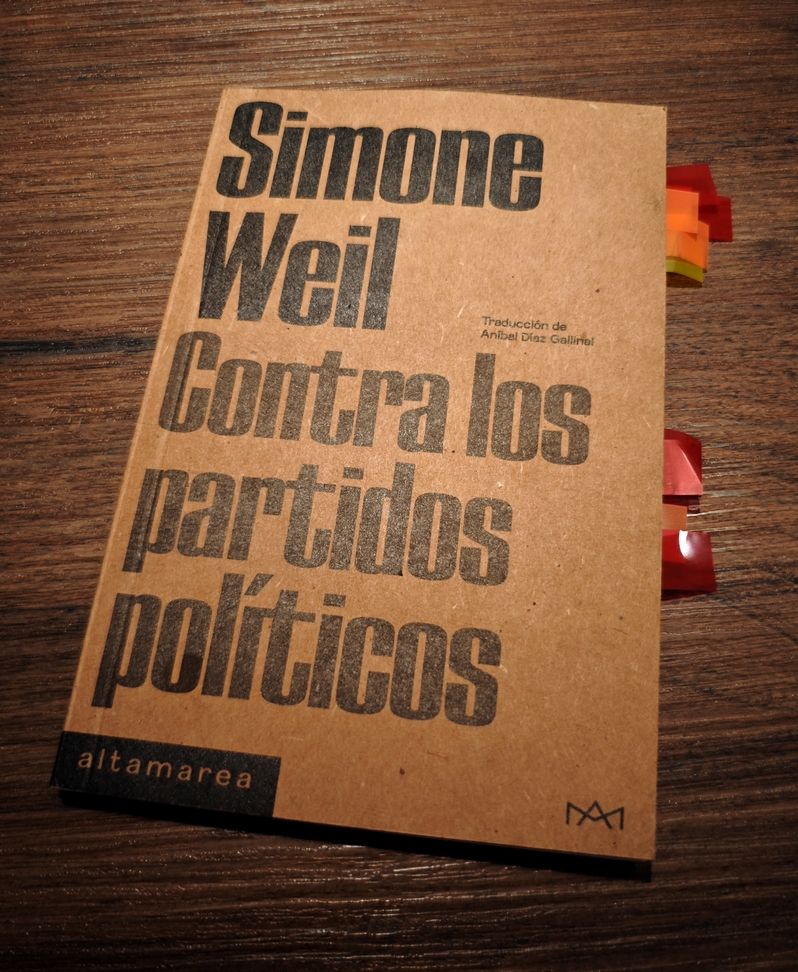
A aquellos amigos que quieran saber el origen y las causas del desbarajuste político actual, tanto en el ámbito nacional como en el mundial, recomiendo fervientemente este panfleto que escribió Simone Weil y que se publicó póstumamente en el año 1950 con el nombre de Note sur la suppression générale des partis politiques. Los criterios que impulsan a los partidos políticos, y por los que se rigen, y que Weil analiza aquí sencilla y certeramente, por fuerza tenían que abocar a la sociedad a esta situación penosa en la que se encuentra.
Me veo en la urgencia de señalar el hecho curioso de que una persona sincera haya de vencer una cierta resistencia interior, en estos tiempos, si quiere hacer una sugerencia a sus allegados, habida cuenta de que de los cientos de recomendaciones que un individuo contemporáneo cualquiera recibe a lo largo del día, el único propósito de alrededor de un cuarenta por ciento es apoderarse de su dinero, el de un treinta por ciento es hacerle partícipe y cómplice de convicciones que solo favorecen a quien emite las recomendaciones, y casi la totalidad del resto son gritos desesperados de seres que quieren aliviar su soledad haciendo uso de todo de lo que pueden apoderarse si con ello consiguen sacar la cabeza un momento por encima de la masa y llamar la atención de los demás.
La más ligera sospecha que pueda despertarse, en uno o en los demás, de que los motivos inconscientes de esta recomendación pertenecen a una de esas categorías le hace a uno desfallecer. Pero también y quizá más importante, inquieta la falta de respeto en la que uno incurriría al usar la figura y el trabajo de Simone Weil, que tan sinceramente ejecutó este texto, para esos fines tan instrumentales.
P.S. Unos días después de publicar esta nota, me ha invadido la desazón frente a la posibilidad de que, de hecho, nadie quiera conocer el origen y las causas del desbarajuste político actual, que suponer que hay quien quiere es lo que tiene de ridículo de esta entrada y de su autor.
Recommendation
For those friends who want to know the origin and causes of the current political turmoil, both nationally and globally, I highly recommend this pamphlet written by Simone Weil and published posthumously in 1950 under the title Note sur la suppression générale des partis politiques. Must exist English translation, as she wrote it while in England. The criteria that drive political parties, and by which they are governed, and which Weil analyses here simply and accurately, were bound to lead society into the painful situation in which it now finds itself.
I feel compelled to point out the curious fact that a sincere person has to overcome a certain inner resistance these days if he wants to make a suggestion to his loved fellow human beens , given that of the hundreds of recommendations that any contemporary individual receives throughout the day, the sole purpose of around 40 per cent is to take his money, thirty per cent is to make him a participant and accomplice in convictions that only benefit the person making the recommendations, and almost all the rest are desperate cries from people who want to alleviate their loneliness by using everything they can get their hands on if it means they can rise above the crowd for a moment and get the attention of others.
The slightest suspicion that may arise, in oneself or in others, that the unconscious motives behind this recommendation belong to one of these categories is enough to make one quit. But also, and perhaps more importantly, one is disturbed by the disrespect one would incur by using the figure and work of Simone Weil, who so sincerely executed this text, for such instrumental purposes.
P.S. A few days after publishing this note, I was overcome with unease at the possibility that, in fact, no one wants to know the origin and causes of the current political turmoil, and that assuming that there are those who do is the ridiculous part of this entry and its author.
En un andén de la estación central de Berlín en 2023, un hombre negro, alto, bien vestido, resplandeciente, pasó decidido hacia el tren, con su hijo de la mano, obligándome a mí a retroceder un paso. Cuando entré después en el vagón, vi que estaba hablando airadamente con una persona sentada frente a su hijo. La impresión que me dio es que estaba respondiendo a algún comentario racista o mal educado. Justo en el último momento antes de que se cerraran las puertas entraron también un hombre y una mujer. Eran americanos blancos, ella mucho más joven que él, vestidos con ropa deportiva. Al oír los gritos en el fondo del vagón el hombre dijo… “you need to calm, you need to be gentle”, como si estuviera intentando reducir la tensión pero, de hecho, de forma muy agresiva, además de por el tono, porque era evidente para todos que hablaba sin tener ni idea de lo que ha dado lugar a la discusión, y que lo que quería era dejar claro que la culpa de cualquier cosa que estuviera pasando allí era del señor negro. La mujer intentó hacerle callar, evitar que se metiera en líos, con gestos y frases susurradas, en una actitud que hacía pensar que se encontraban a menudo en situaciones parecidas. Ella parecía un poco lenta y entonces caí en cuenta de que debían pertenecer a las Olimpiadas Especiales, que invadían Berlín esos días, con representantes de todas las nacionalidades. En el vagón también viajaban tres chicas, también americanas, con ropa deportiva, y que parecía también que estaban en Berlín con motivo de las olimpiadas. Empezaron a hablar con la pareja. Él, con una amabilidad y simpatía extremadamente ridículas, sobre todo en contraste con la violencia del gesto anterior, les preguntó por sus nombres. Dos de ellas, con melena larga rubia y muy delgadas, contestaron. “Yo soy Jessica”, dijo una. “Yo soy Julie”, dijo la otra. “Somos hermanas” dijeron las dos. El americano se dirigió a la tercera: “Y tú, ¿cómo te llamas?” “Jeniffer”. “¡Oh, qué bonito nombre!” contestó él.
Intersection
In 2023, on a platform at Berlin Central Station, a tall, well-dressed black man with a resplendent air about him walked purposefully towards the train, holding his son’s hand and forcing me to take a step back. When I got on the train afterwards, I saw that he was angrily confronting someone sitting opposite his son. I got the impression that he was responding to a racist or rude comment. Just before the doors closed, a man and a woman got on too. They were white Americans; she was much younger than him, and they were both dressed in sportswear. Hearing the shouting at the back of the carriage, the man said, ‘You need to calm down. You need to be gentle,’ as if he were trying to reduce the tension. In fact, however, he was being very aggressive in both his tone and his attitude, as it was obvious to everyone that he had no idea what had led to the argument and that he just wanted to make it clear that the black man was at fault. The woman tried to silence him and prevent him from getting into trouble with gestures and whispered phrases. Her attitude suggested that they often found themselves in similar situations. She seemed a little slow, and then I realised that they must be taking part in the Special Olympics, which were being held in Berlin at the time with representatives of all nationalities. Three American girls, also dressed in sportswear, were travelling in the carriage and seemed to be in Berlin for the Olympics too. They started talking to the couple. With an extremely ridiculous kindness and friendliness — especially in contrast to the violence of his previous gesture — the man asked them their names. Two of them, with long blonde hair and very thin, answered. ‘I’m Jessica,’ said one. “I’m Julie,” said the other. ‘We’re sisters,’ they said in unison. The American turned to the third and asked, ‘And you, what’s your name?’ ‘Jeniffer,’. “Oh, what a beautiful name!” he replied.
“A un niño que está muriéndose se le da todo lo que quiere: terrones de azúcar. ¿Qué importa que se estropee el estómago? ¿Y no nos encontramos todos nosotros en la situación de ese niño?”, dijo Nietzsche en 1877. Y mi hermano me contó, cuando estaba ya muy enfermo, que había preguntado al doctor si podía fumar, con el nuevo tratamiento. “¡Fume! ¡Fume!”. Mala señal, como si los yogures que te sirven en el avión estuvieran caducados.
Cuando dormíamos a pierna suelta los somníferos estaban reservados para las ocasiones: decepciones, lutos, y obsesiones de trabajo irresolubles. Cuando todavía no íbamos a morir, los terrones se racionaban. Quienes controlan el mercado de terrones ahora han disipado la niebla y no hay barrera que pueda contener los apetitos más inmediatos (los vendedores de caramelos, en los Estados Unidos de América, retrasaron el cambio de horario estacional, para que en Halloween no esté tan oscuro y los niños puedan mendigar un rato más por las calles, y chantajear a sus vecinos). Rienda suelta, principio de placer.
Tras la pandemia se han abandonado los análisis de índices de glucosa en la sangre. No importa el hígado, ni el Amazonas, ni las botellas vacías que navegan por los ríos. El turismo más depredador sabe más dulce, la esclavitud más exigente parece más liberadora. Políticas impulsadas contra el estómago y el corazón, con precisión obnubiladora. La intemperancia triunfa bajo el nombre de dejadez, el mayor aliado de extremistas en todos los puntos cardinales -con excepción de ese de verdad extremo-
Pobres opulentos, consumiendo falsos bienes de consumo, porque “no es pobre el que tiene poco, sino el que desea más”, que escribió Séneca. Quedan pocos que se avergüencen de sus privilegios -son los que no los tienen-; quedan pocos que se conformen con sus obligaciones. Unos y otros son los pocos felices sobre la Tierra.
¡Qué fue de la templanza! La aceleración de las vanguardias empujó al arte fuera de ese gozne.
En 1954, James Olds y Peter Milner (Olds & Milner, 1954) hicieron un experimento que causó un gran impacto en la comunidad científica (Olds & Milner, 1954). Implantaron un electrodo en el núcleo accumbens de una rata. La función de ese electrodo era estimular eléctricamente ese núcleo, produciendo una descarga de dopamina. La rata tenía una palanca que podía apretar. Cada vez que la apretaba, recibía una descarga. La rata no paraba de apretar la palanca, y dejaba de comer o beber. Al final, muchas de las ratas morían.
O tempora, o mores!
“A dying child is given everything he wants: sugar cubes. What does it matter if his stomach is ruined? And are we not all in the same situation as that child?” said Nietzsche in 1877. And my brother told me, when he was already very ill, that he had asked the doctor if he could smoke with the new treatment. “Smoke! Smoke!” A bad sign, like when the yoghurt they serve you on the plane has expired.
When we slept soundly, sleeping pills were reserved for special occasions: disappointments, bereavements, and unsolvable work obsessions. When we weren’t about to die, sugar cubes were rationed. Those who control the sugar cube market have now cleared the fog, and no barrier can contain the most immediate appetites (candy sellers in the United States delayed the seasonal time change so that it wouldn’t be so dark on Halloween and children could beg on the streets a little longer and blackmail their neighbours). Free rein, pleasure principle.
In the wake of the pandemic, blood glucose testing has been abandoned. The liver, the Amazon, and the empty bottles floating down the rivers don’t matter. The most predatory tourism tastes sweeter, the most demanding slavery seems more liberating. Policies driven towards the stomach and the heart, with blinding precision. Intemperance triumphs under the name of laziness, the greatest ally of extremists in all directions—with the exception of the truly extreme.
Poor opulent people, consuming false consumer goods, because “it is not the one who has little who is poor, but the one who desires more,” as Seneca wrote. Few remain who are ashamed of their privileges—they are the ones who do not have them; few remain who are content with their obligations. Both are the few happy ones on Earth.
What happened to temperance! The acceleration of the avant-garde pushed art out of that hinge.
In 1954, James Olds and Peter Milner (Olds & Milner, 1954) conducted an experiment that had a major impact on the scientific community (Olds & Milner, 1954). They implanted an electrode in the nucleus accumbens of a rat. The function of this electrode was to electrically stimulate the nucleus accumbens, producing a dopamine release. The rat had a lever that it could press. Every time it pressed the lever, it received a dopamine release. The rat would not stop pressing the lever, and would stop eating or drinking. In the end, many of the rats died.
Es curioso pensar ahora lo bien que estábamos hace tan solo cinco años, un poco más quizá, antes de la pandemia. Entonces solo había que preocuparse por salvar el planeta, por la destrucción de los océanos, por los incendios forestales, por la poca naturaleza que le íbamos a dejar a las generaciones venideras, si las hubiera, podíamos dedicar todo el tiempo a pensar el fin de la vida sobre el planeta y en la cuasi omnipresencia del capitalismo en nuestra experiencia del mundo. Qué dedicación tan noble era esa que ocupaba los medios de comunicación, empujada por los jóvenes y contestada desde sus tribunas privilegiadas por los adultos más recalcitrantes. Todo eso ya ha sido olvidado, ahora uno ya no tiempo para pensar en cosas elevadas, para sufrir en algo cuya solución es tan difícil y lejana. Ahora hay que pensar en problemas inmediatos e irresolubles que dependen puramente de la maldad de los que los dirigen y los que los alientan: la muerte en Gaza -¡de hambre!-, los que mueren en Ucrania, la última patochada que ha hecho o dicho el dictador, la impudicia de las declaraciones del líder belicoso y exterminador, la posibilidad de que un individuo -elegido democráticamente, recordemos- entre imbécil y psicópata, apriete un botón para ver qué pasa, como un niño que quiere ver qué tiene el juguete dentro, y haga trizas las vidas de millones de personas. Es importante pensar en esto para darse cuenta de lo bien que estamos, y de cómo hablaremos de estas injusticias con nostalgia dentro de cinco años, si llegamos hasta entonces.
Nostalgia
It’s weird to think now how good things were just five years ago, maybe a bit more, before the pandemic. Back then, all we had to worry about was saving the planet, the destruction of the oceans, forest fires, the little nature we were going to leave to future generations, if there were any, and we could devote all our time to thinking about the end of life on Earth and the quasi-omnipresence of capitalism in our experience of the world. What a noble cause it was that occupied the media, driven by young people and answered from their privileged platforms by the most recalcitrant adults. All that has now been forgotten. Now we no longer have time to think about lofty things, to suffer over something whose solution is so difficult and distant. Now we have to think about immediate and unsolvable problems that depend purely on the evil of those who run them and those who encourage them: death in Gaza – from hunger! those dying in Ukraine, the latest blunder made or uttered by the dictator, the shamelessness of the bellicose and exterminating leader’s statements, the possibility that an individual – democratically elected, let us remember – somewhere between an imbecile and a psychopath, will press a button to see what happens, like a child who wants to see what is inside a toy, and shatter the lives of millions of people. It is important to think about this to realise how good we are, and how we will talk about these injustices with nostalgia in five years’ time, if we get that far.
Quien puede ver con claridad en medio del engaño general es como un hombre cuyo reloj funciona bien cuando todos los relojes de la ciudad en la que vive están equivocados. Solo él sabe la hora exacta, pero ¿de qué le sirve? Arthur Schopenhauer
Schopenhauer cuenta esta microparábola como metáfora de la verdad filosófica, y para lamentarse de cómo quien concibe el sentido de la vida con la exactitud que marca la hora un reloj nuclear, solo lo hace entre mucha gente confundida, aunque segura de sus convicciones.
Esas tres líneas le sirven al filósofo alemán Hans Blumenberg para escribir un artículo, incluido en su libro’ «La inquietud que atraviesa el río», en el que desquicia todas las reflexiones a las que invita Schopenhauer ahí.Para Blumenberg, este hombre con el reloj con la hora correcta es un orgulloso que, por su prurito de exactitud y verdad, no acepta poner su reloj a la hora de todos los demás, lo que solucionaría su problema, y podría así acudir a las reuniones con otros ciudadanos sin adelantarse ni atrasarse.
Una vez que se le ha perdido el respeto a Schopenhauer, ya es difícil parar y entonces lo siguiente para Blumenberg es cargar las culpas, no sobre el protagonista de la historia, sino sobre el narrador, al que considera absurdo al dar por sentado que una persona pueda conocer la hora real, mientras que todos los demás ignoran esta información. Para esto se apoya en que el tiempo es algo que depende del público: es este el que establece la correlación de la hora con los movimientos de los astros, el que decide por convenio los momentos que se dan como principio o final de las horas y los días. Dice: “El poseedor solitario del tiempo verdadero en una ciudad en la que solo hay torres con relojes que marcan la hora equivocada no es un sabio, sino un necio. La historia pretende disuadir a uno de pensar con impaciencia que todos pueden y deben seguir sin demora al poseedor de la verdad. De hecho, muestra lo contrario: por qué nunca lo seguirían.”
Blumenberg es muy poco generoso con Schopenhauer. Se puede decir que, para conseguir poner a Schopenhauer en ridículo, ha tenido que atrasar y adelantar su reloj varias veces. Porque introduce en su crítica el argumento estratégico pero sin pruebas, de que frente al reloj de ese hombre están todos los demás,sincronizados, y además “en las torres de las iglesias”. Eso no está de ningún modo en Schopenhauer quien solo dice que “están equivocados”. Si estuvieran equivocados al unísono, quizá habría que plegarse ante Blumenberg, pero el hecho es que unos atrasan y otros adelantan, algunos están parados, y otros, que funcionan regularmente, tienen una hora distinta cada uno- curiosamente, esos relojes regulares son los que siempre están equivocados, cada uno se engaña de una manera distinta y regular, la que le hace sentir mejor-. Como sucede necesariamente con las equivocaciones, cada uno de estos relojes está equivocado a su propia manera -los relojes que tienen la hora correcta, por el contrario y por definición, han de estar sincronizados, todos igual de correctos-. En la estadísticamente improbable circunstancia de que los relojes equivocados de todos los ciudadanos estuvieran equivocados de la misma forma, quizá podría contarse con alguna base desde la que dar por buena esa equivocación, en cuanto que sería de utilidad, por más que parcial, para la interacción entre aquellas personas que tienen relojes equivocados (siempre que estén sincronizados en su equivocación).
El reloj que da la hora correcta, la da correcta todo el tiempo, porque como he dicho, al contrario que la mayor parte de los relojes equivocados, su medir es regular. Es con ese reloj con el que se puede establecer una correlación con los fenómenos astronómicos, cuando el tiempo del reloj coincide, sin sobrar y sin faltar, con el del movimiento de los astros, y entonces se puede medir el día más largo del año, por ejemplo, correctamente, con un reloj con la hora correcta. Se podría pensar -quizá Schopenhauer lo hizo- que el reloj de ese señor es un reloj solar y, como escribe Jünger en La tijera, “cabe fabricar relojes que se adelanten o se retrasen un solo segundo en un lapso de tiempo de mil años. Ese reloj, sin embargo, está a más distancia de lo absoluto que un reloj de sol de la Antigüedad”. De esa manera, no solo tendría la hora correcta, sino que sería esa corrección. Al fin y al cabo el reloj nuclear está también equivocado, por un poco.
En cualquier caso, ese reloj con la hora correcta es correcto de muchas otras maneras, además de la astronómica. El reloj con la hora correcta, a pesar de no coincidir con ninguno de la ciudad, puede que coincida con el de los trenes, que tienen un medir meta-ciudadano del tiempo, con un referente exterior a ese contexto en el que Schopenhauer acota su parábola y que Blumenberg, porque le conviene, interpreta como una representación de la totalidad de lo humano. Porque hay que tener en cuenta también que no es, como da a entender Blumemberg, que todos esos ciudadanos que defienden la hora equivocada se hayan puesto de acuerdo, sabia y soberanamente, para someter el tiempo conjuntamente, lo que quizá podría convertir efectivamente en un necio al hombre con la hora correcta, si hacemos caso a Gorgias, que llamaba “a la tragedia un engaño en el que el que engaña es más honesto que el que no engaña y el que es engañado más sabio que el que no es engañado”. Lo sabio, en ese caso, hubiera sido suspender su incredulidad con los demás para disfrutar de la obra de teatro. Pero, de hecho, la hora correcta fue impuesta para todos por los trenes, sobre aquella hora solar que marcaba el día a los humanos anteriores a la revolución industrial, y que las iglesias intentaron mantener tanto como pudieron en la pugna contra el ferrocarril y lo que traía en sus vagones. Puede que esa hora correcta sea impuesta por leyes arbitrarias, no lo niego, pero cuánto más arbitrarias son las leyes que carecen de ley, o que aplican una ley distinta a cada caso.
Si me irrita esta crítica de Blumenberg es porque no es de buena fe. Parecería que, escrito como está en el año 1987, el libro se hubiera inspirado en La condición posmoderna, publicado ocho años antes, en el que Jean-François Lyotard analiza -que no sanciona- la decadencia de las grandes narrativas como medio para explicar el mundo. Parecería que Blumemberg, sintiéndose mayor ya a sus 68 años, con el propósito de conjurar la posibilidad de que su público pensase que se había quedado trasnochado, se hubiera dicho a sí mismo: “Maldita sea, no hay verdad absoluta. A ver dónde puedo dejar constancia de que lo sé. Ich bin doch nicht blöd”.
Estoy harto de asistir, hasta en los lugares más banales y cotidianos, a afirmaciones explícitas y taimadas de que la verdad es relativa. Vale, puede que lo sea, pero desde luego solo saben que es relativa aquellos que buscan una verdad absoluta por todas partes y no la encuentran, no los que dan por buena cualquiera verdad gregaria solo porque alguien les ha dicho que la verdad es relativa. Porque el argumento de que la verdad es relativa solo es legítimo cuando se usa para minar las propias seguridades, para autoboicotear el conocimiento propio, no para fundamentarlo en la inestabilidad del de los demás. A quien rechaza la verdad absoluta sin haberla buscado le sucede como al hombre natural, Kierkegaard dixit, que empieza por ignorar lo que es verdaderamente horrible y, sin embargo, no sólo no se libera del espanto, sino que se pone a temblar por lo que en realidad no es horrible. Contra lo que se defiende popularmente de que cada uno tiene una verdad, lo que hay que argumentar es que, efectivamente, cada uno tiene una manera distinta de alejarse de la verdad. Esa es la base de la subjetividad.
Aparte de ese factor para la decadencia del prestigio de la verdad que es el orgullo generalizado que se ha extendido por el mundo y por el que el valor de las opiniones de las gentes más vulgares se equilibra en sus mentes con el de las personas más educadas y ponderadas, hay otro que fluye más profundo: la idea de una verdad última no ha sido abandonada porque la gente se haya vuelto sabia de repente, y aplique ahora su depurado espíritu crítico a todo lo que se le presente a juicio, sino porque el río revuelto ayuda a los furtivos. ¿De qué habría fake news y alternative truth, si no fuera porque sirve a los intereses de una manera particular de entender el mundo? Había que construir un contexto que afirmara tácitamente que no hay verdad para que las mentiras más disparatadas adquirieran inmediata legitimidad y al por mayor -hay que afirmar la inmoralidad, la depravación y la corrupción de los políticos para que los políticos queden sancionados en sus robos, en sus actos inmorales-. El hombre con la hora correcta (Schopenhauer) no quiere imponerse sobre la sociedad de los relojes equivocados, sino que esta, representada aquí por Blumenberg, ejerce una violencia onmiabarcadora sobre el defensor de la verdad.
La verdad más apaleada, por su condición de estar siempre presente y por siempre ser ocultada, es la de que todos los seres humanos, uno por uno, van a morir. Pero hasta de eso se puede dudar, si te pones: puede que no sea cierto que nos vamos a morir, que estén en un error quienes lo crean, que esa no sea una verdad definitiva. Lo que es cierto, seguro, es que todos los humanos, en la medida que lo son, lo creen, que se van a morir, incluso, o especialmente, los que se consideran y afirman que son inmortales. Da igual la hora que marque su reloj que, tomando esa noción como punto de apoyo, un hombre justo puede mover el mundo pero, ¿de qué le sirve? For nothing now can ever come to any good.
Stop the clocks!
He who can see truly in the midst of general infatuation is like a man whose watch keeps good time, when all clocks in the town in which he lives are wrong. He alone knows the right time; what use is that to him? Arthur Schopenhauer
Schopenhauer tells this micro-parable as a metaphor for philosophical truth, lamenting how those who conceive the meaning of life with the accuracy of a nuclear clock do so only among many confused people who are nevertheless sure of their convictions.
These three lines serve as inspiration for German philosopher Hans Blumenberg to write an article, included in his book Care Crosses the River, in which he dismantles all of Schopenhauer’s reflections. For Blummenberg, this man with the clock that tells the correct time is an arrogant man who, because of his obsession with accuracy and truth, refuses to set his clock to the same time as everyone else, which would solve his problem and allow him to attend meetings with other citizens without being early or late.
Once Schopenhauer’s respect has been lost, it is difficult to stop, and so the next step for Blumenberg is to assign blame, not to the protagonist of the story, but to the narrator, whom he considers absurd for taking it for granted that one person can know the real time, while everyone else is ignorant of this information. To support this, he argues that time is something that depends on the public: it is the public that establishes the correlation between time and the movements of the stars, that decides by convention the moments that mark the beginning and end of hours and days. He says: ‘The solitary possessor of the true time in a city with nothing but clock towers with the wrong time is not a wise man but a fool. By disregarding this, the storyteller betrays more about himself than about what he seeks to illustrate: that for those following the wrong time, an appropriate deadline must be set for finally grasping what the one person with a clear head saw immediately. The story is supposed to dissuade one from thinking impatiently that all can and must follow the possessor of truth without delay. In fact, it shows the opposite: why they would never follow him’.
Blumenberg is very ungenerous to Schopenhauer. It could be said that, in order to ridicule Schopenhauer, he has had to set his clock back and forward several times. Because he introduces into his criticism the strategic but unproven argument that all other clocks are synchronised among them against this man’s clock, and moreover ‘in church towers’. This is not at all what Schopenhauer says, who only says that ‘they are wrong’. If they were all wrong in unison, perhaps one would have to bow to Blumenberg, but the fact is that some are behind, others are ahead, some are stopped, and others, which work regularly, each have a different time—curiously, those regular clocks are the ones that are always wrong, each deceiving itself in a different and regular way, the one that makes it feel better. As is necessarily the case with mistakes, each of these clocks is wrong in its own way—clocks that are correct, on the contrary and by definition, must be synchronised, all equally correct. In the statistically improbable circumstance that all citizens’ wrong clocks were wrong in the same way, there might be some basis for accepting that mistake as valid, in that it would be useful, however partially, for interaction between those people who have wrong clocks (provided they are synchronised in their wrongness).
The clock that tells the correct time is correct all the time because, as I have said, unlike most clocks that are wrong, it measures time regularly. It is with this clock that a correlation can be established with astronomical phenomena, when the time on the clock coincides, without excess or deficiency, with the movement of the stars, and then the longest day of the year, for example, can be measured correctly with a clock that tells the correct time. One might think – perhaps Schopenhauer did – that this gentleman’s clock is a sundial and, as Jünger writes in Die Schere (The Scissors), ‘it is possible to make clocks that are only one second fast or slow over a period of a thousand years. Such a clock, however, is further from the absolute than a sundial of antiquity’. In this way, it would not only have the correct time, but it would be correctness itself. After all, the nuclear clock is also wrong, by a little.
In any case, that clock with the correct time is correct in many other ways, besides the astronomical one. The clock with the correct time, despite not matching any of the city’s clocks, may match that of the trains, which have a meta-city measure of time, with a reference point outside the context in which Schopenhauer sets his parable and which Blumemberg, because it suits him, interprets as a representation of the totality of humanity. Because we must also bear in mind that it is not, as Blumemberg implies, that all those citizens who defend the wrong time have wisely and sovereignly agreed to submit to time collectively, which could perhaps effectively turn the man with the correct time into a fool, if we listen to Gorgias, who called ‘tragedy a deception in which the deceiver is more honest than the deceived and the deceived wiser than the deceiver’. The wise thing, in that case, would have been to suspend one’s disbelief in others in order to enjoy the play. But, in fact, the correct time was imposed on everyone by the trains, over and above the solar time that marked the day for humans before the industrial revolution, and which the churches tried to maintain as much as they could in their struggle against the railway and what it brought in its carriages. That correct time may be imposed by arbitrary laws, I do not deny it, but how much more arbitrary are laws that lack law, or that apply a different law to each case.
If Blumenberg’s criticism irritates me, it is because it is not in good faith. Written as it is in 1987, the book seems to have been inspired by The Posmodern Condition, published eight years earlier, in which Jean-François Lyotard analyses – but does not approve – the decline of grand narratives as a means of explaining the world. It would seem that Blumenberg, feeling old at 68, in order to ward off the possibility that his audience might think he had become outdated, said to himself: ‘Damn it, there is no absolute truth. Let’s see where I can make it clear that I know this. Ich bin doch nicht blöd.’
I’m sick of hearing, even in the most banal and everyday places, explicit and sly assertions that truth is relative. Okay, maybe it is, but surely the only people who know it is relative are those who seek absolute truth everywhere and cannot find it, not those who accept any gregarious truth just because someone has told them that truth is relative. Because the argument that truth is relative is only legitimate when used to undermine one’s own certainties, to sabotage one’s own knowledge, not to base it on the instability of others. Those who reject absolute truth without having sought it are like the natural man, according to Kierkegaard, who begins by ignoring what is truly horrible and yet not only fails to free himself from horror, but begins to tremble at what is not really horrible. Contrary to the popular belief that everyone has their own truth, what must be argued is that, in fact, everyone has a different way of distancing themselves from the truth. That is the basis of subjectivity.
Apart from this factor in the decline of the prestige of truth, which is the widespread pride that has spread throughout the world and whereby the value of the opinions of the most vulgar people is balanced in their minds with that of the most educated and thoughtful, there is another that runs deeper: the idea of an ultimate truth has not been abandoned because people have suddenly become wise and now apply their refined critical spirit to everything that comes before them for judgement, but because troubled waters help the thieves. Why would there be fake news and alternative truth if it did not serve the interests of a particular way of understanding the world? A context had to be constructed that tacitly affirmed that there is no truth, so that the most absurd lies could acquire immediate legitimacy and wholesale acceptance—the immorality, depravity and corruption of politicians must be affirmed so that politicians can be understood as normal executers of theft and immoral acts. The man with the correct time (Schopenhauer) does not want to impose himself on the society of wrong clocks, but rather, represented here by Blumenberg, the society exercises all-encompassing violence on the defender of truth.
The most beaten-up truth, because it is always present and always hidden, is that all human beings, one by one, are going to die. But even that can be doubted, if you think about it: it may not be true that we are going to die, that those who believe it are mistaken, that this is not a definitive truth. What is certain is that all humans, to the extent that they are human, believe that they are going to die, even, or especially, those who consider themselves and claim to be immortal. No matter what time their clock shows, taking that notion as a starting point, a just man can move the world, but what good does it do him? For nothing now can ever come to any good.
Mi amigo John pasó una temporada en Logroño, mi lugar de nacimiento, poco después de conocernos en Madrid. John es de California, donde vive su familia, pero lleva décadas viviendo en Nueva York. En los años ochenta hizo un largo viaje por el mundo, incluyendo varios lugares en Asia y Europa, para acabar en Madrid. Cuando nos conocimos estaba trabajando en una serie de pinturas en encáustica. Le daba pena que, al terminársele el dinero, tuviera que volver a su vida y trabajo en NYC sin la posibilidad de acabar esta serie. Así que le ofrecí el estudio que yo tenía en Logroño. La ciudad era más barata, no tenía que pagar vivienda y podía concentrarse en sus pinturas, algo bastante más fácil ahí que en el Madrid de los 80s. Pasó en Logroño como seis meses e iba y venía a menudo a Madrid, donde yo vivía entonces. El viaje duraba cuatro horas y media en autobús y por aquel entonces, durante el viaje, ponían en los monitores del autobús dos películas a todo volumen, para hacer el trayecto más llevadero a unos viajeros y más penoso a otros. En una ocasión, viajando hacia Madrid, me contó que habían puesto una película de gánsters ambientada en la ciudad de Nueva York. Mientras cruzaba los campos sorianos se desarrollaba en el monitor una escena que había sido rodada en el East Village, el barrio donde John tiene su apartamento, una situación peculiar, la de estar en ese autobús, mirando en la televisión esos lugares tan familiares. Pero la sorpresa se volvió inquietante cuando el protagonista dentro de la trama, entró en el mismísimo edificio en el que él vivía y subió por las escaleras a un apartamento. Cuando me lo contó al llegar, sorprendido por la casualidad enorme de que esa película se hubiera rodado precisamente en su edificio, nos imaginamos que la cosa hubiera podido ir todavía más lejos, y que hubiera entrado en su propio apartamento y rebuscado en sus libros, entre sus papeles o entre su ropa. Existían pocas posibilidades de que esto ocurriera, pero todavía había menos de que viajando en el metro de Nueva York pudiera yo ver una película de gente que entraba en mi estudio de Logroño.
Por esa época se contaba un chiste que tenía relación con eso, porque algo estaba sucediendo en ese momento con respecto a la globalización, un movimiento subterráneo de las conciencias además del superficial que se veía en las cifras de negocio entre países. En la Rioja hay dos pueblos que se llaman Arenzana, uno junto otro y uno es Arenzana de arriba y el otro Arenzana de abajo. El protagonista del chiste es de Arenzana de arriba y un día se le ocurre que quiere visitar Japón. Entonces va a la plaza del pueblo, donde sale el autobús para Logroño y le pide al conductor un billete para Japón. Este le explica que no puede dárselo, pero que cuando llegue a Logroño vaya a la estación de tren y pregunte. Así que coge el autobús hasta Logroño y allí, en la ventanilla de Renfe pide un billete para Japón. El empleado le dice que él le puede vender un billete a Madrid y que allí puede ir al aeropuerto y preguntar. Eso es lo que hace y, en el mostrador de Iberia compra un billete que, tras algunas escalas, le permite viajar hasta Tokio. Pasa unos días disfrutando del país, pero un día ya se cansa y decide volver a su pueblo, así que se dirige a una estación de tren de las muchas que hay en Tokio, se acerca a la ventanilla y pide un billete a Arenzana. El empleado le contesta: ¿Alenzana de aliba o alenzana de abajo?
Con los años puede no parecer tan gracioso, pero hay que tener en cuenta que, en los años ochenta Japón era un país remoto, inimaginable y Arenzana era algo muy cercano y familiar para alguien nacido en Logroño, y era el choque de esas dos condiciones, en el contexto de la globalización creciente, lo que justificaba el que el chiste encontrara un público.
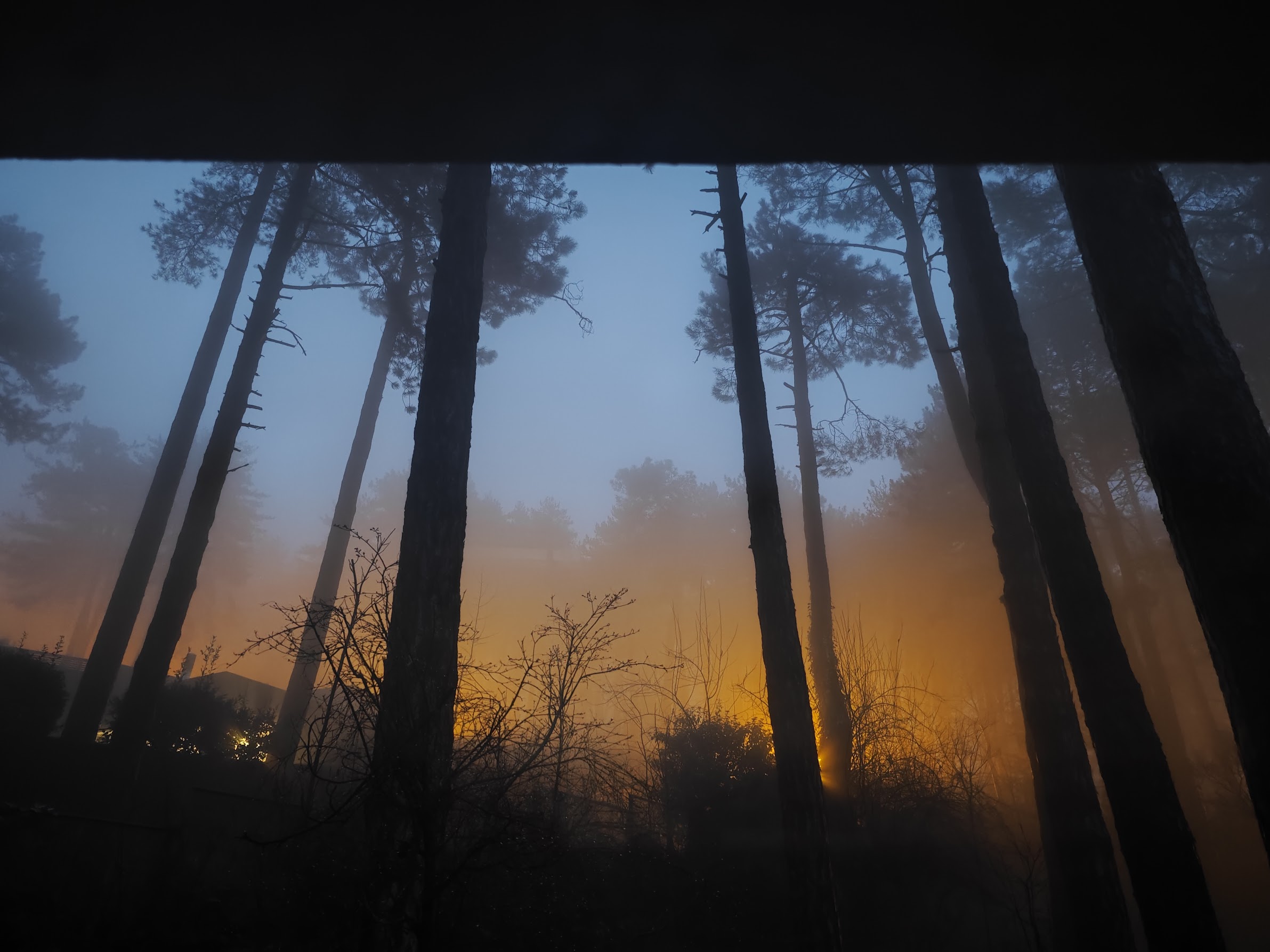
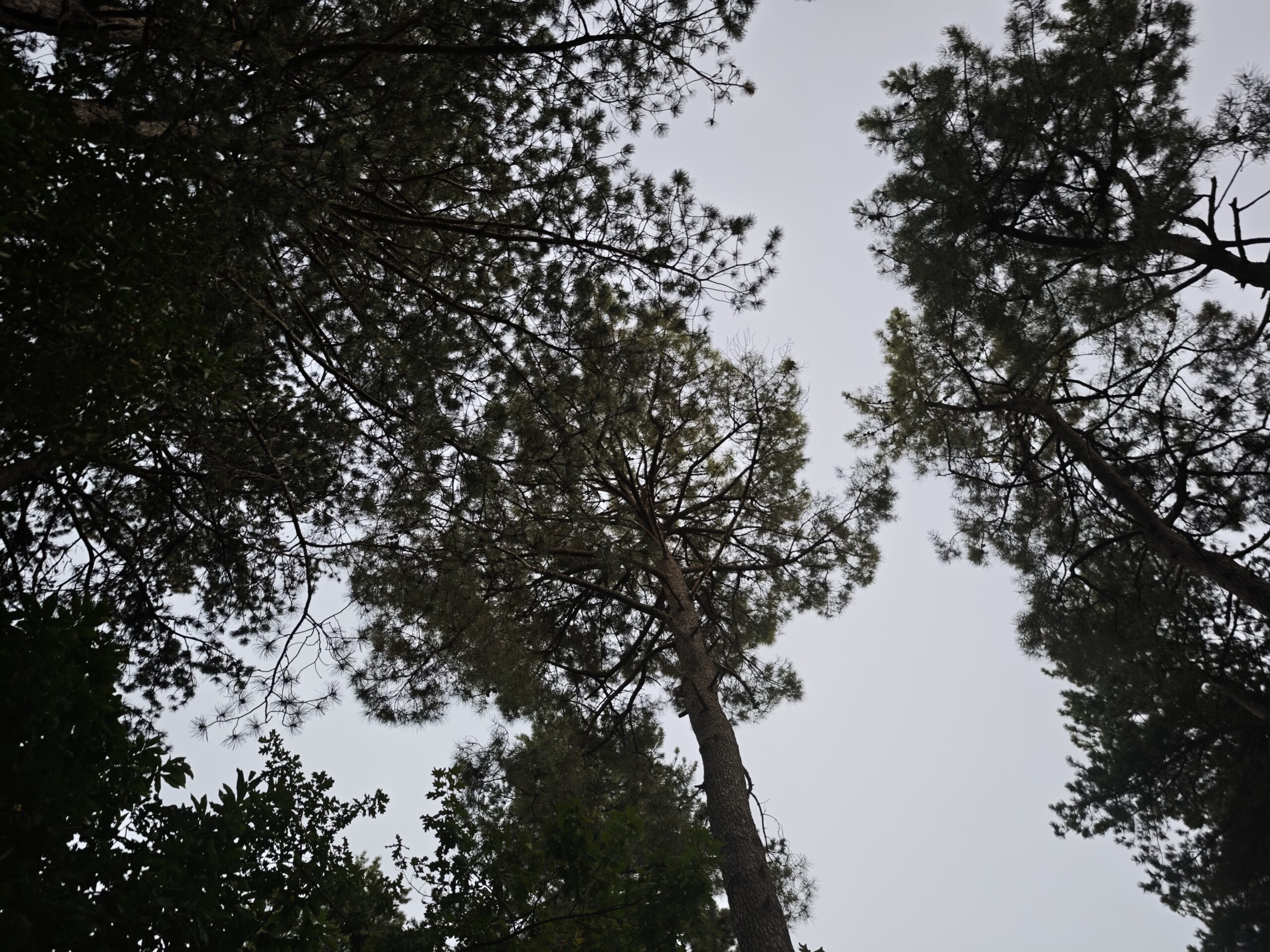
El cambio de los medios de comunicación ha ido de forma consistente en esa dirección, y ahora abro una página en el navegador de mi ordenador en mi casa en El Escorial y aparece un anuncio, vete a saber creado dónde, alojado en qué servidor, por una empresa con su domicilio fiscal en qué continente, en el que dice “en San Lorenzo de El Escorial estamos regalando audífonos a mayores de 65 años”. De hecho, en la última película de Almodóvar, de producción norteamericana y ambientada en los Estados Unidos, las dos mujeres protagonistas, interpretadas por Julianne Moore y Tilda Swinton, viajan en un momento desde la ciudad de Nueva York al norte del estado, a una casa de campo en los alrededores de Woodstock. En una escena que en la que pasean por los alrededores de la casa, entre pinos, tengo una sensación extraña, parecida, supongo a la de John en aquella ocasión, por el inquietante parecido de los árboles del estado de NY y los de El Escorial. Después, cuando hay una cámara subjetiva de la mirada de las mujeres hacia arriba, me doy cuenta de que no puede ser un parecido casual, porque ese cielo entre los pinos es el que yo veo cada mañana. Tras una búsqueda en Internet se revela que, efectivamente, esa parte de la película ha sido rodada a unos metros de mi casa.
My friend John spent some time in Logroño, my hometown, shortly after we met in Madrid. John was born in California, where his family lives, but he has been living in New York for decades. At one point in the 1980s, he took a long trip around the world, including several places in Asia and Europe, ending up in Madrid. When we met, he was working on a series of encaustic paintings. He was sad that he was running out of money and had to go back to his apartment and job in NYC without being able to finish the series. So I offered him the studio space I had in Logroño. The city was cheaper, he didn’t have to pay for a studio or accommodation, and he could concentrate on his work, which was much more difficult in Madrid in the 1980s. He spent about six months there and often came back to Madrid, where I was living at the time. The trip took four and a half hours by bus, and at that time, during the journey, they showed two films at full volume on the bus monitors, to make the journey more bearable for some passengers and more painful for others. On one occasion, travelling to Madrid, he told me that they had shown a gangster film set in New York City. As he crossed the fields of Soria, one of the scenes that had been shot in the East Village, the neighbourhood where John has his flat, was playing on the monitor. It was a peculiar situation, being on that bus, seeing those places. But the surprise turned disturbing when the protagonist in the plot entered the very building where he lived and climbed the stairs to a flat. He told me about it when he arrived, surprised by the enormous coincidence that the film had been shot in his building, we imagined that things could have gone even further, and that fhe character could have entered his own flat and rummaged through his books, his papers or his clothes. There was little chance of this happening, but there was even less chance that while travelling on the New York underground I would see a film of people entering my studio in Logroño.
At that time, there was a joke related to this, because something was happening at that moment with regard to globalisation, an underground movement of consciousness in addition to the superficial one that could be seen in the business figures between countries. In La Rioja, there are two villages called Arenzana, one next to the other, one is Arenzana de Arriba (upper) and the other is Arenzana de Abajo (lower). The protagonist of the joke is from Arenzana de Arriba, and one day he decides he wants to visit Japan. So he goes to the town square, where the bus to Logroño leaves, and asks the driver for a ticket to Japan. The driver explains that he can’t give him one, but that when he gets to Logroño, he should go to the train station and ask there. So he takes the bus to Logroño and there, at the Renfe ticket office, he asks for a ticket to Japan. The employee tells him that he can sell him a ticket to Madrid and that there he can go to the airport and ask. That’s what he does, and at the Iberia counter he buys a ticket that, after a few stopovers, allows him to travel to Tokyo. He spends a few days enjoying the country, but one day he gets tired and decides to return to his village, so he heads to one of the many train stations in Tokyo, goes to the ticket office and asks for a ticket to Arenzana. The employee replies: ‘Alenzana de Aliba or Alenzana de Abajo?’
Over the years, it doesn’t seem so funny, but you have to bear in mind that in the 1980s, Japan was a remote, unimaginable country, and Arenzana was something very close and familiar to someone born in Logroño, and it was the clash of these two conditions, in the context of growing globalisation, that justified the joke finding an audience.
The media has consistently changed in this direction, and now when I open a page on my computer at home in El Escorial, an advertisement appears, created who knows where, hosted on who knows what server, by a company with its registered office on who knows what continent, saying ‘in San Lorenzo de El Escorial we are giving away hearing aids to people over 65’. In fact, in Almodóvar’s latest film, produced in the US and set in the United States, the two female protagonists, played by Julianne Moore and Tilda Swinton, travel at one point from New York City to the north of the state, to a country house near Woodstock. In a scene where they are walking around the house, among pine trees, I have a strange feeling, similar, I suppose, to John’s on that occasion, because of the striking resemblance between the trees in New York State and those in El Escorial. Later, when there is a subjective camera shot of the women looking up, I realise that it cannot be a coincidence, because that sky between the pine trees is the one I see every morning. After searching the Internet, I discovered that this part of the film was indeed shot a few metres from my house.
Muchos desprecian el telediario, no se creen lo que dicen ahí. Los más listos buscan su propia información, en las redes, en servidores especializados y exquisitos.
El telediario es la opinión más común, la que se absorbe sin darse uno cuenta, la que se cree a pies juntillas, especialmente gracias a la expresión “todo lo que dicen en las noticias es mentira”. Esa frase es el excipiente con el que unos y otros se tragan las noticias y los mensajes ocultos que conllevan. Lo mismo pasa con la publicidad, en televisión o cualquier otro sitio: “Eso es sólo publicidad”, y uno se lo traga sin pensar.
El sistema de envenenamiento funciona exactamente igual en esos servidores que uno busca solo que, siendo más sutil su funcionamiento, es más difícil de detectar y neutralizar. Los más exigentes son más exigentes de la forma. Se tragan el mismo mensaje, en las mismas proporciones, pero de forma más exquisita, preparados con condimentos exóticos que hacen más dulce el bocado.
Un día cualquiera la mitad de las noticias pueden ser sobre el calentamiento del planeta, y la otra mitad sobre el éxito del turismo, como si fueran asuntos que no se relacionan en absoluto. Esto, la mayor parte de las veces no son noticias, sino publicidad. Todavía hay otra mitad, que es la publicidad que la política se hace a sí misma.
Pero las noticias más entrañables estos días son las que muestran al rey y sus secuaces actuando como si la guerra fuera un fenómeno natural del mismo género que el granizo. Solo que los aviones son bellos, y van a defender bien el flanco oriental, con todas esas piruetas.
Television news
Many people despise television news; they don’t believe what they say. The smartest ones seek their own information on social media and specialised, high-quality websites.
Television news is the most common opinion, the one that is absorbed without realising it, the one that is believed hook, line and sinker, especially thanks to the expression “everything they say on the news is a lie”. That phrase is the excipient with which people swallow the news and the hidden messages it carries. The same thing happens with advertising, on television or anywhere else: ‘That’s just advertising,’ and you swallow it without thinking.
The poisoning system works exactly the same way on those servers that one seeks out, only that, being more subtle in its operation, it is more difficult to detect and neutralise. The most demanding are more demanding in form. They swallow the same message, in the same proportions, but in a more exquisite form, prepared with exotic seasonings that make the bite sweeter.
On any given day, half the news may be about global warming, and the other half about the success of tourism, as if they were completely unrelated issues. Most of the time, this is not news, it is advertising. There is still another half, which is the advertising that politics does for itself.
But the most endearing news these days is that which shows the king and his henchmen acting as if war were a natural phenomenon on a par with hailstones. Except that the planes are beautiful, and they will defend the eastern flank well, with all their pirouettes.