
English below
Después de dos días en Viena conversando con otros artistas sobre el fenómeno de la voz en off y sus variantes, esta mañana he tomado el tren regional que conecta la Westbahnhof con Kirchstetten, un pueblo pequeño de la baja Austria en el que Wystan Hugh Auden pasó intermitentemente los quince últimos años de su vida y en su totalidad los, de momento, cincuenta de su muerte.
Una hora de viaje para la que he reservado la lectura de W.H. Auden: In the Autumn of the Age of Anxiety, una biografía del poeta escrita por Alan Levy como ampliación de un artículo que había publicado años antes en el New York Times. Cuando faltaban pocos días para volar a Viena me había entrado la urgencia por saber más de los últimos años de la vida de Auden, y había buscado el libro por las librerías en la red, resultando que en Viena se encontraba el ejemplar más conveniente, por precio y porque, al estar en esa ciudad, podría recibirlo a tiempo para la visita. Me estaba esperando en el hotel a la llegada. El ejemplar, por casualidad, está firmado por el propio Levy.
El libro empieza con el autor en el tren desde Viena a Kirchstetten, como yo, pero cincuenta y tres años antes y con la expectativa de encontrar a Auden esperándole en la estación con su Wolkswagen beetle, listo para recogerle y llevarle a casa, donde almorzarán y tendrán una conversación con suave vocación de entrevista.
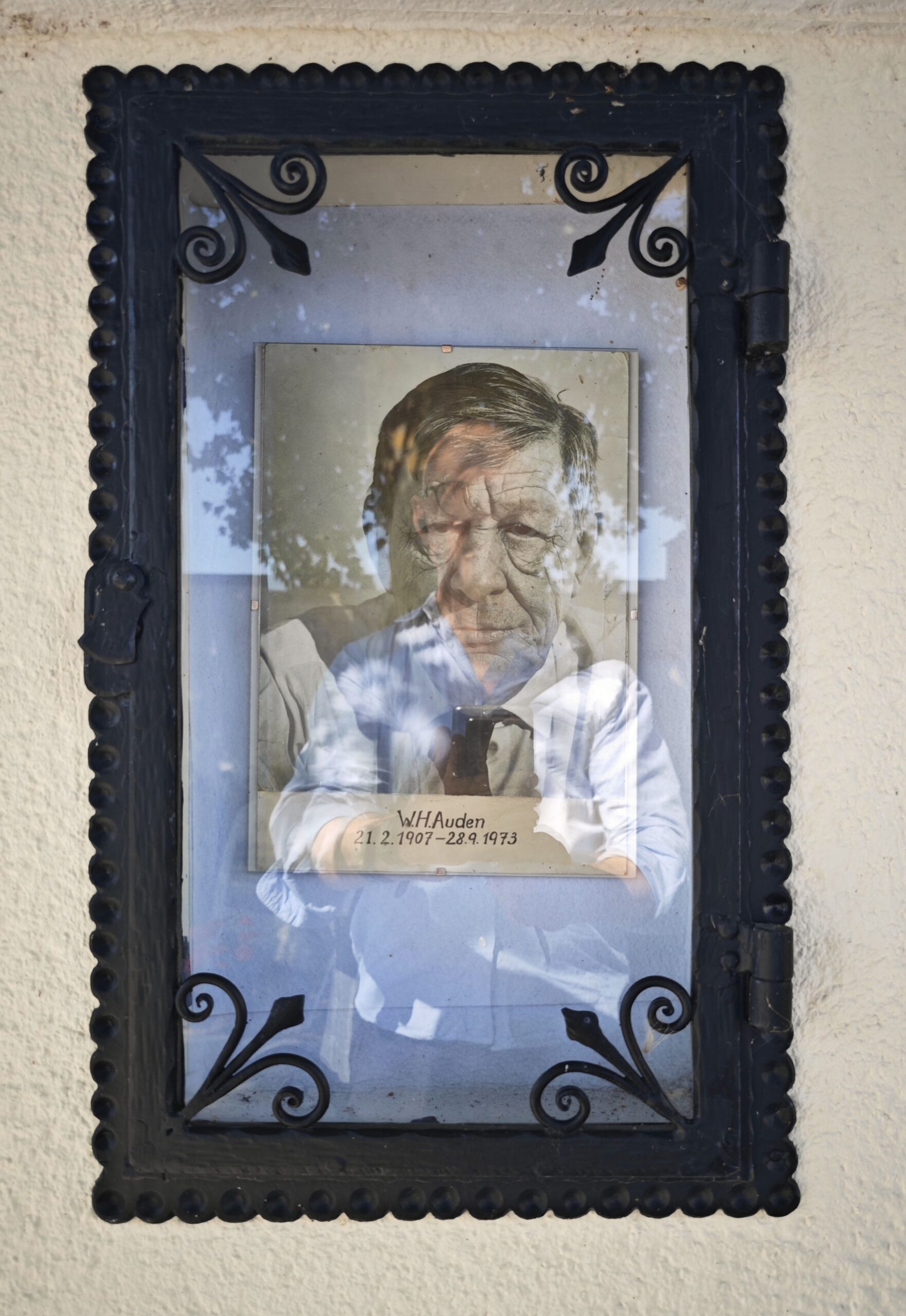
Hace cuatro años encargué online otro libro, los aforismos de Josep Joubert, a un vendedor privado de Barcelona, un señor muy amable que escribía como si se comunicase conmigo desde los primeros años del siglo XX, con mucha cortesía y pomposidad. Parecía, también, muy despistado porque el paquete que recibí contenía El prolífico y el devorador, de W H Auden, publicado en la misma colección y con una portada muy parecida a la del solicitado. El vendedor, entre disculpas elaboradas me pidió que guardase el libro como regalo, mientras enviaba el de Joubert a continuación. Esa fue mi iniciación en el que, hasta entonces, había sido solo un poeta más para mí. ¡Qué maravilloso accidente fue este que me proporcionó en Auden un nuevo amigo y, en su retrato, un compañero para los que de Wittgenstein, Kierkegaard y Gide hay sobre mi chimenea!
Al llegar a Kirchstetten nadie está esperando en la estación. Tampoco se bajan más pasajeros del tren. Hay un silencio de apeadero de película del oeste. Solo al salir a la calle percibo la conversación de algunos clientes en la terraza de un bar pequeño al otro lado. De este pueblo nacido alrededor de la estación sale una carreterita casi recta hacia el sur, Bahnstrasse, que comunica a través de los campos de maíz con el pueblo original de Kirchstetten, donde Auden tenía su residencia, donde todavía reside. La calle señala ese grupo de casas sobre el que destaca la torre de la iglesia, en la cima de una colina.
Es un día radiante de principio de septiembre, con el cielo despejado pero sin el calor agobiante de agosto. Empiezo a caminar por el sendero junto a la carretera. A los lados, ocasionalmente, hay árboles cargados de fruta que no han sido cosechados, y manzanas y ciruelas están extendidas alrededor en un círculo amplio, aplastadas por los coches y los pocos caminantes, medio podridas, más densa la acumulación cuanto más cerca del tronco.
Voy escuchando en los auriculares una selección de poemas leídos por Auden mismo. No entiendo más que fragmentos, a causa de la pronunciación, del vocabulario, de lo complejo de las construcciones. Incluso en las traducciones en castellano me resulta difícil la poesía, y la de Auden. Sin embargo, es una banda sonora apropiada, si no por el contenido, sin duda por la textura sonora, una voz en off autorizada.
He leído su poesía por puro entusiasmo, forzándome a ello, siempre con esfuerzo. Las alegrías que he tenido en estos años con Auden se han desencadenado siempre tras encontrarme con sus apreciaciones sobre arte, cultura y política, y con comentarios y anécdotas de su vida, siempre de lo más humilde, de lo más compasivas y, en lo que al arte se refiere, también inflexibles. Algo parecido me sucede con Ludwig Wittgenstein: la dificultad que tengo para su filosofía solo puede ser compensada por la total entrega a sus otros escritos y anécdotas personales.
La voz de Auden empieza a recitar Deaths’s Echo unos veinte minutos después de que he salido de Kirchstetten, en el momento que llego a este otro pueblo, que se llama igual y que tiene también en su límite un letrero con su nombre, similar al que sobrepasé hace un rato, solo que este no está cruzado por una línea roja. Como si el término municipal de Kirchstetten se extendiera por todo el planeta con excepción de esos cuatrocientos metros de campos de maíz a punto de ser recolectados. También hay un cartel que dirige hacia la casa de Auden, y otro a la de Josef Weinheber, poeta así mismo, natural del lugar, que se suicidó al final de la segunda guerra mundial cuando se acercaba el Ejército Rojo a la localidad. Los dos poetas tienen en el pueblo su respectiva casa museo.
Las indicaciones guían al visitante invitándole a rodear la colina, la iglesia. Hay casas a los dos lados del camino, en medio de jardines limpios y ordenados que se pueden ver tras empalizadas de madera bajas. La decoración y el diseño son un poco torpes y dan una impresión artificial, muy distinta de la que uno tiene cuando pasea por lugares igual de anónimos en zonas residenciales anónimas en Japón. Todos los jardines tienen algún árbol frutal no cosechado, atentando contra la pulcritud del conjunto.
La casa de Auden está en el barrio de Hinterholz (lugar apartado), al otro lado de una autopista que hay que cruzar por debajo, a través de un túnel estrecho. Lo conocía de una grabación de la televisión austríaca del año 1967, cuando fueron a entrevistarle para su sesenta cumpleaños. Unos metros más allá de la salida está la Audenstrasse, que ya se llamaba así cuando el poeta vivía allí.
En Audenstrasse hay otros tres edificios. Me pregunto que significará el nombre de la calle para quienes viven en estas casas. Al final del recorrido, a la izquierda, se reconoce la estructura que he visto en documentales, las ventanas verdes tras las que el poeta trabaja en imágenes cinematográficas de la época, captadas desde fuera. En el balcón hay una reproducción fotográfica a tamaño real de Auden, tomada en ese mismo lugar, de forma tal que el poeta parece estar apoyado en la barandilla, pero en blanco y negro. Encuentro que el edificio es más grande de lo que hacen pensar los documentales. Lo veo también a través de la empalizada, ya que para visitar el interior es necesaria una reserva que no quise hacer porque me hubiera obligado a compartir este momento con el guía o vigilante. En la empalizada, bajo un buzón de correos americano, hay dos placas de bronce pequeñas: W. H. Auden y Chester Kallman.
Detrás de la casa se ven los paneles acústicos que protegen a este lado de la autopista del ruido de los coches y que cumplen su función solo parcialmente. La autopista ya existía en aquellos tiempos, pero puede que para Auden y Kallman el rumor del tráfico fuera solo un recuerdo de que Nueva York todavía existía más allá.
La calle acaba en un camino sin asfaltar que se adentra en un bosque de robles y carpes. Por el camino he visto abetos, pinos y trepadora de Virginia, una planta que se extiende con rapidez donde cae. Una vegetación muy parecida a la que encuentro en los alrededores de mi casa en la sierra, a una hora de tren de Madrid. Hace siete años que vivo allí, y se me ocurre en el paseo que puede que cuando me mudé estuviera buscando un retiro parecido a este, años antes de que Auden me hiciera compañía: un lugar tranquilo, separado, en un pueblo cuyo nombre hasta entonces no significaba nada y alrededor del cual una realidad urgente se genera, in the middle of somewhere. Esperar allí la muerte, siempre con trabajo pendiente, con algunas cosas que escribir y repasar. Ser enterrado después a unos trescientos metros de la vivienda.
Tres clases de personas: tres vías de salvación.
Aquellos que buscan
- A través de la manipulación de las cosas no humanas: el granjero, el ingeniero, el científico
- A través de la manipulación de otros seres humanos: el político, el profesor, el médico;
- A través de la manipulación de sus propias fantasías: el artista, el santo.
Se puede decir que Auden murió muy joven, a los sesenta y seis años, la misma edad a la que murió mi padre. Auden vivió exactamente siete meses más que él. A mí me faltan todavía tres para alcanzar esa edad ahora, en el momento en el que emprendo el camino hacia el cementerio del pueblo. Not to be born is the best for men, oigo entonces por los auriculares. He quedado allí con Robert, un amigo que viene en coche desde los Alpes, donde vive. “La cita es a las doce en la tumba de Auden” es una frase que, en esta tierra tan cercana al escenario de El tercer hombre, parece extraída de alguna novela de Graham Greene. Llego con tiempo para pasear con calma y estar un rato solo frente a la tumba. Pero tras dar unas cuantas vueltas por entre las lápidas no consigo encontrar la suya. Comparo cada rincón del cementerio con las imágenes que hay en Internet, y no coinciden. Finalmente resulta estar en un pequeño recinto junto a la iglesia, separado del cementerio principal. Abetos crecen en la tumba. Hasta que llega mi amigo, no hay nadie en los alrededores.
Aunque los edificios todavía existen, las dos tabernas a las que solía acudir Auden ya cerraron. Robert ha encontrado una casa de comida en un pueblo cercano que probablemente Auden visitó en más de una ocasión. Comemos un schnitzel vienés en el jardín, bajo un tilo centenario, mientras hablamos de los poetas muertos, del cine y la corrección política, de la vida en el arte. Vuelvo a Viena con él, en su coche, entre otros muchos coches.
Mil perdones y buenas noches.
Acabo de llegar al piso y leo su mensaje.
Quédese el libro que le he mandado por error
Mañana sin falta le mando el que usted ha pedido
Por correo certificado y sin cargo, sólo faltaría.
Con lo rápido y diligente que se ha portado usted
y voy y meto la pata.
Bien, en serio quédese con el tomo mal enviado
Ya le hago un mensaje con el nº de Correos
Recibo un cordial saludo, dispénseme usted
¡Ay, esos calores!
A day for Auden
A day for Auden
After two days in Vienna talking with other artists about the phenomenon of voiceover and its variants, this morning I took the regional train connecting the Westbahnhof with Kirchstetten, a small town in Lower Austria where Wystan Hugh Auden intermittently spent the last fifteen years of his life and the entirety of the, so far, fifty years of his death.
An hour’s journey for which I had set aside to read W.H. Auden: In the Autumn of the Age of Anxiety, a biography of the poet written by Alan Levy as an extension of an article he had published years earlier in the New York Times. With only a few days to fly to Vienna, I had an urge to find out more about the last years of Auden’s life, and I had searched the book in bookshops on the net, and it turned out that the most convenient copy could be found in Vienna, both in terms of price and because, being in that city, I could receive it in time for the visit. It was waiting for me at the hotel on arrival. The copy, by chance, is signed by Levy himself.
The book begins with the author on the train from Vienna to Kirchstetten, like me, but fifty-three years earlier and expecting to find Auden waiting for him at the station in his Wolskwagen beetle, ready to pick him up and take him home, where they will have lunch and a conversation with the gentle vocation of an interview.
Four years ago I ordered another book online, the aphorisms of Josep Joubert, from a private seller in Barcelona, a very nice man who wrote as if he had been communicating with me from the early years of the twentieth century, with great courtesy and pomposity. He seemed, also, very absent-minded because the package I received contained W H Auden’s The Prolific and the Devourer, published in the same collection and with a cover very similar to the one requested. The seller, between elaborate apologies, asked me to keep the book as a gift, while he sent Joubert’s next. This was my initiation into what, until then, had been just another poet to me. What a wonderful accident it was that in Auden it gave me a new friend and, in his portrait, a companion to those of Wittgenstein, Kierkegaard and Gide on my mantelpiece!
When I arrive in Kirchstetten, no one is waiting at the station. Nor do any other passengers get off the train. The platform is as quiet as in a Western. Only when I step out onto the street do I hear the conversation of a few customers on the terrace of a small bar on the other side. From this village born around the station, a small, almost straight road leads south, Bahnstrasse, which connects through the cornfields to the original village of Kirchstetten, where Auden had his residence, where he still resides. The road points to this group of houses, above which the church tower stands out on the top of a small hill.
It’s a bright day in early September, with clear skies but without the oppressive heat of August. I start walking along the path beside the road. On the sides there are occasional trees laden with unpicked fruit, and apples and plums are spread around in a wide circle, crushed by cars and the few walkers, half rotten, the denser the accumulation the closer to the trunk.
I am listening to a selection of poems read by Auden himself. I only understand fragments, because of the pronunciation, the vocabulary, the complexity of the constructions. Even in the Spanish translations I find the poetry difficult, and Auden’s poetry too. Nevertheless, it is an appropriate soundtrack, if not for the content, then certainly for the sound texture, an authorised voiceover.
I have read his poetry out of sheer enthusiasm, forcing myself to do so, always with effort. The joys I have had over the years with Auden have always been triggered by his insights into art, culture and politics, and by comments and anecdotes from his life, always most humble, most compassionate and, as far as art is concerned, also uncompromising. Something similar happens to me with Ludwig Wittgenstein: the difficulty I have with his philosophy can only be compensated by my total devotion to his other writings and personal anecdotes.
Auden’s voice begins to recite Deaths’s Echo about twenty minutes after I have left Kirchstetten, by the time I reach this other town, which has the same name and also has a sign with its name on its boundary, similar to the one I passed a while ago, only this one is not crossed by a red line. As if the municipal boundary of Kirchstetten stretched across the entire planet except for those four hundred metres of cornfields about to be harvested. There is also a sign pointing to Auden’s house, and another to the house of Josef Weinheber, a local poet himself, who committed suicide at the end of the Second World War as the Red Army approached the village. Both poets have their respective house museums in the village.
The signs guide the visitor around the hill, around the church. There are houses on either side of the road, set in neat and tidy gardens that can be seen behind low wooden palisades. The decoration and design are a little clumsy and give an artificial impression, very different from the one you get when you walk through equally anonymous places in anonymous residential areas in Japan. All the gardens are planted with unharvested fruit trees, detracting from the neatness of the whole.
Auden’s house is in the Hinterholz (out-of-the-way) district, on the other side of a motorway that has to be crossed underneath through a narrow tunnel. I knew it from an Austrian television recording from 1967, when he was interviewed for his sixtieth birthday. A few metres beyond the exit is Audenstrasse, which was already called Audenstrasse when the poet lived there.
In Audenstrasse there are three other buildings. I wonder what the name of the street means to those who live in these houses. At the end of the route, on the left, you recognise the structure I have seen in documentaries and photographs, the green windows behind which the poet works in film images of the time, captured from the outside. On the balcony is a life-size photograph of Auden, taken on the same spot, so that the poet appears to be leaning on the railing, but in black and white. I find that the building is bigger than the documentaries make it seem. I can also see it through the palisade, because a reservation is necessary to visit the interior, which I didn’t want to make because it would have forced me to share this moment with the guide or guard. On the palisade, under an American post box, there are two small bronze plaques: W. H. Auden and Chester Kallman.
Behind the house you can see the acoustic panels that protect this side of the highway from the noise of cars and which only partially fulfil their function. The highway already existed in those days, but for Auden and Kallman the rumble of traffic may have been just a reminder that New York still existed beyond it.
The road ends in an unpaved path that leads into a forest of oaks and hornbeams. Along the way I saw firs, pines and Virginia creeper, a plant that spreads rapidly wherever it falls. Vegetation very similar to what I find around my home in the mountains, an hour’s train ride from Madrid. I’ve lived there for seven years, and it occurs to me on the walk that I may have been looking for a retreat like this when I moved, years before Auden kept me company: a quiet, separate place, in a town whose name until then meant nothing and around which an urgent reality is generated, in the middle of somewhere. Waiting there for death, always with work to do, with some things to write and review. Then to be buried some three hundred metres from the house.
Three kinds of people: three roads to salvation.
Those who seek it
- (1) through the manipulation of non-human things: the farmer, the engineer, the scientist
- (2) through the manipulation of other human beings: the politician, the teacher, the doctor
- (3) through the manipulation of their own phantasies: the artist, the saint
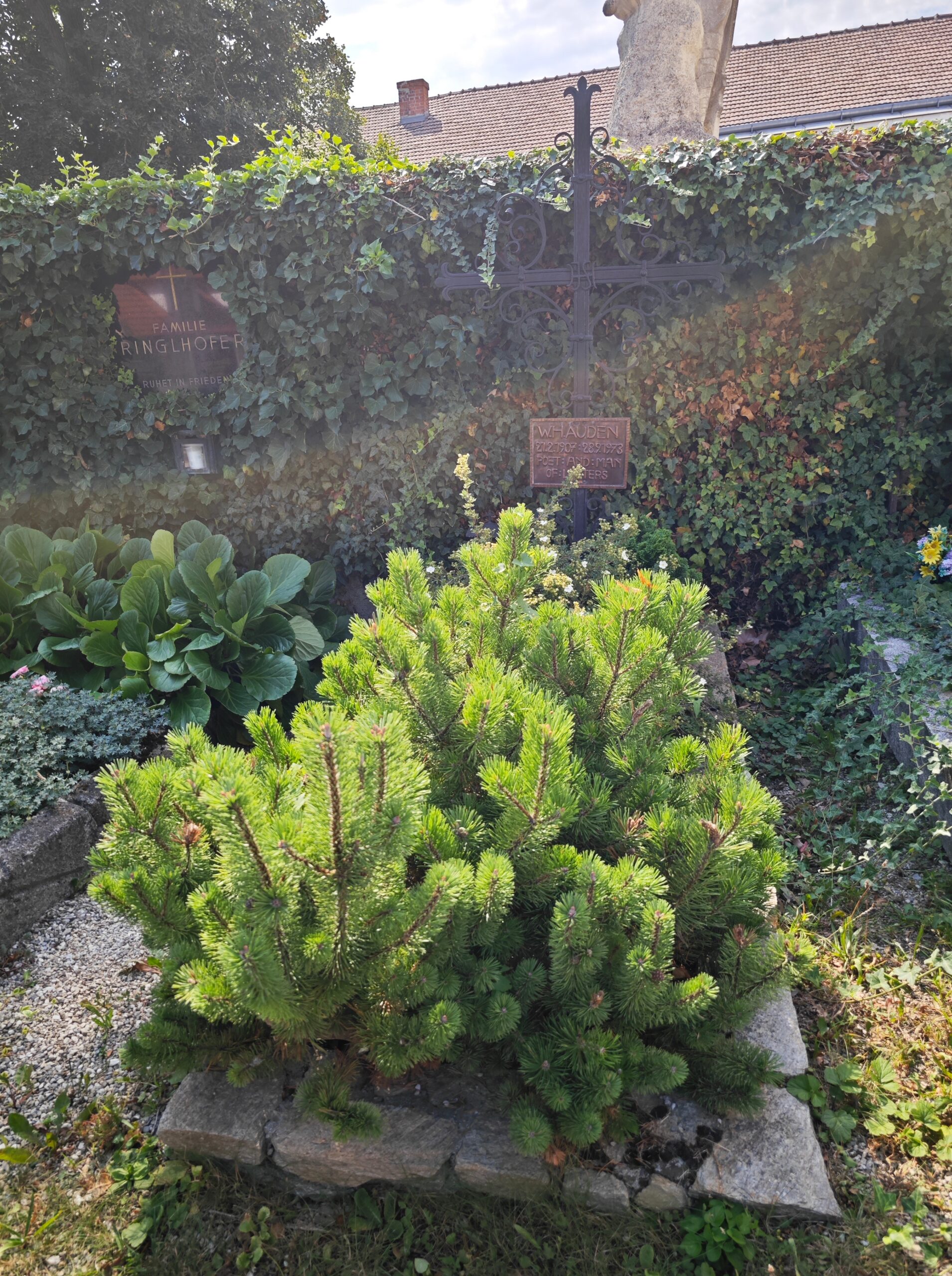
You could say that Auden died very young, at the age of sixty-six, the same age at which my father died. Auden lived exactly seven months longer than he did. I am still three months short of that age now, as I make my way to the village cemetery. Not to be born is the best for men, I hear then over the headphones. I’m meeting Robert, a friend of mine who is driving from the Alps, where he lives. «The appointment is at twelve o’clock at Auden’s grave» is a phrase that, in this land so close to the setting of The Third Man, seems to be taken from a Graham Greene novel. I arrive in time for a leisurely stroll and some time alone in front of the grave. But after walking around the gravestones a few times, I can’t find his. I compare every corner of the cemetery with the images on the Internet, and they don’t match. Finally it turns out to be in a small enclosure next to the church, separate from the main cemetery. Fir trees grow on the grave. Until my friend arrives, there is no one around.
Although the buildings still exist, the two taverns Auden used to go to have closed. Robert has found an eating house in a nearby village that Auden probably visited on more than one occasion. We eat a Viennese schnitzel in the garden, under a century-old lime tree, while we talk about dead poets, about cinema and political correctness, about life in art. He takes me back to Vienna in his car, among many other cars.
A thousand pardons and good night.
I have just arrived at the flat and read your message.
Keep the book I sent you by mistake.
Tomorrow without fail I will send you the one you have requested
By registered mail and free of charge, that’s all it takes.
As quick and diligent as you have been in your task
and I go and mess up.
Well, seriously keep the mis-sent volume
I will send you a message with the post office number.
Yours faithfully, please accept my apologies.
Oh, the heat!
Sencillamente apaciguador. Me encanta.
Muchas gracias, Manuel. El reportaje ha tenido en mí un efecto reparador. Si estuviera grabado, me lo escucharía caminando. Me ha enganchado esa expresión: «voz en off autorizada».