
(For those who, upon seeing Violeta Mayoral’s work, have found themselves absent-mindedly pondering its meaning)
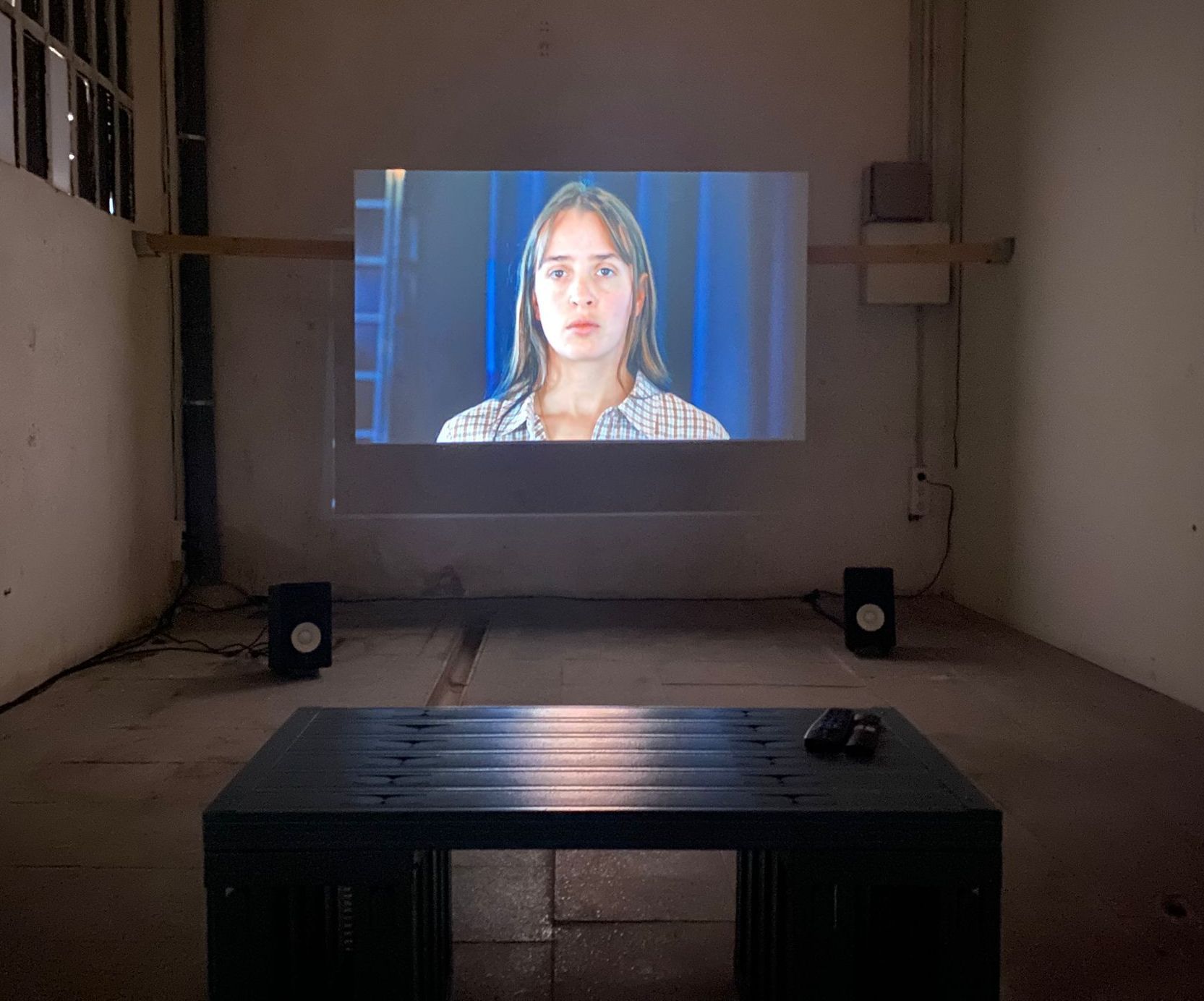
Instalation by Violeta Mayoral at etHALL
Anyone who belongs to the category determined by the title of this text knows that the video it refers to shows, in succession, the faces of four singers performing a piece of music in front of the camera, mentally, that is, without any sound coming from their throats or any music being heard. Each performance lasts about three minutes, the time it is understood to take to think the piece.
Although this title greatly reduces the chances of this text being disseminated—perhaps only relevant to its author and, to a lesser extent, to the author of the work in question—I am not going to restrict the scope of my speculations, which will cover a very broad area. If this work were exhibited in one of the international cultural hubs, if many people were to visit the exhibition regularly, if many of them stopped to watch the thirteen-minute video, if Violeta Mayoral’s work were studied extensively like that of Shakespeare or Velázquez, perhaps some of the viewers would remember, as I did while watching the work, a passage from Arthur Conan Doyle’s short story The Cardboard Box.
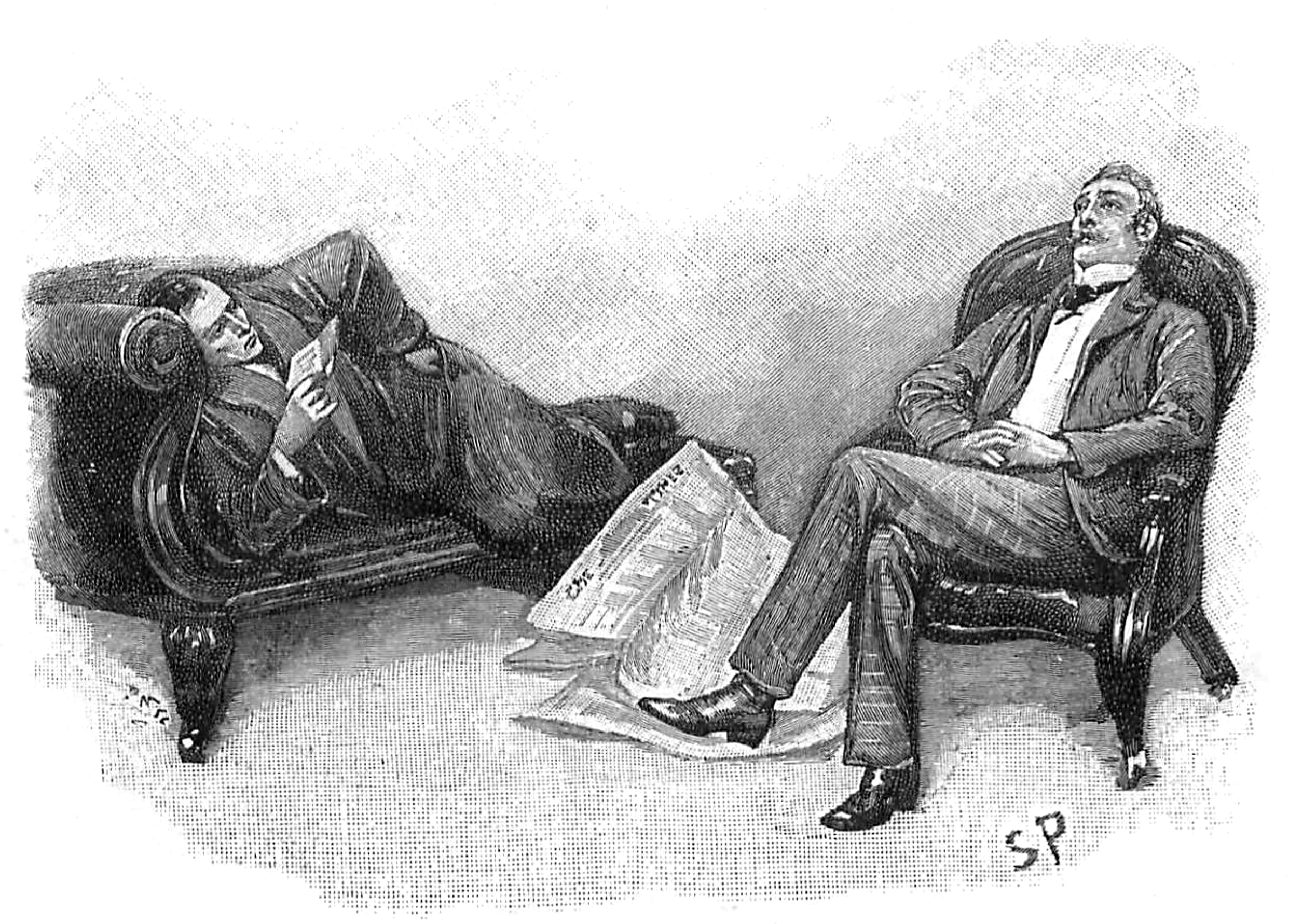
Illustration from The Strand Magazine, where The Cardboard Box was first published.
In it, Dr Watson, after giving up reading a newspaper and realising that Sherlock Holmes is too absorbed to talk, begins to think distractedly, until his companion interrupts him with an exclamation that seems out of context: «You are right, Watson,» said he. «It does seem a most preposterous way of settling a dispute.».
- "Most preposterous!" I exclaimed, and then suddenly realizing how he had echoed the inmost thought of my soul, I sat up in my chair and stared at him in blank amazement.
- "You remember," said he, "that some little time ago when I read you the passage in one of Poe's sketches in which a close reasoner follows the unspoken thoughts of his companion, you were inclined to treat the matter as a mere tour-de-force of the author. On my remarking that I was constantly in the habit of doing the same thing you expressed incredulity. The features are given to man as the means by which he shall express his emotions, and yours are faithful servants."
From there, Holmes explains how he has been following the chain of Watson’s reasoning, starting with the gesture with the newspaper, by observing his appearance, his gestures, and especially his eyes, where he was looking, what facial expressions he was making, which part of his body he was touching, and so on, until he arrived at that final thought.
- “At this point I agreed with you that it was preposterous and was glad to find that all my deductions had been correct.”
- “Absolutely!" said I. "And now that you have explained it, I confess that I am as amazed as before.”
If one were as perceptive and observant as Sherlock Holmes, one might be able to mentally hear the melody played in Mayoral’s video by simply examining the performers’ subtle —in most cases— facial movements. A first gesture could refer to a specific note, tone or melody, and from there all the others would be deduced —or abducted— in succession until the piece is finished, reproduced in the brain at the same rhythm as the performer. The performers’ faces are very expressive and, in fact, there are certain gestures that can be interpreted even by those who do not know much about music, gestures, or the interpretation of music or gestures: a general air of concentration and effort can be seen throughout all the performances.
Transactional psychologist Eric Berne conducted an experiment at the end of 1945 consisting of interviewing nearly 10,000 soldiers, who came to his office in succession over four months for about 50 seconds each, all dressed in the same military uniform and with the same haircut. He asked them two questions: ‘Are you nervous?’ and ‘Have you ever been to a psychiatrist?’ During this period, the author attempted to predict, based on silent observation of the soldier, how each man would answer the two routine questions in that particular situation. He saw that this could be done with surprising accuracy and wondered how he had managed to make those predictions, as they were not obvious.
The correct interpretation of gestures, both in Berne’s experiment and in the case of the video —or in Conan Doyle’s passage— requires repeated training in observation. You have to look closely at each gesture to understand its meaning. On one occasion, to create one of my works, Points of View (2008), I dubbed the voices of several artists, trying to synchronise my words with the movement of their lips, and I understood many of their expressions in a way that I would not have been able to without that detailed study of timing and intonation. Specifically, when dubbing the American artist Joan Jonas, I discovered that a pause in a sentence that I found unnatural to imitate, just before she mentions Goya’s name, responded to the artist’s modesty in comparing herself to that famous artist, an emotion that would have gone unnoticed in the usual viewing of the video.
It is certain that, even if the viewer does not possess this ability and is unfamiliar with the piece being performed – I do not know what melody was going through the minds of these singers – they can clearly perceive the start, that transition from calm to tension that marks the beginning, and then the feeling of relaxation that comes when it is supposed to end, followed by one of the performers leaving the frame and, in the other three cases, a neutral expression. In this sense, the relationship between the visitor and this work is somewhat similar to that between viewers and John Cage’s 4′33″. The beginning of that piece is marked by the opening of the piano lid and the end by the closing of the lid. What happens in between, according to many authors, is silence, and according to others, the accidental noises of the room. In the video, the gestures break a silence that, in the conceptual context of this work, would be equivalent to a completely hieratic attitude, one in which the mental exercise, in its purity, does not transcend the physical surface of the performers. The sound of their breathing, which can be heard occasionally, is in a different dimension.
With the exception of the first and last gestures, it can be said that all the others are inscrutable, indecipherable; they are ‘submerged’, one might say, and thanks to this metaphor I dare to compare the silenced melody with those submarines that left their bases in the Second World War and whose location could only be calculated by the enemy from their port of departure and with a strict measurement of time, imagining at each moment the corresponding point on the most probable route, a tentative record whose accuracy was not confirmed until the submarine surfaced again and was sighted. Whether the sequence is that of thought or melody, it will be the most logical thought and the most harmonious note that can give clues about the evolution of the piece.
All the problems presented by submarines in combat, or in films of the genre, are related to the interpretation of signs, the relationship between what the instruments, radar and sonar indicate and what is happening outside the vessel, or the image that the vessel projects to the outside world through bubble decoys and false or distorted messages intended to confuse those who are following it. A significant aspect of this work lies in this uncertainty: what lies behind those faces? What connection exists between those gestures and the music? It is a problem of translation, but above all of interface, of the mistrust that any interface invites when a critical viewer has deprived it of transparency. In other words, the work raises a question about technique and technology that is normally faced by technical figures such as doctors or detectives and, in some respects, also artists and philosophers. Almost all of the reflections I note here can refer to thinking about technology and interfaces.
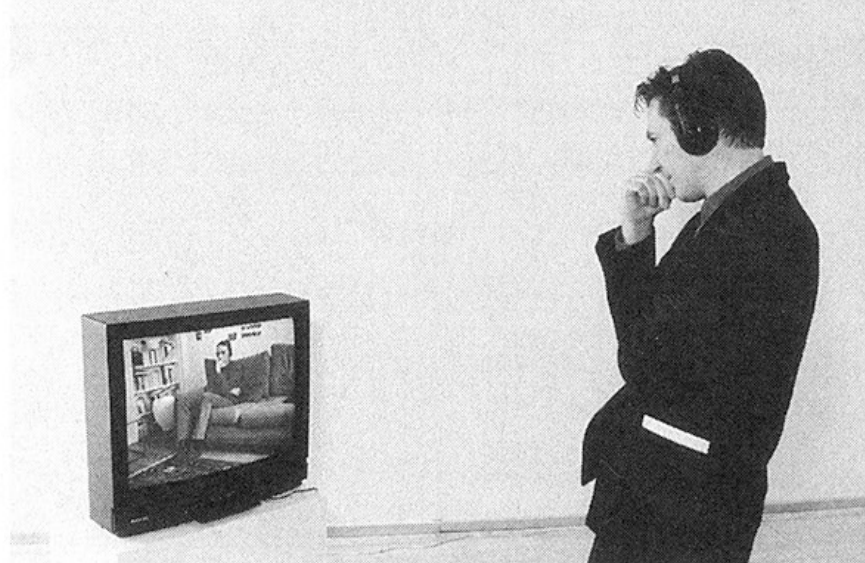
The Soldier’s Tale, Then and Now 1998, is approximately the same length as Mayoral’s workl
A work by Pierre Bismuth that I curated in 2005, in an exhibition on the psychological effect of works of art, presents a monitor showing a young man sitting in an armchair, concentrating on the music he is listening to through headphones. Next to the monitor is another armchair and another set of headphones. The viewer can sit down and listen to the music that the man was presumably listening to at the time of recording: Igor Stravinsky’s L’histoire du soldat. Although the man depicted in the images does not make any gestures, the feeling of intimacy with him experienced by the visitor who puts on the headphones is unsettling—as if they were sharing thoughts, reading each other’s minds through the music—even stranger when one realises that one is experiencing it in sync with the experience that man had in the past, when the video was recorded. In this case, many of the viewers are familiar with the melody, and it is also a musical melodrama, so to follow the sequence presented in the work, one can use either the rhythm of the music or the melody, the phrases or the complete story of the work, which is based on a Russian fairy tale. Bismuth’s work seems to propose a procedure for achieving this intimacy that is contrary to Mayoral’s, since here the gesture is null while the sound information is complete, even to the point of saturation.
Because in addition to training to interpret gestures, this synchronisation requires a certain disregard for logical processes, it requires a certain letting go, taking risks, a main component of Sherlock Holmes’ method of deduction, according to Thomas Sebeok and Jean Umiker-Sebeok in a book in which they compare the detective to Charles Sanders Peirce, the theorist of signs and father of contemporary semiotics (thanks to that book, I discovered that story by Conan Doyle). And so, in the strangeness of that intimacy, there is also a certain coercive effect: one feels a little forced to think that one’s mental processes are running in step with those of the young man, those of the music. And that same subordination occurs with the singers and their silent music, as if they and the spectators were all together in the same narrative, praying, united by the ceremonial repetition of a mantra (a mental instrument) used by religious sects to meditate, or to nullify individuality by synchronising the synaptic connections of all brains — or chanting the slogans established by propaganda at demonstrations. At the same time, it also brings to mind the sense of community that must have existed in oral societies prior to writing, where mythical stories, when spoken aloud, were reviewed over and over again in the minds of many who knew them or were learning them for the purpose of passing them on to their successors. When someone says “Con diez cañones por banda”, it is possible that the phrase “del uno al otro confín” will soon appear in the minds of many people of my generation (first and last verses of a popular stanza by Spanish poet José de Espronceda). I wonder if the experience of this video is similar for those who are perfectly familiar with the piece being performed—the artist and the protagonists, for example. The performers memorise the score and become the score themselves, as their gestures are the figures on the stave of the video, which the authorised viewer follows.
The game proposed is not recreational, but seductive. Mayoral’s work, while inviting this abandonment of one’s own judgement, this effort to alienate oneself in the personality of the performers and join their mental processes, prevents it through all the difficulties the video poses in identifying with them. Only if one feels captivated by the work, by the artist, or by art—as I am—can one maintain one’s interest in tension with these rejections. To be effective, the work demands an act of faith, you putting yourself in its hands and letting yourself be carried away. Suspecting that Bismuth’s character was actually listening to a different piece of music than the one being played does nothing to contribute to a more intense aesthetic experience. Viewers who consider their critical duty to assume that the singers are lying—that they are actually only pretending that a melody is running through their minds—or that the artist is doing so, will have a much poorer visit to the exhibition—to the extent of the poverty of that attitude. But that is not enough, and the complete experience also requires a constant awareness of what is happening, forcing one to maintain that tension. The game lies in the alternation between the suspension of disbelief and the Verfremdungseffekt.
Although I admit that the work has won me over, that does not mean that I like it completely. I find inconsistencies, some of which the artist may have already considered and decided were necessary, lesser evils—it may also be that her objectives were others that I cannot even imagine. It would take a great deal of effort to investigate what I would have done in her place, but it is certain that these rough edges help me to think, something that might not have been able to achieve a perfect work.
Because, in fact, one of the concerns that the work provoked in me was that, at times, the gestures seemed a little excessive. This is another way in which the work puts one in tune with the other viewers, as I imagine that we were all thinking at the same time at every moment of the film in the same sequence: “here he has exaggerated”, “that seems to have come from his guts”, “he is making a great effort”… and the video was the score for our thoughts.
At times, the singers’ expressiveness seemed unnatural, as if they felt obliged to assure the audience that they were, in fact, performing the piece, that they were not faking it. Watson’s attitude, as analysed by Holmes in the passage quoted above, is carefree; he does not know he is being observed, so it is understood that the connection between his thoughts and his gestures is mediated only by his personality, not by his conscious will. The performers, on the other hand, whether they like it or not, feel observed, and this affects their behaviour, especially when what is asked of them disregards the ability that gives them confidence on stage: they have been told not to make any sound and, probably, also to avoid making a fuss – I wondered there, too, if they should perform only mentally or if they were allowed to do so respiratorily. But overacting seems natural when you have been deprived of the resource of that voice through which all the expressiveness of singing is usually channelled, and which, once repressed, is forced to come out elsewhere, like water that is prevented from escaping and ends up finding a crack through which to gush forth. In some works of art involving actors, the artist achieves naturalness through saturation, forcing the performer to pay attention to so many complex tasks that they have no mind for anything else. There are many contemporary examples, but for proximity’s sake, I will cite Erik Bünger’s work The Empire Never Ended, in which a musician is forced to perform a composition so fast and complex that it demands more concentration than is possible, and in this way ‘operates at the intersection where total control and total lack of control coincide’ – note the musician’s face of absolute alienation. It is a phenomenon that I experienced personally during my short period of learning the Japanese tea ceremony, and continuously throughout my artistic practice, when I set such ambitious goals for my projects that they require my total effort, overwhelm me and, as a result, can only disappoint.
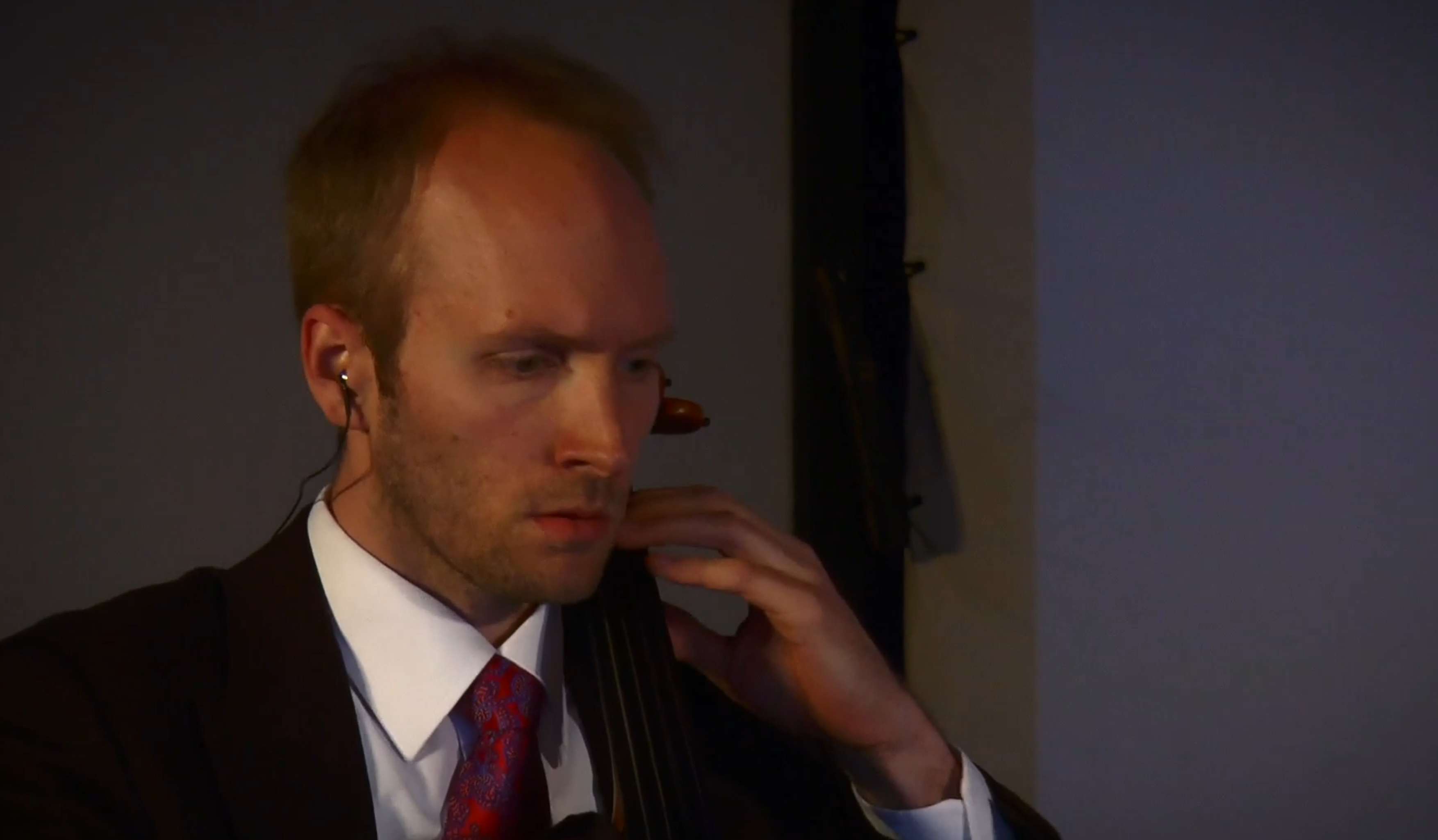
The Empire Never Ended, Erik Bünger
Another doubt that the work raises for me concerns formal decisions. During the screening, I was distracted several times by wondering whether the protagonists were reading a score on a teleprompter, as they were staring intently at the camera. As I later learned, these mental singers perform from memory. Reading the score would have seemed natural in the musical medium, as well as enhancing their credibility and better synchronising the minds of the performers and the viewer, as if they were singing karaoke, united in the rhythm marked by the notation. I cannot think of anything that makes the video more interesting by the fact that they stare at the viewer, except that in this way the work adheres to a convention that makes it seem like contemporary art, creating another kind of intimacy with the audience, as happens, for example, with the portraits in Koyaanisqatsi, with Rineke Dijkstra’s photographed characters, or in Gillian Wearing’s work 60 Minutes Silence.
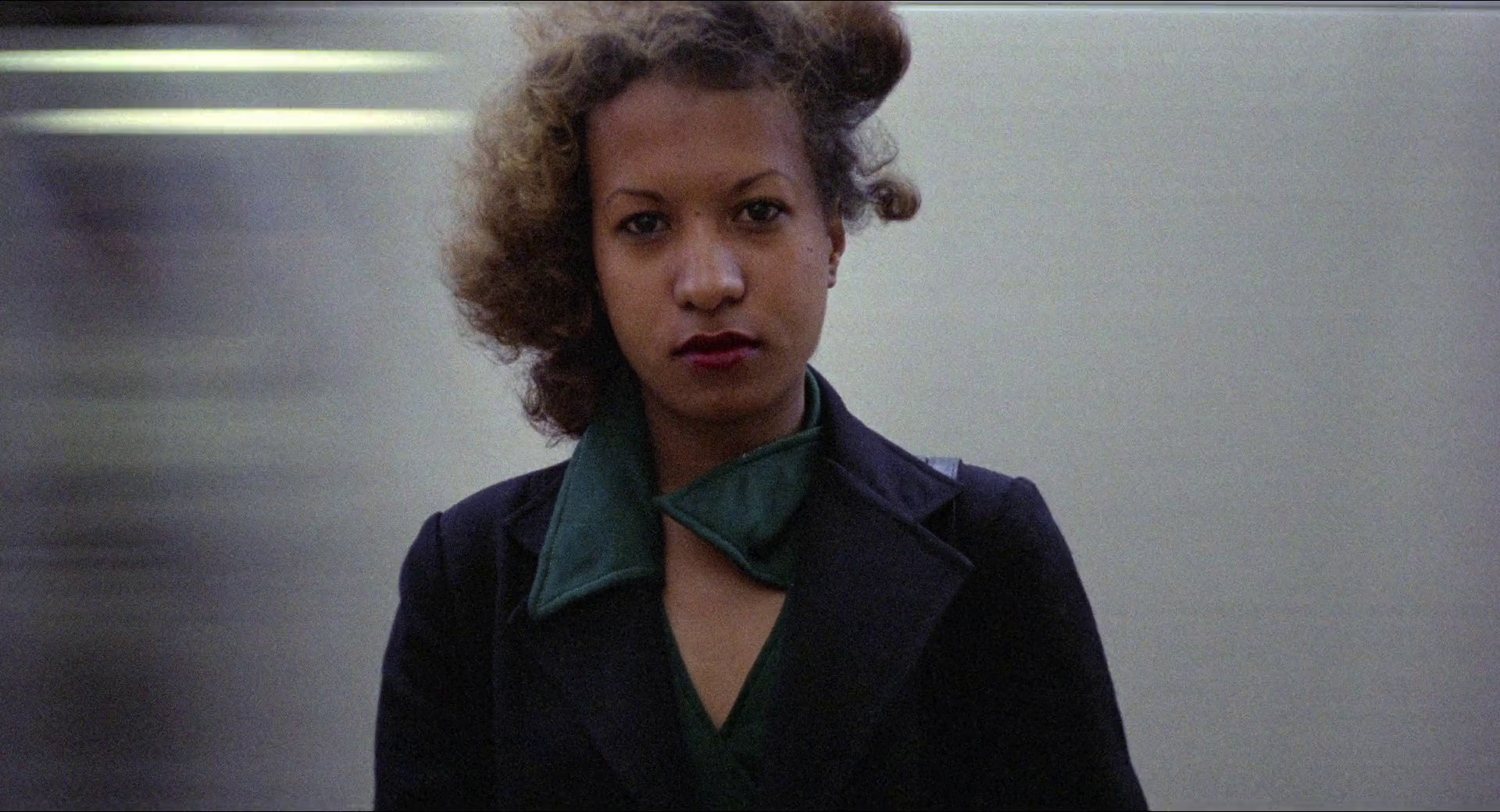
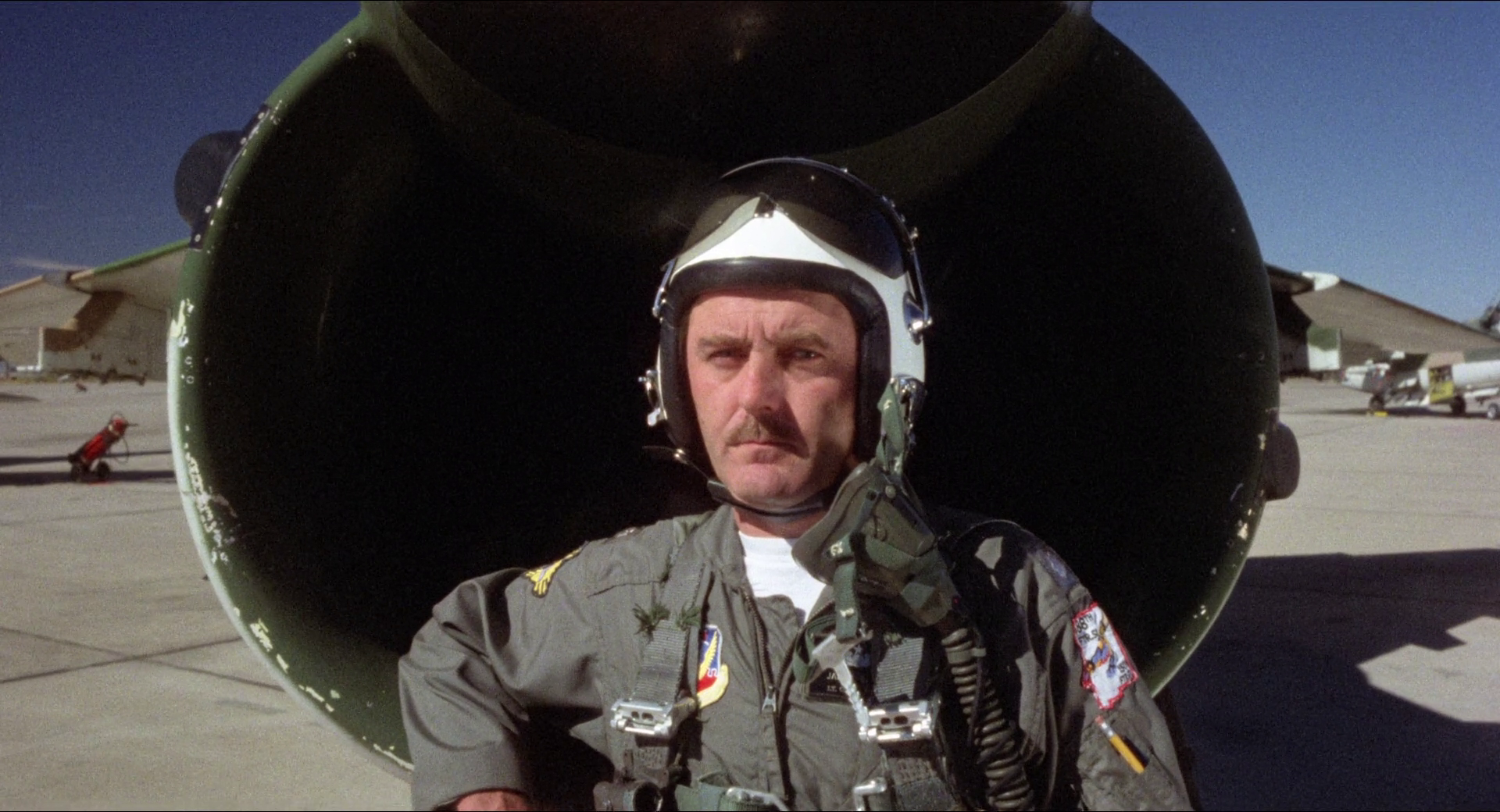
Two stills from Godfrey Reggio’s Koyaanisqatsi (1982)
In this latter work, the artist presents on a video a group of uniformed police officers who stare silently and motionlessly at the camera for one minute (the description of Wearing’s work in the Arts Council collection literally states that ‘none of the characters or individuals speaks their mind here’). It could be a real military band mentally performing a piece of music, and we would perceive by simply Wearing telling us so, if we decided to have faith in her or in art, as I have said seems appropriate in every artistic occasion, even though in this case, those portrayed are not even police officers, but actors dressed as police officers. If this circumstance has any significance, it is only in the same direction but in the opposite sense to that which Roberto Rossellini gave to the fact that in his 1954 film Francesco, giullare di Dio, the roles of the monks of the group of St. Francis of Assisi were played by real Franciscan monks.
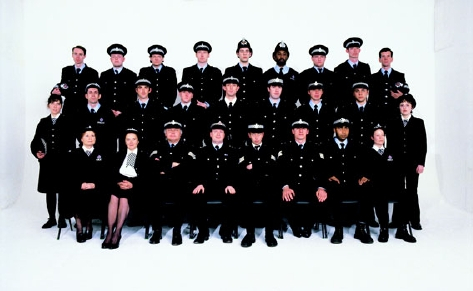
60 Minutes Silence by Gillian Wearing.
The gaze towards the camera contributes to the effect that puzzled me, whereby the performers in the play seem more aware of the instrument and the presence of the audience, which enhanced the feeling of artificiality. The direct gaze conveys a sense of special awareness, as Roland Barthes, our trusted semiotician, points out in an appendix to his book L’obvie et l’obtus, 1982.
In the Rijksmuseum in Amsterdam, there is a series of paintings by an anonymous painter known as “The Master of Alkmaar”. They are scenes from everyday life, with people gathered for one reason or another, which changes in each painting; in each of the groups there is a character, always the same: lost in the crowd, while the others appear unaware, this is the only one who, in each painting, looks the painter (and me too) straight in the eye. This character is Christ.
For this reason, I believe that it would have been more appropriate to the meaning of the work, richer, if the singers had been presented, as far as possible, lost in their thoughts – like Watson or, in another sense, Holmes when concentrating on his object of study.
Finally, one last cause for concern for me is the feeling that many of the artist’s decisions are inconsistent. I do not mean to say that there are other necessary ones, but that the ones that have been chosen, even if they are the best, do not manage to free me from that feeling of inconsistency. In a way, every work of art is unfounded—every poem—and in honour of accuracy, it would be better if it did not exist, but many of them manage to create the fiction of a complete closure in their process. The choice of the musical piece, its duration, the number of performers, their sequential rather than simultaneous appearance, or the size of the projection, which makes the figures larger than life… are not justified in themselves, nor by each other. I have also always wondered what reason there was for Cage’s work to last four minutes and thirty-three seconds, apart from purely promotional reasons and Cage’s frequent glorification of arbitrariness, which I particularly dislike.
Despite these objections, it is clear that the experience of viewing this work, as with most of the few works of art I encounter, is particularly satisfying because of the artist’s willingness to make you feel intelligent. More and more often, one is treated as if one were stupid, because that is what most of the population demands, and so that is what it is given. During the screening, and in the days since, when the memory of it has circulated in my mind, I have felt like that detective who can understand the most complex riddles—although here, perhaps, the difficulty and the value lie precisely in the simplicity of the riddle. Ludwig Wittgenstein and W. H. Auden, two of my heroes—to call them ‘favourite authors’ would be a lack of decorum and an emotional betrayal—were particularly fond of detective novels, and I have no trouble explaining why, nor identifying with that fondness. Art and philosophy are that search for clues, which cannot be tackled using the usual mathematical logic employed by scientists (‘cette saloperie de logique’, as Becket would say), but rather through what Peirce calls ‘logic utens’, which is a certain general method by which each person arrives at the truth, without, however, being aware of that method and without being able to specify what it consists of. Therein lies one reason why Wittgenstein became fond of crime fiction: the minimalism of the genre often represents an essential aspect of his philosophy. This style of literature has the ability to say without really saying, to use indirect means such as tone and mood, atmosphere and setting, symbolism and the choice of details to evoke an understanding, or simply a feeling, that is all the stronger, and perhaps all the truer, for never having been explicitly expressed.
Dupin, Poe’s close reasoner referred to by Holmes above, in The Purloined Letter, meets with the police prefect, a diligent but unimaginative investigator who fails to locate the letter of the title because he relies on conventional, ‘mathematical’ methods of investigation. He assumes that the thief must have concealed the letter in a complex, hidden or secret compartment. In reality, as Dupin easily discovers, it is hidden in plain sight. And that is another difference between the pursuit of art and that of science, because in art everything is clear and simple and visible at first glance, and one only needs to look carefully. In fact, Holmes often insists to Watson that he sees the same things as other people, and that he has simply trained himself to apply his method in order to determine the full meaning of those perceptions. ‘Watson, you see everything. However, you fail to reason about what you see. You are too timid in making your inferences.’ It takes courage, in the execution or contemplation of a work, to understand that the problem has already been posed, rather than giving up at first glance. Wittgenstein believed that philosophical problems are not solved by finding new hidden facts, but by organising the known facts that are already in view. As Watson says at the end of that story, everything is explained, and yet it remains amazing. The wonder of art is that the trick is not really a trick: the artist—the poet, the philosopher—is a detective who never finds the murderer. But he is very good at his job and manages to find everything else.
I must quote Auden to conclude this reflection, as he wrote that in reading, ‘the identification of fantasy is always an attempt to avoid one’s own suffering: the identification of art is a sharing in the suffering of another.’ That is the kind of identification I have found in the work that has prompted me to write all this.