
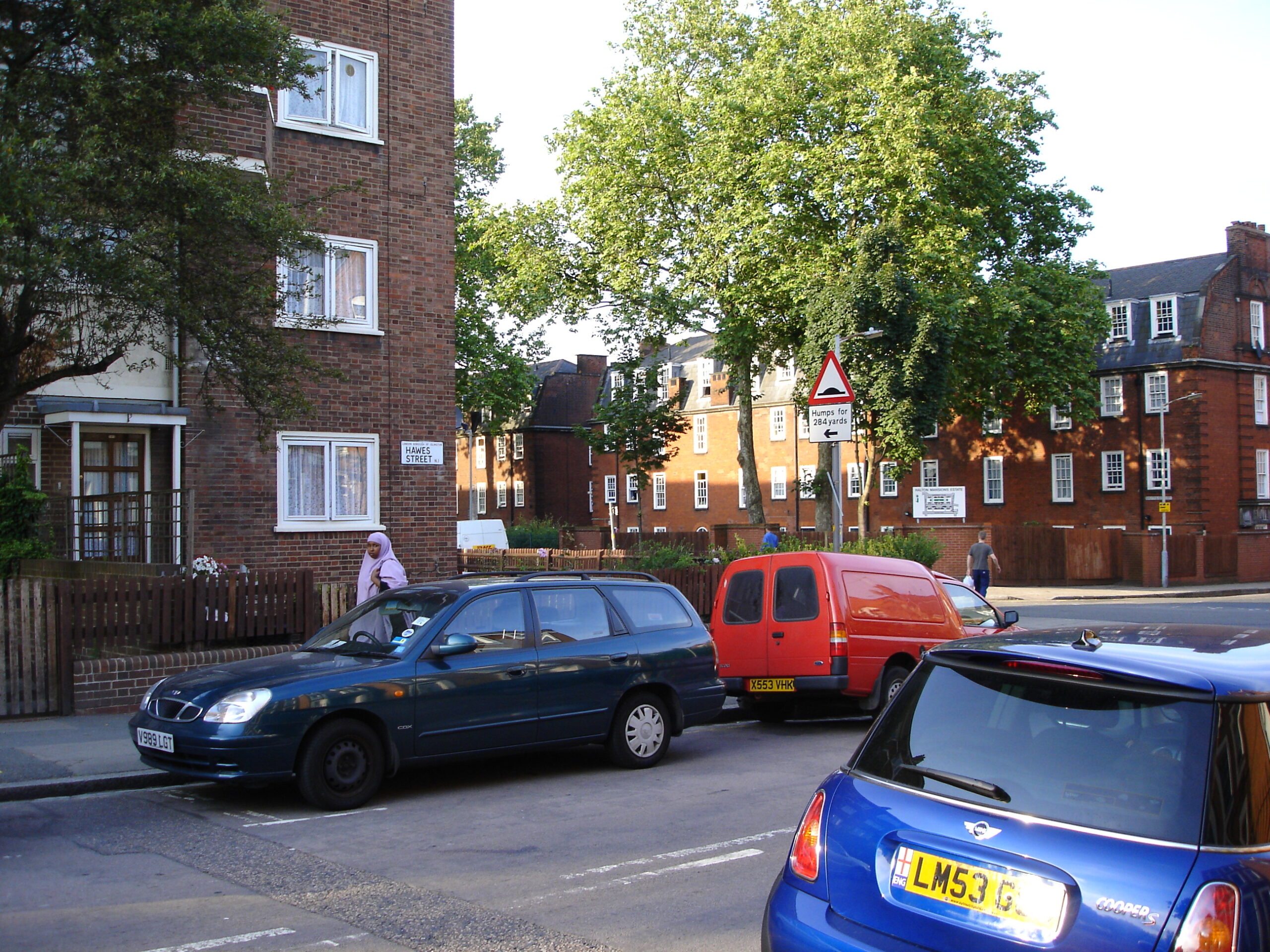
La esquina propiamente dicha /the very corner.
En la casa de Islington de la que hablé en un artículo anterior me pasaron varias cosas que, reunidas, harían una buena miniserie experimental. Un domingo de 2005 me levanté temprano y salí de casa para tomar un café en Upper street. Llevaba conmigo unas bolsas que quería depositar en el contenedor de reciclaje de la esquina. Bajé, salí del edificio y giré a la izquierda. Oí voces que venían de la esquina, de personas a las que los arbustos me impedían ver. Pensé que eran jóvenes tras una noche de juerga, así que, por precaución londinense, caminé bien pegado a los arbustos, con una intención inconsciente de retrasar el momento en que nos viéramos, por si acaso.
Resultó ser un joven negro y muy delgado, de unos 25 años, que iba hablando solo. Al verme se calló y caminó hacia mí. Me dijo «disculpe». Me detuve y le dije «¿sí?». Entonces me dio una bofetada en la cara, bastante fuerte.
¡Vaya! Salté hacia adelante mientras él me rebasaba y me giré, para comprobar si tenía intenciones de continuar conmigo.
No, no me perseguía. Se quedó allí gritando, con los brazos extendidos hacia el cielo, diciendo algo sobre dios. Se arrodilló un momento y volvió a levantarse, totalmente desinteresado por mi reacción. Poco después continuó caminando.
Yo me acerqué al contenedor de reciclaje, frotándome la mejilla y caminando, como se decía antes, con la barba sobre el hombro, es decir, volviendo el rostro a un lado y a otro, como hacen los que tienen enemigos.
A 15 metros del contenedor, una chica lloraba. Tendría unos 15 años y llevaba dos bolsos, uno colgado de cada hombro. Parecía que se había pasado la noche estudiando en casa de una amiga. Cuando me vio, vino en mi dirección.
– Disculpe.
– Sí
– Me ha dado una bofetada.
– Sí, lo sé. A mí también. No hay nada que podamos hacer al respecto.
Ella lloró. No podía entender la lógica del asunto, era pensamiento abrumador.
– ¿Estás bien? ¿Puedo hacer algo por ti?
Se alejó.
Me pregunté si debería llamar a la policía. Está mal que alguien abofetee a chicas jóvenes indefensas, que moleste a la gente y siembre el miedo. Pero es muy difícil de probar y, en la práctica, no ha sido un suceso tan terrible como para que cunda el pánico. Uno lleva toda la vida recibiendo bofetadas que no puede devolver. Pensé que lo más prudente era seguirlo desde la distancia para ver si se limitaba a abofetear a la gente, o si pasaba a mayores, lo que me ayudaría a tomar una decisión sobre la policía.
Mientras yo hablaba con esa chica nuestro agresor se había alejado unos cincuenta metros. Fui en esa dirección. Volví a pasar por delante del portal de mi casa y, un poco más allá, en la puerta de un bloque de viviendas de protección oficial vi a un tipo de unos treinta y cinco años, corpulento, que se frotaba la mejilla mientras miraba la dirección en la que se alejaba el abofeteador. Continué caminando y pasé por delante de él. El objetivo estaba a punto de llegar a la esquina de la calle. En ese momento un coche de policía apareció por la esquina opuesta, enfrentándole, moviéndose muy despacio hasta detenerse en medio del cruce. Una mujer policía salió del coche. El tipo, que iba a doblar la esquina, al ver a la agente cambió de dirección y se dirigió hacia ella. Cuando estaban muy cerca, vi cómo él decía algo, que no pude oír por la distancia, y cómo inmediatamente intentaba abofetearla. El entrenamiento de la policía dio sus frutos y en un movimiento rápido, que habría de verse en cámara lenta si se quisiera describir en detalle, levantó su brazo, detuvo el movimiento de brazo del agresor, y agarró de tal manera a su oponente que, en lo que me pareció un solo gesto, lo dejó inmovilizado en el suelo, con un lado de la cara bien pegado al asfalto. Otros dos policías salieron del coche y se le echaron encima. Durante los diez minutos que estuve mirando no se movieron. No sé a qué esperaban, pero mis ganas de café vencieron a mi curiosidad y me marché.
Su reacción frente a la policía me había confortado. El contacto que había mantenido esa mañana con ese joven no discriminaba a quienes eran abofeteables sin riesgo de aquellos que podían acarrear consecuencias. Así se podían calificar sus bofetadas de espontáneas, sin cálculo para nadie, producto de una persona que se ha abofeteado a sí mismo ya muchas veces. O quizá, lo único que buscaba era las consecuencias y, sin cálculo, salía a buscarlas sistemáticamente, hasta que aparecieran. ¿Cuántas bofetadas habría repartido esa mañana? ¿Cuántas en su vida? ¿Qué habría tomado? ¡Cuánto daría por pasar diez minutos dentro de esa cabeza! Dentro, pero en una grada, protegido, y sin consecuencias, sin muchas consecuencias, de forma calculada.
Massive Attack
Several things happened to me in the Islington house I mentioned in a previous article that, taken together, would make a good experimental mini-series. One Sunday in 2005, I got up early and left the house to have a coffee on Upper Street. I was carrying some bags that I wanted to put in the recycling bin on the corner. I went downstairs, left the building and turned left. I heard voices coming from the corner, from people I couldn’t see because of the bushes. I thought they were young people after a night out, so, out of London caution, I walked close to the bushes, with an unconscious intention of delaying the moment we would see each other, just in case.
It turned out to be a young, very thin black man, about 25 years old, who was talking to himself. When he saw me, he stopped talking and walked towards me. He said, ‘Excuse me.’ I stopped and said, ‘Yes?’ Then he slapped me in the face, quite hard.
Wow! I jumped forward as he passed me and turned around to see if he intended to continue.
No, he wasn’t chasing me. He stood there shouting, his arms outstretched towards the sky, saying something about God. He knelt down for a moment and got back up, completely uninterested in my reaction. Shortly afterwards, he continued on his way.
I approached the recycling bin, rubbing my cheek and walking, as they used to say, with my beard over my shoulder, that is, turning my face from side to side, as those who have enemies do.
Fifteen metres from the bin, a girl was crying. She was about 15 years old and carrying two bags, one slung over each shoulder. She looked like she had spent the night studying at a friend’s house. When she saw me, she came towards me.
– Excuse me.
– Yes
– He slapped me.
– Yes, I know. I was also slapped. There’s nothing we can do about it.
She cried. She couldn’t understand the logic of it all; it was overwhelming.
– Are you okay? Can I do anything for you?’
She walked away.
I wondered if I should call the police. It’s wrong for someone to slap defenceless young girls, harass people and spread fear. But it’s complicated to prove and, in practice, it wasn’t such a terrible incident that it warranted panic. You spend your whole life getting slapped in the face, in one way or another, and not being able to hit back. I thought it would be wisest to follow him from a distance to see if he continued slapping people, or if he escalated, which would help me decide whether to call the police.
While I was talking to the girl, our attacker had moved about fifty metres away. I headed in that direction. I passed my front door again and, a little further on, at the door of a block of council flats, I saw a burly man of about thirty-five rubbing his cheek as he looked in the direction the slapper had gone. I kept walking and passed in front of him. The target was about to reach the corner of the street. At that moment, a police car appeared from the opposite corner, facing him, moving very slowly until it stopped in the middle of the intersection. A policewoman got out of the car. The guy, who was about to turn the corner, saw the officer and changed direction, heading towards her. When they were very close, I saw him saying something, which I couldn’t hear from the distance, and he immediately try to slap her. The police officer’s training paid off and in a quick movement, which would have to be seen in slow motion to be described in detail, she raised her arm, stopped the attacker’s arm and grabbed her opponent in such a way that, in what seemed to me like a single gesture, she left him immobilised on the ground, with one side of his face pressed against the asphalt. Two other police officers got out of the car and jumped on top of him. During the ten minutes I watched, they didn’t move. I don’t know what they were waiting for, but my desire for coffee overcame my curiosity and I left.
His reaction to the police had comforted me. The contact I had had that morning with this young man did not discriminate between those who were slap-worthy without risk and those who could bring consequences. His slaps could be described as spontaneous, without calculation for anyone, the product of a person who had slapped himself many times before. Or perhaps all he was looking for was consequences and, without calculation, he went out to seek them systematically, until they appeared. How many slaps had he dealt out that morning? How many in his life? What had he been using? What would I give to spend ten minutes inside that head! Inside, but on a platform, protected, and without consequences, without many consequences, in a calculated way.