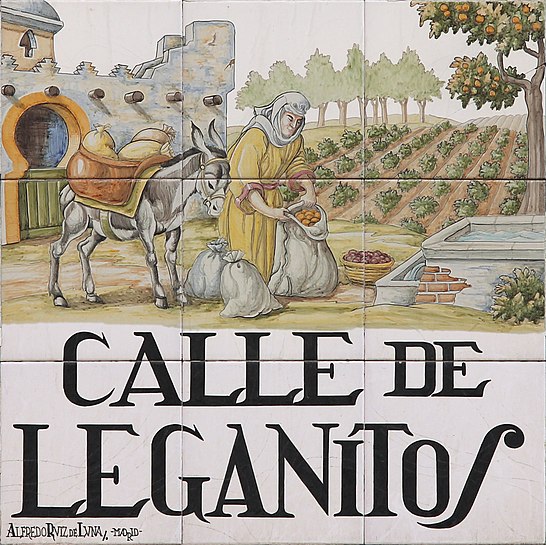
Sign of CALLE DE LEGANITOS (street) in Centro District in Madrid (Spain). Tilework by Alfredo Ruiz de Luna.
Si el ayuntamiento de Madrid fuera de izquierdas, y con sentido del humor, quizá se pudiera llegar a un acuerdo municipal por el que se le otorgara a Donald Trump el nombre de una calle madrileña. Es coherente. Pongamos por caso, la calle Leganitos, en el distrito centro, una vía importante e histórica aunque un poco marginal y oscura y, no por casualidad, llena de comercios con propietarios de origen chino, como por ejemplo el restaurante autoexplicativo “Chinese Food”, en el número 24, la peluquería Tay Yang Feng o la librería Liang You, entre otros. A partir del acto de presentación de esa resolución, el ayuntamiento de Madrid, en todas las comunicaciones públicas en las que tuviera que referirse al actual presidente de los Estados Unidos, lo haría con el nombre de “Sr. Leganitos”. Esto es algo que quizá hubiera podido suceder en los años ochenta, cuando un señor en su sano juicio decidía, como parte del rumbo social e simbólico de la ciudad, los odónimos de sus calles. En este caso, se trataría de una reversión del efecto odonímico pero, seguro, también entre sus competencias. El nombre de la calle Leganitos, según una rápida investigación, proviene del árabe «al-gannit», que significa «huertas» o «de las huertas», ya que antiguamente esa zona estaba cultivada por moriscos.
Madrid Tourism
If the Madrid city council were left-wing, and with a sense of humour, perhaps they could reach a municipal agreement to name Donald Trump after a Madrid street. It is coherent. Let’s take Leganitos street, in the central district, an important and historic passage, although a bit marginal and obscure and, not by chance, full of shops with owners of Chinese origin, such as the self-explanatory restaurant ‘Chinese Food’, at number 24, the hairdresser Tay Yang Feng or the bookshop Liang You, among others. From the act of presentation of this resolution onwards, the Madrid City Council, in all public communications in which it had to refer to the current president of the United States, would do so with the name ‘Mr. Leganitos’. This is something that could perhaps have happened in the 1980s, when a man in his right mind decided, as part of the social and symbolic direction of the city, the names of its streets. In this case, it would be a reversal of this odonymic effect, but surely, also among its competences. The name of Leganitos street, according to a quick investigation, comes from the Arabic ‘al-gannit’, which means ‘orchards’, as this area was formerly cultivated by the Moors.
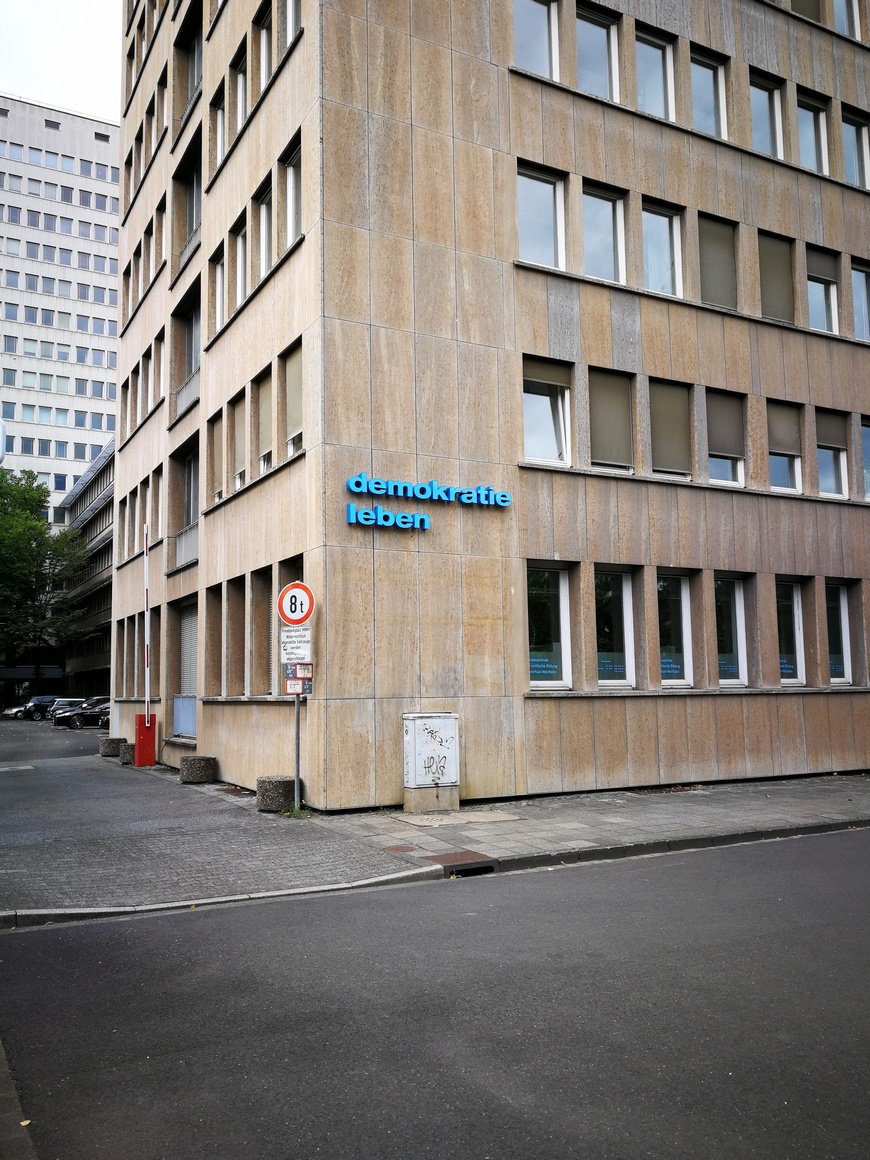
La democracia tiene la culpa del estado actual del mundo, del cambio climático, de la brecha entre ricos y pobres, de la extenuación de los recursos naturales, de la explotación del hombre por el hombre, de las crisis migratorias y, por supuesto, del triunfo de los populismos.
“No. La culpa es del capitalismo”, me contestan.
Democracia y capitalismo, lo mismo me dan porque son lo mismo, porque la una es solo una herramienta del otro, un instrumento para allanar el terreno al paso del capital, un mecanismo de control legislativo, propagandístico y psicológico por el que el capitalismo se protege de los disidentes, una compleja estructura de palos burocráticos en las ruedas de cualquier cambio a mejor.
La única diferencia entre democracia y capitalismo se encuentra en el hecho de que las gentes de buena voluntad del mundo, que quieren lo mejor para la humanidad y para el planeta, claman por “menos capitalismo” al mismo tiempo que exigen “más democracia”. Podría decir que eso es parecido a pedir “más rosas pero menos espinas”, pero de hecho la metáfora “más rosas pero menos pétalos” se adecúa mejor al absurdo fútil de estos anhelos –“más espinas pero menos espinas” es todavía más claro-.
Parece mentira que a nadie, entre esta buena gente del mundo que sin duda existe, que desea el bien para todos, que se lamenta de la forma en la que el ser humano camina hacia la destrucción y que abomina de los fantoches que, poco a poco pero inexorablemente, van tomando el mando de las instituciones mundiales, le resulte sospechoso que la democracia sea defendida por la izquierda y por la derecha, por la extrema izquierda y por la extrema derecha, por los bancos, por los empresarios, por las grandes corporaciones y los pequeños negocios, por los obreros, los ecologistas y los influencers. Todos animan a ir a votar, a celebrar esa fiesta grande de la democracia que son las elecciones. ¿Qué postura política para el cambio puede representar algo que todos apoyan sin restricción? Muchos piensan que en la democracia actual no se puede hacer nada porque no se juega limpio. Algo se podría hacer si llegaran a darse cuenta de que en una democracia no hay juego limpio porque es consustancial al juego democrático la tendencia hacia la inmundicia: es la necesidad de los gobiernos y las corporaciones de jugar sucio lo que hace que las democracias se establezcan y triunfen.
La ventaja principal con la que cuenta la democracia para resultar tan útil al capital es esta: cuando se discute sobre su conveniencia y en lo que se refiere a la vida cotidiana, los medios siempre tienen preeminencia sobre los fines. Sin embargo, dentro del ámbito especulativo y simbólico los fines mantienen intacto todo su poder. La maquinaria propagandística democrática salta con rapidez de un lado a otro, y responde sistemáticamente con los argumentos de la vida cotidiana a las objeciones conceptuales, y con argumentos ideológicos a las demandas sobre las condiciones de la vida de las gentes.
El sufragio es el eje en el que pivota esta virtud, en cuanto que todo esfuerzo se emplea en asegurar el derecho que -según afirma este sistema-, cada persona tiene de emitir su voto. El sufragio es un medio que se convierte en un fin rápidamente cuando impide que el contenido del voto sea significativo y valioso -impide que el voto sea útil, algo que, a su vez, también debería ser tan solo un medio para otro fin más elevado-. Si la consigna primordial de la democracia fuera otra que “una persona, un voto”- si fuera, por ejemplo, “igualdad ante la ley”, “ante las instituciones financieras”, o “igualdad” a secas-, no sería tan fácil usarla para los fines del capital: si las acciones políticas, de gobiernos o de ciudadanos, se contrastaran con el fin de la igualdad en lugar de con el sufragio universal, la mayor parte de ellas quedarían en evidencia como imposiciones del capitalismo. La igualdad frente a las urnas impide todas esas otras igualdades que efectivamente podrían mejor las condiciones sociales -la igualdad de oportunidades, por ejemplo, podría empezar por la igualdad a la hora de presentarse a las elecciones, un ámbito democrático donde los privilegios y las barreras de entrada han sido bien preservadas-.
El fenómeno democrático se convierte en global y su trama impenetrable porque la misma concepción de la democracia contiene un mecanismo por el que sus víctimas se autoproclaman sus portavoces, sus máximos defensores, y los represores últimos e implacables de todo lo que arroje una sombra sobre ella. La ilusión democrática se adhiere fuerte en la capa emocional de los individuos debido a su carácter adulador. Es un hecho claro que cuanto más ignorante es una persona más valora sus pocas ideas. La democracia hace más ignorante a los ignorantes porque les reafirma en las imágenes del mundo en las que ya viven y, como resultado, están siempre dispuestos a defenderlas con más entusiasmo. Es el orgullo, estúpido, es el orgullo.
Esta campaña de propaganda exhaustiva a favor de la democracia que desde hace siglos está desarrollándose desde todos los ángulos, en los medios de comunicación, en las conversaciones cotidianas, y en el ámbito más íntimo del pensamiento de los individuos y de su amor propio, resulta en un control represor de la sociedad por el que es imposible hacer una crítica del sistema sin aparecer ante los ojos de muchos como un dictador, un privilegiado, un arrogante y un desalmado -y que todas esas cualidades resulten repulsivas-. Probablemente muchos de los que hayan podido leer estos párrafos han pensado cosas parecidas del autor de este artículo ya desde la segunda línea. La democracia es un ideal, lo sabemos, siempre es imperfecta, es un fin hacia el que hay que tender. Sin embargo, ha conseguido la perfección absoluta en su aparato legitimador, acalla cualquier crítica en el mismo momento que empieza a enunciarse, impide cualquier posibilidad alternativa a ese agujero negro que todo lo absorbe, a la consigna irrenunciable de “una persona, un voto”.
“Hay democracias y democracias”, me dicen. Parece que la que tenemos es la mala y que siempre le falta un hervor. La idea del comunismo nunca se contrasta con lo que hubiera podido ser, o con lo que podría llegar a ser, sino con lo que fue -más o menos desfigurado en la narración-. ¿Por qué a la democracia, por el contrario, se le concede ese privilegio de la presunción de inocencia? Toda crítica hacia la democracia se mide con su ideal más platónico y excelso, y los innumerables casos de corrupción, de desigualdad, de consecuencias perniciosas para individuos, instituciones y sociedades, de derivas fascistas, etcétera, todos los horrores del gulag democrático, son desestimados como males menores. A cualquier mención del comunismo sigue indefectiblemente la palabra «Stalin», mientras que las loas de la democracia nunca invocan la que les sería equivalente, e incluso más adecuada, la palabra «Hitler».
No parece difícil defender que un buen rey es mejor que una mala democracia. Que un buen dictador sería mejor que una buena democracia, siendo igual de cierto, es más difícil. Es claro que los dictadores buenos son tan escasos como los mirlos blancos, e incluso esos, al contrario que los mirlos, tienen la tendencia a abandonar su cualidad específica y extraordinaria (la bondad), por indolencia, por debilidad, por presiones de sus enemigos y, sobre todo, por la presión de la democracia. Ahora bien, las buenas democracias son tan escasas o más que los buenos dictadores y tienden a la corrupción de forma naturalmente democráctica. Nunca sabremos si hay dictaduras buenas porque a los presuntos posibles dictadores, de buena o mala voluntad, con buenas ideas e intenciones o sin ellas, se les cuelga sin dilación, bien se encarga de ello el sistema democrático. Las «buenas» democracias que la gente pone como ejemplos, imperfectos pero mejores, están en vías de extinción, porque en ellas el capitalismo -es decir, el espíritu democrático- va venciendo los frenos que la tradición humanista ponía a la democracia -Suecia, como ejemplo destacado-. Las democracias más desarrolladas, como la norteamericana, son las más capitalistas.
Hace años le dije a un amigo de pocos estudios que no creía en la democracia y me contestó semi irónicamente, pero como un resorte, si quería, entonces, que Franco volviera a gobernar. Lo mismo me podría haber respondido con otra frase del repertorio: “¿Quién va entonces a mandar? ¿Tú?”. Todas las objeciones que se hacen a cualquier crítica radical -verdadera- de la democracia son siempre sofisticaciones de esa tan burda, argumentos de oposición solo un poco más evolucionados e informados que ese y, en todos los casos, recursos prefabricados extraídos de las páginas de los periódicos. “Si no democracia, entonces ¿qué?” no es una pregunta inocente, sino un arma arrojadiza contra quien pueda esbozar una respuesta. Si la pregunta fuera genuina se podría contestar: una democracia en la que los votos de los más preparados valgan más que los de los menos. Esa respuesta no significa nada, evidentemente, y habría que analizar muchos factores, de qué manera sería posible y conveniente algo parecido a eso. Sin embargo, da igual, porque la idea nunca puede ser discutida, ni mejorada, ni sustituida por otra mejor, porque toda posibilidad de ir más allá de la democracia se encuentra con risas sardónicas y descalificaciones airadas y violentas. Hay poderosos intereses que se ocupan de así sea.
Probablemente la respuesta ideal a «si no democracia, entonces ¿qué?», sea «fraternidad», un disparate. “Igualdad”, que es un poco más realista, en última instancia es solo un sinónimo de comunismo, una posibilidad que despierta, sobre todo, pereza, e invita a muchos a imaginarse a sí mismos inmediatamente haciendo colas para comprar pan y vodka, tal es la profundidad a la que opera la propaganda democrática en las mentes de sus súbditos. Nadie quiere ser igual, nadie debe ser igual, dice la publicidad en todos los ámbitos.
Democracy
Democracy is to blame for the current state of the world, for climate change, for the gap between rich and poor, for the depletion of natural resources, for the exploitation of man by man, for migration crises and, of course, for the triumph of populism.
‘No. It is capitalism’s fault’, I am told.
Democracy and capitalism, it’s all the same to me because they are the same, because one is just a tool of the other, an instrument to pave the way for capital, a mechanism of legislative, propagandistic and psychological control by which capitalism protects itself from dissidents, a complex structure of bureaucratic sticks in the wheels of any change for the better.
The only difference between democracy and capitalism lies in the fact that the people of goodwill in the world, who want the best for humanity and the planet, are clamouring for ‘less capitalism’ while demanding ‘more democracy’. I could say that this is akin to asking for ‘more roses but fewer thorns’, but in fact the metaphor ‘more roses but fewer petals’ is better suited to the futile absurdity of these yearnings – ‘more thorns but fewer thorns’ is even clearer.
It seems incredible that no one, among these good people of the world who undoubtedly exist, who wish well for all, who lament the way in which human beings are moving towards destruction and who abhor the puppets who, little by little but inexorably, are taking control of the world’s institutions, is suspicious that democracy is the only way to achieve a better world, suspicious that democracy is defended by the left and the right, by the extreme left and the extreme right, by banks, by entrepreneurs, by big corporations and small businesses, by workers, environmentalists and influencers. They all encourage people to go out and vote, to celebrate the great festival of democracy that elections are. What political stance for change can represent something that everyone supports without restriction? Many people think that nothing can be done in today’s democracy because there is no fair play. Something could be done if they came to realise that there is no fair play in a democracy because the tendency towards filth is inherent in the democratic game: it is the need for governments and corporations to play dirty that makes democracies establish and succeed.
Democracy’s main advantage in being so useful to capital is this: when discussing its desirability, and as far as everyday life is concerned, the means always take precedence over the ends. Within the speculative and symbolic realm, however, the ends retain all their power intact. The democratic propaganda machine jumps quickly from one side to the other, and systematically responds with the arguments of everyday life to conceptual objections, and with ideological arguments to demands about the conditions of people’s lives.
Suffrage is the hinge on which this virtue pivots, in that every effort is made to secure the right of every person to cast his or her vote, according to this system. Suffrage is a means that quickly becomes an end when it prevents the content of the vote from being meaningful and valuable – it prevents the vote from being useful, which, in turn, should also only be a means to a higher end. If the primary slogan of democracy were anything other than ‘one person, one vote’ – if it were, for example, ‘equality before the law’, ‘before financial institutions’, or ‘equality’ pure and simple – it would not be so easy to use it for the ends of capital: if political actions, by governments or citizens, were tested against the end of equality rather than universal suffrage, most of them would be exposed as impositions of capitalism. Equality at the ballot box precludes all those other equalities that might actually improve social conditions – equality of opportunity, for example, might begin with equality in standing for election, a democratic arena where privileges and barriers to entry have been well preserved.
The democratic phenomenon becomes global and its fabric impenetrable because the very conception of democracy contains a mechanism whereby its victims proclaim themselves its spokespersons, its ultimate defenders, and the ultimate and implacable repressors of anything that casts a shadow over it. The democratic illusion sticks strong in the emotional layer of individuals because of its sycophantic character. It is a clear fact that the more ignorant a person is the more he values his few ideas. Democracy makes the ignorant more ignorant because it reaffirms them in the images of the world they already live in and, as a result, they are always ready to defend them more enthusiastically. It is the vanity, stupid!
This exhaustive propaganda campaign in favour of democracy that has been going on for centuries from every angle, in the media, in everyday conversations, and in the innermost realm of individuals’ thoughts and self-esteem, results in a repressive control of society whereby it is impossible to criticise the system without appearing to many as a dictator, privileged, arrogant and heartless – and all of these qualities being repulsive. Probably many of those who may have read these paragraphs have already thought similar things about the author of this article right from the second line. Democracy is an ideal, we know, it is always imperfect, it is an end towards which we must strive. However, it has achieved absolute perfection in its legitimising apparatus, it silences any criticism at the very moment it begins to be enunciated, it prevents any alternative possibility to that all-absorbing black hole, to the inalienable slogan of ‘one person, one vote’.
‘There are democracies and democracies’, I am told. It seems that the one we have is the bad one, a bit undercooked. The idea of communism is never contrasted with what it could have been, or with what it could become, but with what it was – more or less disfigured in the narrative. Why is democracy, on the other hand, granted the privilege of the presumption of innocence? All criticism of democracy is measured against its most Platonic and lofty ideal, and the countless cases of corruption, inequality, pernicious consequences for individuals, institutions and societies, fascist drifts, etc., all the horrors of the democratic gulag, are dismissed as lesser evils. Any mention of communism is unfailingly followed by the word ‘Stalin’, while praise of democracy never invokes the equivalent, and even more appropriate, word ‘Hitler’.
It does not seem difficult to argue that a good king is better than a bad democracy. That a good dictator would be better than a good democracy, while equally true, is more difficult. It is clear that good dictators are as rare as white blackbirds, and even those, unlike blackbirds, have a tendency to abandon their specific and extraordinary quality (goodness), out of indolence, weakness, pressure from their enemies and, above all, pressure from democracy. However, good democracies are as rare or rarer than good dictators and tend to be corrupt in a naturally democratic way. We will never know if there are good dictatorships because would-be dictators, whether they have good or bad will, good ideas and intentions or not, are hanged without delay, as the democratic system takes care of that. The ‘good’ democracies that people hold up as examples, imperfect but better, are on the way to extinction, because in them capitalism – that is, the democratic spirit – is overcoming the brakes that the humanist tradition placed on democracy – Sweden, as an outstanding example. The most developed democracies, such as the United States, are the most capitalist.
Years ago I told a friend of little education that I did not believe in democracy and he answered me semi-ironically, but like a spring in his step, if I wanted Franco to return to power. He could have answered me in the same way with another phrase from the repertoire: ‘Who’s going to be in charge then? You?’. All objections to any radical – genuine – criticism of democracy are always sophistries of such crude, opposition arguments only slightly more evolved and informed than that and, in all cases, prefabricated resources culled from the pages of newspapers. ‘If not democracy, then what?’ is not an innocent question, but a weapon hurled at anyone who can venture an answer. If the question were genuine, it could be answered: a democracy in which the votes of the better educated are worth more than those of the less educated. That answer means nothing, of course, and many factors would have to be analysed, in what way something like that would be possible and desirable. However, it doesn’t matter, because the idea can never be discussed, nor improved, nor replaced by a better one, because any possibility of going beyond democracy is met with sardonic laughter and angry, violent disqualifications. Powerful interests see to it that this is the case.
Probably the ideal answer to ‘if not democracy, then what?’ is ‘fraternity’, which is nonsense. ‘Equality’, which is a little more realistic, is ultimately just a synonym for communism, a possibility that arouses, above all, laziness, and invites many to imagine themselves immediately queuing for bread and vodka, such is the depth to which democratic propaganda operates in the minds of its subjects. No one wants to be equal, no one should be equal, says advertising in all areas.
En una mesa frente a mí, en la cafetería, hay un hombre que viste una camiseta con esta frase escrita en el pecho: “La revolución empieza leyendo”. Está leyendo, quizá porque cada vez que se pone la camiseta se siente obligado a leer, o porque usar la camiseta le da más fuerza para continuar la lectura, o porque, una vez que lee, rentabiliza así un poco más su esfuerzo.
Qué gran responsabilidad elegir el libro que uno va a leer cuando se adorna con una camiseta como esa –¿qué libro será el que pueda iniciar la revolución?, ¿qué revolución?–. Hace unos años subí al segundo piso de una cafetería en Tottenham Court Road en Londres y encontré a unos sesenta jóvenes cada uno con un ejemplar de la nueva entrega de Harry Potter, que se vendía por primera vez esa mañana en la librería de al lado. Caminé perplejo a través de un relato de ciencia ficción, porque leían con el libro en alto, mostraban ostensiblemente la portada, como coreografiados. Si alguno llevaba esa camiseta, el libro la ocultaba. Quizá alguna revolución empezó ahí. Eso es incierto.
El hombre de la camiseta se ha reunido ahora con su familia, que acaba de llegar a su mesa, y ya no lee. Yo le miro de vez en cuando, pero la mayor parte del tiempo soy yo el que está leyendo. En este momento me gustaría llevar una camiseta que dijera: “¡La revolución empieza leyendo, no comprando camisetas, listo!”, pero por supuesto que eso no serviría de nada. Hay que refrenar esos impulsos.
Me encuentro con conocidos del pasado, compañeros de colegio quizá que, llegados a una edad, cuando ya han alcanzado la estabilidad económica, sus hijos han crecido y viven fuera de casa, y una vez que trabajar intensamente ha perdido aquél sentido que les animaba, han caído en cuenta de todo el tiempo que han estado absorbidos en esas ocupaciones, sin realizarse. Ahora reclaman dedicación a sí mismos, quieren leer, disfrutar con los libros como lo hacían en la juventud –“perder el tiempo”–. Se enfrentan a esa noble tarea en las librerías y adquieren las novelitas de adolescentes que dejaron a medio leer cuando se convirtieron en personas responsables.
Leer puede ser bueno, no lo niego, pero depende del libro que leas. Los hay muy buenos. Hay anuncios de televisión que son muy buenos, dice la gente, llenos de imaginación y creatividad, auténticas obras de arte, dice la gente. Quizá. Como si hubiera que ver trescientas veces seguidas la misma película de superhéroes para poder asistir a una proyección de, por ejemplo, Fanny y Alexander. Hay muchos libros cuya lectura es peor para el espíritu, incluso, que mirar algo en Netflix. Hay libros que hacen mucho daño, a los que los leen y a los que los escriben, por lo menos como a la mitad de unos y de otros, más o menos. Los Padres de la Iglesia llevan siglos diciéndolo (no debían referirse a los mismos libros, o quizá sí).
Veo una chica por la calle que lleva una bolsa de tela decorada con un imperativo: “abre un puto libro”. Hasta quienes abrazan la cultura prefieren ser malotes y les resulta divertido combinar consignas humanistas con palabras soeces, smartand witty. Parecen invitar a leer libros malos, esos dañinos, esos “libros putos”. Un consejo con vocación moral admirable cuya arrogancia ha sido provocada, en el mejor de los casos, por el pudor que les produciría ser, simplemente, buena gente que quiere lo mejor para sus congéneres. Además de que no es suficiente con solo abrirlos, ¿por qué no una bolsa que simplemente diga “lee un buen libro”?
Una moral mínima diría: “En un mundo en el que hace tiempo que los libros no parecen libros, sólo valen como tales los que no lo son”. La mayor parte de los libros son narcóticos. No son estupefacientes de tanta potencia como casi cualquier serie de televisión pero de todas formas su intención y efecto es adormilar. Si las series o los deportes son para aquellos que quieren dormir a pierna suelta, esos libros son prescritos para la sedación de quienes quieren sentirse despiertos. También hay otros anfetamínicos. Los que curan son muy pocos y el procedimiento por el que te curan, además, consiste en enfermarte un poco más.
Sospecho del elogio generalizado a la lectura, a la lectura en general. De entre todos los libros odiosos, los más odiosos son lo que defienden indiscriminadamente los libros, las plañideras de la desaparición del libro. Sus elogios y denuncias parten del lugar común que soñó Orwell, libros quemados por esvásticas -véase ejemplarmente, Fahrenheit 451-, pero su actitud precipita el apocalipsis que pronosticó Huxley, un mundo inundado por el número suficiente de libros como para que los libros queden ocultos. En el mundo de Orwell no hay sitio para Huxley, pero en el de Huxley, hasta la peor pesadilla de Orwell es bien recibida.
Los libros que vale la pena leer son aquellos que tienen en la portada la frase: “Lo siento, pero este libro no es para ti.”
Celsius 233
At a table in front of me, in the coffee shop, there is a man wearing a T-shirt with this phrase written on the chest: ‘The revolution begins by reading’. He is reading, perhaps because every time he puts on the T-shirt he feels obliged to read, or because wearing the T-shirt gives him more strength to continue reading, or because, once he is reading, this makes his effort a little more profitable.
What a great responsibility to choose the book one is going to read when one is adorned with a T-shirt like that – what book will be the one that can start the revolution, what revolution? A few years ago I went up to the first floor of a coffee shop on Tottenham Court Road in London and found about sixty young people each with a copy of the new Harry Potter release, which was being sold for the first time that morning in the bookshop next door. I walked perplexed through a science fiction story, because they were reading with the book held high, ostensibly displaying the cover, as if choreographed. If anyone was wearing that T-shirt, the book hid it. Maybe some revolution started there. That is uncertain.
The man in the T-shirt has now joined his family, who have just arrived at his table, and no longer reads. I look at him from time to time, but most of the time it is me who is reading. Right now I would like to wear a T-shirt that says: ‘the revolution starts with reading, not buying T-shirts, smart alec!’, but of course that would do no good. Those impulses have to be restrained.
I meet acquaintances from the past, schoolmates perhaps who, at a certain age, when they have reached economic stability, their children have grown up and live away from home, and once working intensely has lost the meaning that encouraged them, they have realised how much time they have been absorbed in these occupations, without achieving anything. Now they demand dedication to themselves, they want to read, to enjoy books as they did in their youth – ‘to waste time’-. They take on this noble task in bookshops and buy the little teenage novels that they left half-read when they became responsible people.
Reading can be good, I don’t deny it, but it depends on the book you read. There are some very good ones. There are TV commercials that are very good, people say, full of imagination and creativity, real works of art, people say. Maybe they are. As if you had to watch the same superhero movie three hundred times in a row to be able to attend a screening of, say, Fanny and Alexander. There are many books whose reading is worse for the spirit, even, than watching something on Netflix. There are books that do a lot of harm, to those who read them and to those who write them, at least to about half of both, more or less. The Fathers of the Church have been saying this for centuries (they must not have been referring to the same books, or maybe they were).
I see a girl in the street carrying a tote bag decorated with an imperative: ‘open a fucking book’. Even those who embrace culture prefer to be badass and find amusing to combine humanist slogans with swear words. They seem to invite to read bad books, those harmful ones, those ‘fucking books’. An admirably moral advice whose arrogance has been provoked, at best, by the embarrassment of simply being good people who want the best for their fellow human beings. Besides that to open them is not enough, why not a bag that simply says ‘read a good book’?
A minimal morality would say: ‘In a world where books have long lost all likeness to books, the real book can no longer be one’. Most books are narcotic. They are not as potent narcotics as almost any television series, but their intention and effect are to lull you to sleep. If series or sports are for those who want to sleep soundly, these books are prescribed for the sedation of those who want to feel awake. There are also other amphetaminic. The ones that cure are very few and the procedure by which they cure you, moreover, consists of making you a little sicker.
I am suspicious of the widespread praise for reading, for reading in general. Of all the hateful books, the most hateful are those who indiscriminately defend books, the mourners of the disappearance of the book. Their praise and denunciations start from the commonplace that Orwell dreamt of, books burned by swastikas – see, exemplarily, Fahrenheit 451– but their attitude precipitates the apocalypse that Huxley predicted, a world flooded by enough books that books are hidden. In Orwell’s world there is no place for Huxley, but in Huxley’s, even Orwell’s worst nightmare is welcome.
The books worth reading are those that have on the cover the sentence: ‘I’m sorry, but this book is not for you’.
«El dilema estético que surge inmediatamente post-Auschwitz (¿qué tipo de objeto, si alguno, mere»ce crearse ante un irrepresentable?, que es la pregunta de Adorno) se expande para albergar este otro: ¿qué tipo de objeto merece crearse, si alguno, en medio de esta aniquilación de la memoria a manos del museo y del periodismo? La respuesta es afirmativa (sí merece crearse) y es simple: un objeto que trate de olvidar que no ocurrió nada. Ya no el objeto que trata de recordar algo, porque eso termina siendo el lado peor de la nostalgia, sino el objeto que trabaja contra el olvido organizado». Mario Montalbetti.
En los años ochenta no hacía falta mucho para vivir, si eras joven, si eras artista, no hacía falta mucho para ser joven y artista; ni portátil, ni tarifa plana, ni conexión a internet, ni teléfono móvil, ni aplicaciones, ni programas de diseño.
Nosotros éramos jóvenes, también. Aun así, ni nos seducía el maquillaje, ni los tacones de plataforma, ni la moda juvenil, ni las drogas recreativas, ni la vanguardia-es-el-mercado, ni la promiscuidad sexual ni las luces de discoteca. Nada fácil, en aquel tiempo, nada común. A pesar de ello, tampoco ensalzábamos con tono solemne la libertad proclamada en tribunas presidenciales, o en manifestaciones callejeras, ni nos satisficieron las dádivas democráticas que el Estado repartía generosamente por aquel entonces, tras haberlas atesorado muchos años, las luchas obreras no nos adularon, ni los ajustes salariales. Eso tampoco era lo habitual.
Juan Hidalgo, que pasó en ocasiones a visitarnos, había creado una tarjeta años antes en la que estaba escrito “Si usted y yo quisiésemos ir a la luna, ¿cuál sería la primera cosa que tendríamos que hacer?”. He pensado en esta frase cada vez que he ido a la Luna. No hay nada que esperar, ni una llamada de la Agencia Espacial, ni un software que calcule la trayectoria, los pesos y las energías, ni una beca, ni un dorsal. Ni siquiera ese compañero que tire de ti, ese cómplice al que preguntar, porque, a decir verdad, todas estas misiones espaciales son bastante solitarias. Hay una manera de ir a la Luna y está al alcance de cualquiera que haga lo primero que haya que hacer, y después lo segundo, y después lo tercero, hasta que, en una de esas, levante la mirada y se sorprenda al ver allí lejos, pequeñito, el maldito planeta azul. Hay una manera de preguntarse qué es lo primero que tendría uno que hacer.
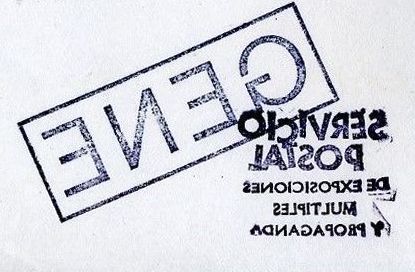
Una mañana de 1986 empecé el Servicio Postal de Exposiciones Múltiples y Propaganda. Se me ocurrió una idea y, en mi ingenuidad, pensé que tenía que ser dicha, que tenía que ser oída. El procedimiento era sencillo: se dibujaba, o se ponía por escrito, se hacían tantas copias como personas conocieras que pudieran agradecer recibir tal cosa, por cariño o sintonía, y se introducía cada copia en un sobre. Se llevaban los sobres a correos. Envío número uno.
Cuando habían sido ya enviadas unas cuantas ideíllas, mías y de amigos y colegas, conocí a los demás miembros de GENE, el grupo que sería, a partir de ahí y durante dos años. El Servicio Postal se convirtió en un órgano de ese cuerpo, y la actividad se multiplicó por diez, la intensidad, la sangre bombeada.
GENE era un grupo de acción política, pero sólo en cuanto que todo aquello que pudiera ser ensalzado -en la política nacional, en la deriva que iban tomando las instituciones culturales españolas, en el mundo del pensamiento y del arte en general-, era sistemáticamente puesto en duda y, a poco que aún levantara la cabeza, objetivo de nuestras mofas y descalificaciones. Era una cuña de oposición artística, una revolución con la cara A iluminada por la utopía.
El proyecto no podía ser sino un éxito, no podía ser sino un fracaso. Contábamos con dos ventajas inconvenientes: que a nadie le importaba lo que hacíamos, y que lo que hacíamos no era útil para que nadie se sintiera importante. Por un lado, nos dejaban en paz por inofensivos -demasiado anarquistas para dar ningún miedo-, por el otro, todavía eran nuestros esos medios que ahora, a poca capacidad de llamar la atención que tengan, han sido usurpados por empresas de mercadotecnia, se han convertido en propiedad desleal de youtubers e instagramers, de influecers, territorios de flash mobs y stealth advertising. Entre todos han dejado exhaustas las fuentes y las desembocaduras. Ahora nuestros envíos irían a la carpeta de spam. Cuando esas condiciones desaparecieron y la ausencia dio sus frutos, otras condiciones más infelices, el grupo también se desvaneció.
Son dos los fenómenos por los que las ideas, actitudes, protestas, reflexiones, críticas y alabanzas pasan de moda y se vuelven obsoletas: puede que los problemas que las causan sean resueltos y vuelvan banales todos los preliminares y puede que esos problemas se vuelvan invisibles, se asuman como parte esencial de la vida -alienación necesaria-. Aquello que antes denunciaba la alienación ha pasado a cuestionar la vida, y todo lo que pone en duda el sentido de la vida, a la vida le parece absurdo.
Si GENE era ya absurdo entonces, ahora podría serlo todavía más, las cosas no han mejorado. Es cierto que una vez que uno se aleja de ese despertar al mundo y pierde la fuerza y la ilusión que resultan de la inconsciencia y la inconsistencia, se encuentra de frente con un dispositivo bien tramado para enredarte; se aceptan golosinas y se acusa recibo de las amenazas que la sociedad va dejando esparcidas por ahí, como si no fueran para ti, pero bien a la vista -la vida profesional compra el absurdo al por mayor y luego lo administra-. Si se ha sido sincero, sin embargo, llegado un momento se vuelve a recuperar aquella misma simplicidad. Ahora he desaprendido lo suficiente como para poder despertarme muchas mañanas tarareando tonadillas que compusimos todos juntos durante esos dos años. Todavía nada que perder y ya nada que perder.
Hay una exposición sobre GENE en la biblioteca del Reina Sofía. Es bonito pasear la mirada por tantas consignas disparatadas, tanta emoción y entusiasmo que fueron derrochados en esos papeles -en ese sentido en el que Bataille es mejor evocado-. Pero también es triste, sobre todo triste. Sí, claro, porque ya no somos jóvenes, he perdido el pelo, me duelen las rodillas y han muerto muchos -¡la muerte ha deshecho a tantos!-. Es triste, especialmente, porque dentro de esas vitrinas ferétricas, mausoléicas, ataúdicas y sarcofáguicas los objetos, desconcertados, preguntan “¿por qué nos habéis traído aquí?” Ahí han dejado de ser absurdos. Las cartelas están todas bien redactadas. No queda nada que decir.
Por lo menos, para algunos, todavía lo mejor de la vida es Ruiz.
SPEMP
In the eighties you didn’t need much to live, if you were young, if you were an artist, you didn’t need much to be young and an artist; no laptop, no flat rate, no internet connection, no mobile phone, no applications, no design programmes.
We were young, too. Even so, we weren’t seduced by make-up, or platform heels, or youth fashion, or recreational drugs, or the avant-garde-is-the-market, or sexual promiscuity or disco lights. Nothing easy, at that time, nothing common. Despite this, we didn’t either praise with a solemn tone the freedom proclaimed in presidential tribunes, or in street demonstrations, nor were we satisfied with the democratic gifts that the state handed out generously at that time, after having hoarded them for many years, the workers’ struggles didn’t flatter us, nor the wage adjustments. That was not the norm either.
Juan Hidalgo, who came to visit us on occasion, had created a card years before on which was written ‘If you and I wanted to go to the moon, what would be the first thing we would have to do? I have thought of this phrase every time I have gone to the moon. There is nothing to look forward to, no call from the space agency, no software to calculate trajectory, weights and energies, no scholarship, no bib number. Not even that partner to pull you along, that accomplice to ask because, to tell the truth, all these space missions are pretty lonely. There is a way to go to the Moon, and it is within the reach of anyone who does the first thing that needs to be done, and then the second, and then the third, until, one of those times, he looks up and is surprised to see the damn blue planet there, tiny, tiny. There is a way of wondering what one should do first.
One morning in 1986 I started the Multiples Exhibitions and Propaganda Postal Service. An idea occurred to me and, in my naivety, I thought it had to be said, it had to be heard. The procedure was simple: draw it, or put it in writing, make as many copies as you knew of people who might be grateful to receive such a thing, out of affection or sympathy, and put each copy in an envelope. The envelopes were taken to the post office. Shipment number one.
By the time a few ideas had been sent out, mine and those of friends and colleagues, I met the other members of GENE, the group that was to be, from then on for two years. The Postal Service became an organ of that body, and the activity increased tenfold, the intensity, the blood pumped.
GENE was a political action group, but only insofar as anything that could be praised – in national politics, in the direction Spanish cultural institutions were taking, in the world of thought and art in general – was systematically called into question and, if it still raised its head, the target of our ridicule and despise. It was a wedge of artistic opposition, a revolution with its A side illuminated by utopia.
The project could only be a success, it could only be a failure. We had two inconvenient advantages: that nobody cared about what we were doing, and that what we were doing was not useful to make anybody feel important. On the one hand, we were left alone as inoffensive – too anarchist to be scary -, on the other hand, we still owned those media that now, as soon as they have the capacity to attract attention, have been usurped by marketing companies, have become the unfair property of youtubers and instagramers, of influencers, territories of flash mobs and stealth advertising. Between all of them, they have left the sources and mouths of the rivers exhausted. Now our submissions would go to the spam folder. When those conditions disappeared and the absence bore fruit to other, unhappier conditions, the group vanished too.
There are two phenomena by which ideas, attitudes, protests, reflections, criticisms and praises go out of fashion and become obsolete: maybe the problems that cause them are solved and make all the preliminaries banal, and maybe those problems become invisible, are assumed as an essential part of life -necessary alienation-. What used to denounce alienation has become a questioning of life, and everything that questions the meaning of life seems absurd to life.
If GENE was already absurd then, it could be even more so now, things have not improved. It’s true that once you move away from that awakening to the world and lose the strength and illusion that come from unconsciousness and inconsistency, you find yourself face to face with a well-contrived device to entangle you; you accept treats and acknowledge receipt of the threats that society leaves scattered around, as if they weren’t meant for you, but well in sight – professional life buys absurdity wholesale and then administers it. If you have been honest, however, at a certain point you get back to that same simplicity. I have now unlearned enough to be able to wake up many mornings humming tunes that we all composed together during those two years. Still nothing to lose and nothing left to lose.
There is an exhibition about GENE in the Reina Sofía library. It’s nice to look at so many crazy slogans, so much emotion and enthusiasm wasted on those papers – in that sense in which Bataille is best evoked. But it is also sad, especially sad. Yes, of course, because we are no longer young, I have lost my hair, my knees hurt and many have died – death has undone so many!. It is sad, especially because inside these casketish, mausoleic, coffinish and sarcophagic display cases, the objects, bewildered, are asking ‘why have you brought us here?’ There they have ceased to be absurd. The labels are all well written. There is nothing left to say.
For some, at least, the best of life is still Ruiz.
Creo que la Tierra es plana. No lo digo con convicción, pero sí con entusiasmo.
La mayor parte de la población piensa que los terraplanistas somos tontos, retrógrados, ridículos. La ciencia, el simple sentido común, demuestra claramente que todo aquello en lo que creemos es falso.
Durante mucho tiempo estaba convencido de que los teraplanistas eran agentes infiltrados de la doxa, enemigos creados artificialmente para que la ciencia pudiera demostrar lo lista y lo buena que es, para que pudiera exhibir todas sus verdades incluso cuando nunca nadie se lo hubiera pedido. Para mí los terraplanistas eran como los flower power que se introducían en las manifestaciones y se mezclaban con los black panthers con el propósito de que pareciera que lo que reivindicaban estos últimos era “haz el amor y no la guerra”.
Quizá en el pasado uno se hacía terraplanista porque pensaba que la Tierra era, de hecho, plana. En la actualidad, sin embargo, parece que lo que la mayor parte está buscando es el sentido de pertenencia a un grupo que el terraplanismo procura – una comunidad mucho más unida que la del simple sentido común-. También, defender que la Tierra es plana llama más la atención, y se consiguen más likes, y se puede ir a congresos, en lugares exóticos -los mismos criterios por los que otros siguen al Manchester United-.
Ahora he pasado a ser uno de ellos, pero no son esos los motivos que me animan. Aunque yo no me sienta especialmente terraplanista eso no importa, porque gran parte de la gente con la que hablo diariamente cree que lo soy. La clave que resuelve esta paradoja es que todos los disidentes nos hemos asimilado y da igual que uno crea que con las vacunas te inoculan chips 5G, que no ha habido ningún ser humano jamás en la Luna, que la estela de los aviones envenena a la población, que ellos te manipulan el cerebro mediante ondas electromagnéticas, que la democracia es injusta, o que el arte actual es un fraude de la sociedad para la sociedad: el papel que te hacen representar en sociedad es el mismo en cualquiera de los casos. Es desagradable representar este papel, tener que defender públicamente que la Tierra es plana -que nadie imagine que me gusta-, pero de todas formas lo hago con resignación, con auténtico entusiasmo, si la alternativa es alabar la ciencia, el progreso, la libertad, y las aplicaciones de mensajería instantánea. Mejor ser terraplanista con estos, que sensato con los otros.
Cuentan en televisión con orgullo humanista que en M.I.T., ese laboratorio de nuevas formas de imperialismo tecnológico, han creado un chatbot para discutir online con chiflados que creemos en estas cosas. Esta inteligencia artificial utiliza las fórmulas verbales más ajustadas, sin que la pasión empañe sus argumentos, sin perder ese objetivo que persigue: anular toda posibilidad de contestar. El público aplaude que existan estos mecanismos de sentido común, que acabarán con esos y poco a poco con otros chiflados, los que dicen que Elon Musk es un psicópata o que los sueldos son bajos, por ejemplo, acabaran definitivamente con las teorías conspirativas. Pero, ¿qué chiflado decide qué es una conspiración y qué no?
Vale. No creo que la Tierra sea plana. Pero eso de que la velocidad de la luz es constante, por eso sí que no paso.
Statements with a tinfoil hat
I believe the Earth is flat. I don’t say it with conviction, but I say it with enthusiasm.
Most of the population thinks that we terraplanists are silly, backward, ridiculous. Science, simple common sense, clearly shows that everything we believe in is false.
For a long time I was convinced that the terraplanners were infiltrated agents of doxa, artificially created enemies so that science could show how clever and how good it is, so that it could display all its truths even when no one had ever asked it to. To me the terraplanners were like the flower power people who would sneak into demonstrations and mingle with the black panthers in order to make it look as if the latter’s claim was ‘make love not war’.
Perhaps in the past one became a terraplanist because one thought that the Earth was, in fact, flat. Nowadays, however, it seems that most people are looking for the sense of belonging to a group that terraplanism provides – much stronger community than that of just common sense. Also, advocating that the Earth is flat gets more attention, and you achieve more likes, and you can go to conferences, in exotic places – the same criteria by which others follow Manchester United.
Now I’ve become one of them, but those are not the reasons that encourage me. Although I don’t feel particularly terra-planning myself, it doesn’t matter, because most of the people I talk to on a daily basis believe I am. The key that resolves this paradox is that all of us dissidents have assimilated and it doesn’t matter if one believes that vaccines inoculate you with 5G chips, that there has never been a human being on the Moon, that the wake of aeroplanes poisons the population, that they are manipulating one’s brain by electromagnetic waves, that democracy is unjust, or that current art is a fraud of society for society: the role they make you play in society is the same in any of the cases. It is unpleasant to play this role, to have to defend publicly that the Earth is flat – let no one imagine that I like it – but I do it with resignation anyway, with genuine enthusiasm, if the alternative is to praise science, progress, freedom, and instant messaging applications. Better to be a terra-planner with these than sensible with the others.
They tell on television with humanist pride that at M.I.T., that laboratory of new forms of technological imperialism, they have created a chatbot to discuss online with crackpots who believe in these things. This artificial intelligence uses the most appropriate verbal formulas, without passion tarnishing its arguments, without losing the objective it pursues: to nullify any possibility of replying. The public applauds the existence of these common sense mechanisms, which will put an end to these and little by little other crackpots, those who say that Elon Musk is a psychopath or that salaries are low, for example, will definitively put an end to all conspiracy theories. But what crackpot decides what is a conspiracy and what isn’t?
All right, I don’t believe that the Earth is flat. But that the speed of light is constant, man, that’s something I really don’t buy.
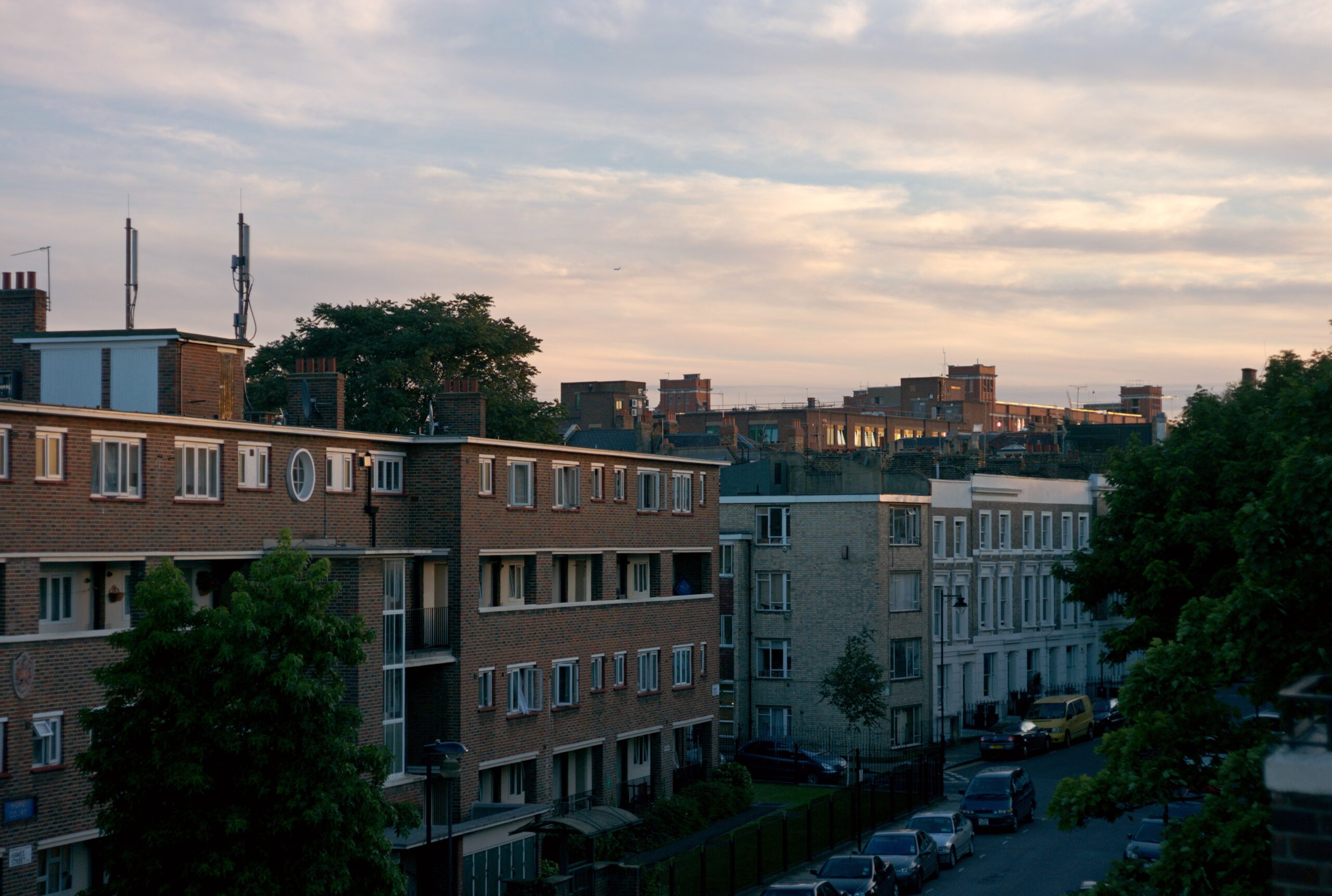
Hacía frío en Islington, en el invierno de 2006. Yo tenía calefacción de gas y recibí una carta que me recordaba la obligatoriedad de pasar la revisión de seguridad. Hacía tiempo que no había venido nadie a comprobar la instalación. Llamé por teléfono a la empresa que aconsejaba el ayuntamiento. Tenía la experiencia de que cada vez que venía alguien a hacer alguna reparación en el piso tenía problemas, por chapucería de los operarios, por la inquietud que me producía el que el visitante estuviera registrando los objetos de valor o, como este caso que voy a contar, porque aparecieran de forma inesperada normativas que yo no conocía o nuevas tareas y obligaciones. Esta vez vino un técnico, comprobó si había fugas y encontró que todo estaba bien. Sin embargo, una nueva ley para este tipo de calefacción de gas, obligaba a tener «ventilación directa» en la casa, lo que significaba simplemente que debería haber un agujero en la pared. El técnico dijo que, al no tener esta ventilación, se veía obligado a sellar el gas. En pleno invierno, sin aviso, me dejaban sin calefacción hasta que solucionara este problema. Le supliqué, le prometí que lo haría inmediatamente, que dejaría una ventana abierta todo el tiempo… Se compadeció de mí y, aunque no muy convencido, dejó el gas funcionando. Me hizo prometer que no abriría la puerta a nadie hasta que solucionara el problema porque él estaba obligado a informar del incidente y los inspectores del ayuntamiento podían estar allí enseguida para comprobar que había hecho bien su trabajo. Si cuando llegaran el gas no estuviera sellado, o el agujero en la pared todavía no existiera, él tendría problemas.
Se marchó y me puse inmediatamente a buscar en las páginas amarillas a alguien que hiciera el trabajo. El procedimiento normal, según pude entender, es hacer un agujero en el cristal de una de las ventanas, e instalar un trozo de plástico que haga circular el aire. Encontré una compañía de gas con servicio 24 horas y esperé a que vinieran. Acordamos que llamarían por teléfono cuando estuvieran delante del edificio, para no abrir a los inspectores del ayuntamiento por equivocación.
En una hora más o menos llamaron al timbre y abrí la puerta. El operario no llevaba ropa de trabajo, ni caja de herramientas. Solo traía en la mano un cortavidrios y la pieza de plástico. Le enseñé la ventana. Me dijo que él cortaría un círculo en el cristal, pondría la pieza y serían cuarenta libras. Bastante dinero, pensé, pero era mejor quitarse el asunto de en medio cuanto antes. “De acuerdo, adelante”. También dijo que el cristal podría romperse, que normalmente no se rompía, pero que si se rompiera, ese no sería su problema. ¿Qué podía decir a eso? Únicamente, “de acuerdo, adelante” y cruzar los dedos. Mientras hacía la operación, un poco torpemente, yo le observaba en tensión, sufriendo por la integridad de mi ventana. Aunque lo intentó varias veces no conseguía un corte limpio, así que empezó a quitar pequeños trozos de cristal a golpecitos. El cristal caía a la calle y cuando se lo advertí pidió una toalla y la puso fuera, en el alfeizar, pero aun así el cristal seguía cayendo. Yo sólo quería que terminara y se fuera.
De hecho, las piezas de cristal no habían caído en la calle, sino en el jardín de mis vecinos y cuando el operario se marchó con sus cuarenta libras, pensé en bajar a recoger los trozos caídos. En realidad habían sido muy pocas piezas y el jardín no merecía tal nombre: estaba lleno de basura, con una lavadora vieja, trozos de madera rotos, todo tipo de objetos de plástico. El jardín trasero estaba todavía peor, lleno de cosas podridas. Pensé que unos pocos trozos de cristal no tenían relevancia en ese paisaje.
Unos días después tuve que ir a España por un tiempo, y a mi regreso no salía mucho de casa y, ya que hacía frío, los vecinos no estaban nunca fuera, así que no me topé con ellos hasta que pasó al menos un mes. Pero un día estaba saliendo del edificio y la señora de la casa hablaba en la puerta con otra persona. Se interrumpió bruscamente y vino hacia mí gritando: “Tú, tú, tú, has llenado mi jardín de cristales. Has puesto a mi hija en peligro. Podría haberse cortado con los cristales. ¡No tienes decencia!”
En pleno invierno era muy improbable que su hija de un año jugara en el suelo del jardín entre la basura que tenían allí acumulada. Pero yo era culpable, así que me excusé como pude: pedí perdón repetidas veces, le pregunté que qué tipo de reparación quería, y me ofrecí a pagar un jardinero, haría lo que me pidiera. Pero ella dijo que así estaba bien. Ya había hecho uso de la oportunidad que se le había presentado, con esa demostración había equilibrado la cuenta, después de esperar todo el mes para ello se había podido relajar. Me disculpé un par de veces más y me fui.
Durante el tiempo que viví en Londres llegué a pensar que la característica más destacada de la vida allí era que no se desperdiciaba ninguna oportunidad: si en una cafetería se podía poner otra mesa, había que hacerlo, para sacarle rendimiento a ese espacio; si había un objeto en la calle desatendido -una bicicleta, por ejemplo-, había que llevárselo; si había algo por lo que se pudiera cobrar, se le ponía precio. Este era solo un caso más en el que había que sacar algún beneficio de eso que se te había puesto delante. Se podría pensar que esto es una forma en la que el capitalismo va transformando la vida cotidiana, y sin duda, la tradición de expansión imperial inglesa formó un tipo de carácter en la población, que fue luego exportado a Norteamérica, donde se perfeccionó –la oportunidad de tantas tierras desocupadas-, y finalmente distribuido desde allí al resto del planeta. Sí, pero el descubrimiento más importante para mí esos años fue ver cómo ese mecanismo funciona, en gran medida, por presión de pares: ya que todos lo hacen, uno también puede hacerlo, uno debe hacerlo porque aquellos que no se aprovechan son tratados de idiotas. Si uno no lo hace se siente ridículo. Porque era algo a lo que se había visto forzada, es por lo que mi vecina no llevó su ventaja hasta el límite. Por este motivo pienso que una de las maneras de resistencia al capitalismo, si no más eficaces desde luego más coherentes, es no hacer uso de ninguna de las oportunidades que se te ofrecen, tener el valor de hacer a menudo ese ridículo. Frontalmente en contra las costumbres locales de muchas culturas, esta actitud de rentabilizar tus activos es la invasión cultural más devastadora de todas las que estamos presenciando, la que puede acabar con la humanidad.
Ese día, después de la reprimenda, fui a Carluccio’s, una cadena de exquisiteces italiana, y compré una lujosa caja de chocolate. Volví a casa, entré en el jardín de los vecinos y llamé al timbre. Abrió el hijo mayor. Del apartamento salía un olor nauseabundo que en parte se debía a que dos gatos y un bulldog compartían la casa con la familia. Le pregunté por su madre. Cuando ella se asomó a la puerta le pedí, por favor, que aceptara los bombones como disculpa, como una muestra de mi pesar, y los disfrutara con su familia. Se quedó estupefacta. No podía entender por qué estaba yo teniendo ese gesto al que no estaba obligado de ninguna manera. Lo único que pudo hacer fue cruzar el umbral y abrazarme mientras lloraba. Ahora el sorprendido era yo. Fue muy triste pensar que alguien había experimentado en su vida tan pocas muestras de buena voluntad como para que esto le resultara tan conmovedor y extraordinario.
La familia no tardó mucho en mudarse a otro sitio. Después del episodio, nos sentíamos incómodos cada vez que nos cruzábamos.
A hole in the wall
It was cold in Islington in the winter of 2006. I had gas heating, and I received a letter reminding me I had to have a safety check. It had been a long time since anyone had come to check the installation. I phoned the company recommended by the local council. The experience I had was that every time someone came to do some repairs in the flat there were problems, because of the shoddiness of the workers, because I was worried that the visitor was exploring the valuables of the flat or, as in this case, because of the unexpected appearance of regulations that I didn’t know about or new tasks and obligations. This time a technician came, checked for leaks and found that everything was fine. However, a new law for this type of gas heating required to have ‘direct ventilation’ in the house, which simply meant that there should be a hole in the wall. The technician said that, not having this ventilation, he was forced to seal the gas. In the middle of winter, without warning, I was left without heating until this problem was solved. I begged him, I promised him that I would do it immediately, that I would leave a window open all the time…. He took pity on me and, although not very convinced, left the gas running. He made me promise not to open the door to anyone until I had fixed the problem because he was obliged to report the incident and the council inspectors could be there straight away to check that he had done his job properly. If when they arrived the gas was not sealed, or the hole in the wall did not yet exist, he would be in trouble.
He left and I immediately start looking in the Yellow Pages for someone to do the job. The normal procedure, as far as I could make out, is to cut a hole in the glass of one of the windows, and install there a piece of plastic to circulate the air. I found a gas company with 24-hour service and waited for them to come. We agreed that they would phone when they were in front of the building, so as not to open the door to the council inspectors by mistake.
Within an hour or so they rang the bell and I opened the door. The worker had no work clothes on, no toolbox. All he had in his hand was a glass cutter and a piece of plastic. I showed him the window. He told me that he would cut a circle in the glass, put the piece in and it would be forty pounds. Quite a lot of money, I thought, but it was better to get it out of the way as soon as possible. ‘All right, go ahead.’ He also said that the glass might break, that it didn’t normally break, but if it did, that wouldn’t be his problem. What could I say to that? Just, ‘all right, go ahead’ and cross my fingers. As he did the operation, a little awkwardly, I watched him in tension, suffering for the integrity of my window. Although he tried several times he couldn’t get a clean cut, so he began to tap out small pieces of glass. The glass was falling into the street, and when I warned him, he asked for a towel and put it outside on the window sill, but still the glass kept falling. I just wanted him to finish and go away.
In fact, the pieces of glass had fallen not in the street, but in my neighbours’ garden and when the workman left with his forty pounds, I thought I would go down and pick up the fallen pieces. Actually, there had been very few pieces and the garden didn’t deserve such a name: it was a plot full of rubbish, with an old washing machine, broken pieces of wood, all kinds of plastic objects. The back garden was even worse, covered the earth with forgetful rotten stuff. I thought that a few pieces of glass had no relevance in that landscape.
A few days later I had to go to Spain for a while, and on my return I didn’t leave the house much and, since it was cold, the neighbours were never outside, so I didn’t run into them for at least a month. But one day I was leaving the building and the lady of the house was talking to someone else at the door. She abruptly interrupted and came towards me shouting: ‘You, you, you, you have filled my garden with glass. You have put my daughter in danger. She could have cut herself with the glass. You have no decency!’
In the middle of winter it was highly unlikely that her one-year-old daughter would be playing on the garden floor among the rubbish they had piled up there. But I was guilty, so I excused myself as best I could: I apologised repeatedly, asked her what kind of repair she wanted, and offered to pay for a gardener, I would do whatever she asked. But she said that was fine. She had already made use of the opportunity she had been presented with, with that demonstration she had balanced the account, after waiting the whole month for it she could relax. I apologised a couple more times and left.
During the time I lived in London I came to think that the most salient feature of life there was that no opportunity was wasted: if you could put another table in a café, you had to do it, to make the most of the space; if there was an object in the street unattended – a bicycle, for example – you had to take it away; if there was something you could charge for, you had to put a price on it. This was just another case where you had to make some profit from what was put in front of you. You could think of this as a way in which capitalism is transforming everyday life, and certainly the tradition of English imperial expansion formed a kind of character in the population, which was then exported to North America, where it was perfected – the opportunity of so much unoccupied land – and finally distributed from there to the rest of the world. Yes, but the most important discovery for me in those years was to see how that mechanism works, to a large extent, by peer pressure: since everyone else is doing it, you can do it too, you must do it because those who don’t take advantage of it are treated as idiots. If you don’t do it, you feel ridiculous. Because it was something she had been forced to do that my neighbour did not push her advantage to the limit. And this is why I think that one of the ways of resisting capitalism, if not the most effective then certainly the most coherent, is not to make use of any of the opportunities offered to you, to have the courage to often make a fool of yourself. This attitude of profiting from your assets is the most devastating cultural invasion of all that we are witnessing, the one that can wipe out humanity.
That day, after the reprimand, I went to Carluccio’s, an Italian delicatessen chain, and bought a luxurious box of chocolate. I returned home, went into the neighbours’ garden and rang the doorbell. The eldest son answered. There was a foul smell coming from the flat, partly since two cats and a bulldog shared the house with the family. I asked for his mother. When she came to the door I asked her to please accept the chocolates as an apology, as a token of my regret, and enjoy them with her family. She was stunned. She could not understand why I was making this gesture to which I was in no way obliged. All she could do was cross the threshold and hug me while crying. Now, I was the surprised one. It was very sad to think that someone had experienced so little goodwill in her life that this could be so touching and extraordinary for her.
It didn’t take long for the family to move away. After the episode, we felt awkward whenever we passed each other.
Después de dos días en Viena conversando con otros artistas sobre el fenómeno de la voz en off y sus variantes, esta mañana he tomado el tren regional que conecta la Westbahnhof con Kirchstetten, un pueblo pequeño de la baja Austria en el que Wystan Hugh Auden pasó intermitentemente los quince últimos años de su vida y en su totalidad los, de momento, cincuenta de su muerte.
Una hora de viaje para la que he reservado la lectura de W.H. Auden: In the Autumn of the Age of Anxiety, una biografía del poeta escrita por Alan Levy como ampliación de un artículo que había publicado años antes en el New York Times. Cuando faltaban pocos días para volar a Viena me había entrado la urgencia por saber más de los últimos años de la vida de Auden, y había buscado el libro por las librerías en la red, resultando que en Viena se encontraba el ejemplar más conveniente, por precio y porque, al estar en esa ciudad, podría recibirlo a tiempo para la visita. Me estaba esperando en el hotel a la llegada. El ejemplar, por casualidad, está firmado por el propio Levy.
El libro empieza con el autor en el tren desde Viena a Kirchstetten, como yo, pero cincuenta y tres años antes y con la expectativa de encontrar a Auden esperándole en la estación con su Wolkswagen beetle, listo para recogerle y llevarle a casa, donde almorzarán y tendrán una conversación con suave vocación de entrevista.
Hace cuatro años encargué online otro libro, los aforismos de Josep Joubert, a un vendedor privado de Barcelona, un señor muy amable que escribía como si se comunicase conmigo desde los primeros años del siglo XX, con mucha cortesía y pomposidad. Parecía, también, muy despistado porque el paquete que recibí contenía El prolífico y el devorador, de W H Auden, publicado en la misma colección y con una portada muy parecida a la del solicitado. El vendedor, entre disculpas elaboradas me pidió que guardase el libro como regalo, mientras enviaba el de Joubert a continuación. Esa fue mi iniciación en el que, hasta entonces, había sido solo un poeta más para mí. ¡Qué maravilloso accidente fue este que me proporcionó en Auden un nuevo amigo y, en su retrato, un compañero para los que de Wittgenstein, Kierkegaard y Gide hay sobre mi chimenea!
Al llegar a Kirchstetten nadie está esperando en la estación. Tampoco se bajan más pasajeros del tren. Hay un silencio de apeadero de película del oeste. Solo al salir a la calle percibo la conversación de algunos clientes en la terraza de un bar pequeño al otro lado. De este pueblo nacido alrededor de la estación sale una carreterita casi recta hacia el sur, Bahnstrasse, que comunica a través de los campos de maíz con el pueblo original de Kirchstetten, donde Auden tenía su residencia, donde todavía reside. La calle señala ese grupo de casas sobre el que destaca la torre de la iglesia, en la cima de una colina.
Es un día radiante de principio de septiembre, con el cielo despejado pero sin el calor agobiante de agosto. Empiezo a caminar por el sendero junto a la carretera. A los lados, ocasionalmente, hay árboles cargados de fruta que no han sido cosechados, y manzanas y ciruelas están extendidas alrededor en un círculo amplio, aplastadas por los coches y los pocos caminantes, medio podridas, más densa la acumulación cuanto más cerca del tronco.
Voy escuchando en los auriculares una selección de poemas leídos por Auden mismo. No entiendo más que fragmentos, a causa de la pronunciación, del vocabulario, de lo complejo de las construcciones. Incluso en las traducciones en castellano me resulta difícil la poesía, y la de Auden. Sin embargo, es una banda sonora apropiada, si no por el contenido, sin duda por la textura sonora, una voz en off autorizada.
He leído su poesía por puro entusiasmo, forzándome a ello, siempre con esfuerzo. Las alegrías que he tenido en estos años con Auden se han desencadenado siempre tras encontrarme con sus apreciaciones sobre arte, cultura y política, y con comentarios y anécdotas de su vida, siempre de lo más humilde, de lo más compasivas y, en lo que al arte se refiere, también inflexibles. Algo parecido me sucede con Ludwig Wittgenstein: la dificultad que tengo para su filosofía solo puede ser compensada por la total entrega a sus otros escritos y anécdotas personales.
La voz de Auden empieza a recitar Deaths’s Echo unos veinte minutos después de que he salido de Kirchstetten, en el momento que llego a este otro pueblo, que se llama igual y que tiene también en su límite un letrero con su nombre, similar al que sobrepasé hace un rato, solo que este no está cruzado por una línea roja. Como si el término municipal de Kirchstetten se extendiera por todo el planeta con excepción de esos cuatrocientos metros de campos de maíz a punto de ser recolectados. También hay un cartel que dirige hacia la casa de Auden, y otro a la de Josef Weinheber, poeta así mismo, natural del lugar, que se suicidó al final de la segunda guerra mundial cuando se acercaba el Ejército Rojo a la localidad. Los dos poetas tienen en el pueblo su respectiva casa museo.
Las indicaciones guían al visitante invitándole a rodear la colina, la iglesia. Hay casas a los dos lados del camino, en medio de jardines limpios y ordenados que se pueden ver tras empalizadas de madera bajas. La decoración y el diseño son un poco torpes y dan una impresión artificial, muy distinta de la que uno tiene cuando pasea por lugares igual de anónimos en zonas residenciales anónimas en Japón. Todos los jardines tienen algún árbol frutal no cosechado, atentando contra la pulcritud del conjunto.
La casa de Auden está en el barrio de Hinterholz (lugar apartado), al otro lado de una autopista que hay que cruzar por debajo, a través de un túnel estrecho. Lo conocía de una grabación de la televisión austríaca del año 1967, cuando fueron a entrevistarle para su sesenta cumpleaños. Unos metros más allá de la salida está la Audenstrasse, que ya se llamaba así cuando el poeta vivía allí.
En Audenstrasse hay otros tres edificios. Me pregunto que significará el nombre de la calle para quienes viven en estas casas. Al final del recorrido, a la izquierda, se reconoce la estructura que he visto en documentales, las ventanas verdes tras las que el poeta trabaja en imágenes cinematográficas de la época, captadas desde fuera. En el balcón hay una reproducción fotográfica a tamaño real de Auden, tomada en ese mismo lugar, de forma tal que el poeta parece estar apoyado en la barandilla, pero en blanco y negro. Encuentro que el edificio es más grande de lo que hacen pensar los documentales. Lo veo también a través de la empalizada, ya que para visitar el interior es necesaria una reserva que no quise hacer porque me hubiera obligado a compartir este momento con el guía o vigilante. En la empalizada, bajo un buzón de correos americano, hay dos placas de bronce pequeñas: W. H. Auden y Chester Kallman.
Detrás de la casa se ven los paneles acústicos que protegen a este lado de la autopista del ruido de los coches y que cumplen su función solo parcialmente. La autopista ya existía en aquellos tiempos, pero puede que para Auden y Kallman el rumor del tráfico fuera solo un recuerdo de que Nueva York todavía existía más allá.
La calle acaba en un camino sin asfaltar que se adentra en un bosque de robles y carpes. Por el camino he visto abetos, pinos y trepadora de Virginia, una planta que se extiende con rapidez donde cae. Una vegetación muy parecida a la que encuentro en los alrededores de mi casa en la sierra, a una hora de tren de Madrid. Hace siete años que vivo allí, y se me ocurre en el paseo que puede que cuando me mudé estuviera buscando un retiro parecido a este, años antes de que Auden me hiciera compañía: un lugar tranquilo, separado, en un pueblo cuyo nombre hasta entonces no significaba nada y alrededor del cual una realidad urgente se genera, in the middle of somewhere. Esperar allí la muerte, siempre con trabajo pendiente, con algunas cosas que escribir y repasar. Ser enterrado después a unos trescientos metros de la vivienda.
Tres clases de personas: tres vías de salvación. Aquellos que buscan
A través de la manipulación de las cosas no humanas: el granjero, el ingeniero, el científico
A través de la manipulación de otros seres humanos: el político, el profesor, el médico;
A través de la manipulación de sus propias fantasías: el artista, el santo.
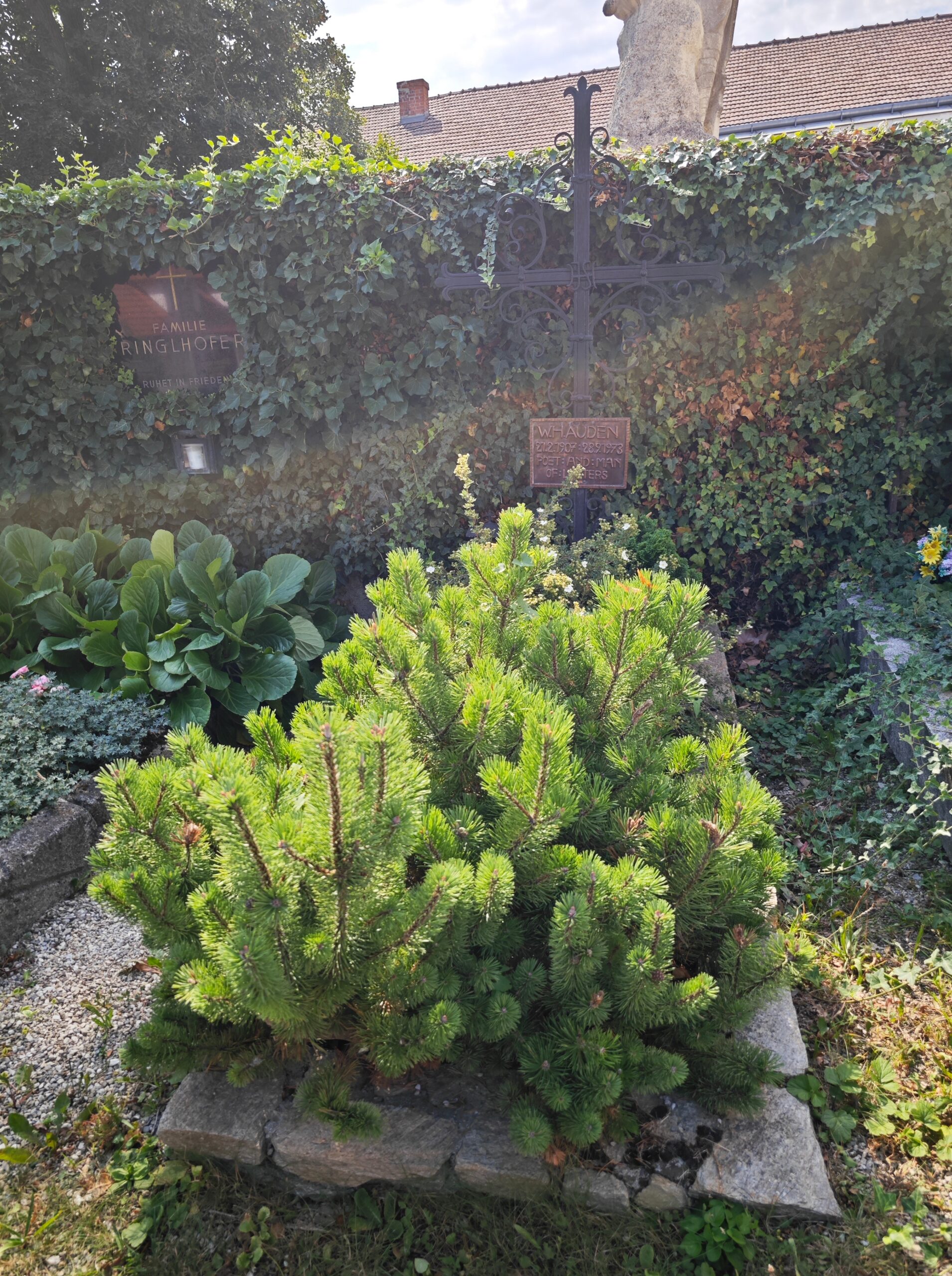
Se puede decir que Auden murió muy joven, a los sesenta y seis años, la misma edad a la que murió mi padre. Auden vivió exactamente siete meses más que él. A mí me faltan todavía tres para alcanzar esa edad ahora, en el momento en el que emprendo el camino hacia el cementerio del pueblo. Not to be born is the best for men, oigo entonces por los auriculares. He quedado allí con Robert, un amigo que viene en coche desde los Alpes, donde vive. “La cita es a las doce en la tumba de Auden” es una frase que, en esta tierra tan cercana al escenario de El tercer hombre, parece extraída de alguna novela de Graham Greene. Llego con tiempo para pasear con calma y estar un rato solo frente a la tumba. Pero tras dar unas cuantas vueltas por entre las lápidas no consigo encontrar la suya. Comparo cada rincón del cementerio con las imágenes que hay en Internet, y no coinciden. Finalmente resulta estar en un pequeño recinto junto a la iglesia, separado del cementerio principal. Abetos crecen en la tumba. Hasta que llega mi amigo, no hay nadie en los alrededores.
Aunque los edificios todavía existen, las dos tabernas a las que solía acudir Auden ya cerraron. Robert ha encontrado una casa de comida en un pueblo cercano que probablemente Auden visitó en más de una ocasión. Comemos un schnitzel vienés en el jardín, bajo un tilo centenario, mientras hablamos de los poetas muertos, del cine y la corrección política, de la vida en el arte. Vuelvo a Viena con él, en su coche, entre otros muchos coches.
Mil perdones y buenas noches.
Acabo de llegar al piso y leo su mensaje.
Quédese el libro que le he mandado por error
Mañana sin falta le mando el que usted ha pedido
Por correo certificado y sin cargo, sólo faltaría.
Con lo rápido y diligente que se ha portado usted
y voy y meto la pata.
Bien, en serio quédese con el tomo mal enviado
Ya le hago un mensaje con el nº de Correos
Recibo un cordial saludo, dispénseme usted
¡Ay, esos calores!
A day for Auden
A day for Auden
After two days in Vienna talking with other artists about the phenomenon of voiceover and its variants, this morning I took the regional train connecting the Westbahnhof with Kirchstetten, a small town in Lower Austria where Wystan Hugh Auden intermittently spent the last fifteen years of his life and the entirety of the, so far, fifty years of his death.
An hour’s journey for which I had set aside to read W.H. Auden: In the Autumn of the Age of Anxiety, a biography of the poet written by Alan Levy as an extension of an article he had published years earlier in the New York Times. With only a few days to fly to Vienna, I had an urge to find out more about the last years of Auden’s life, and I had searched the book in bookshops on the net, and it turned out that the most convenient copy could be found in Vienna, both in terms of price and because, being in that city, I could receive it in time for the visit. It was waiting for me at the hotel on arrival. The copy, by chance, is signed by Levy himself.
The book begins with the author on the train from Vienna to Kirchstetten, like me, but fifty-three years earlier and expecting to find Auden waiting for him at the station in his Wolskwagen beetle, ready to pick him up and take him home, where they will have lunch and a conversation with the gentle vocation of an interview.
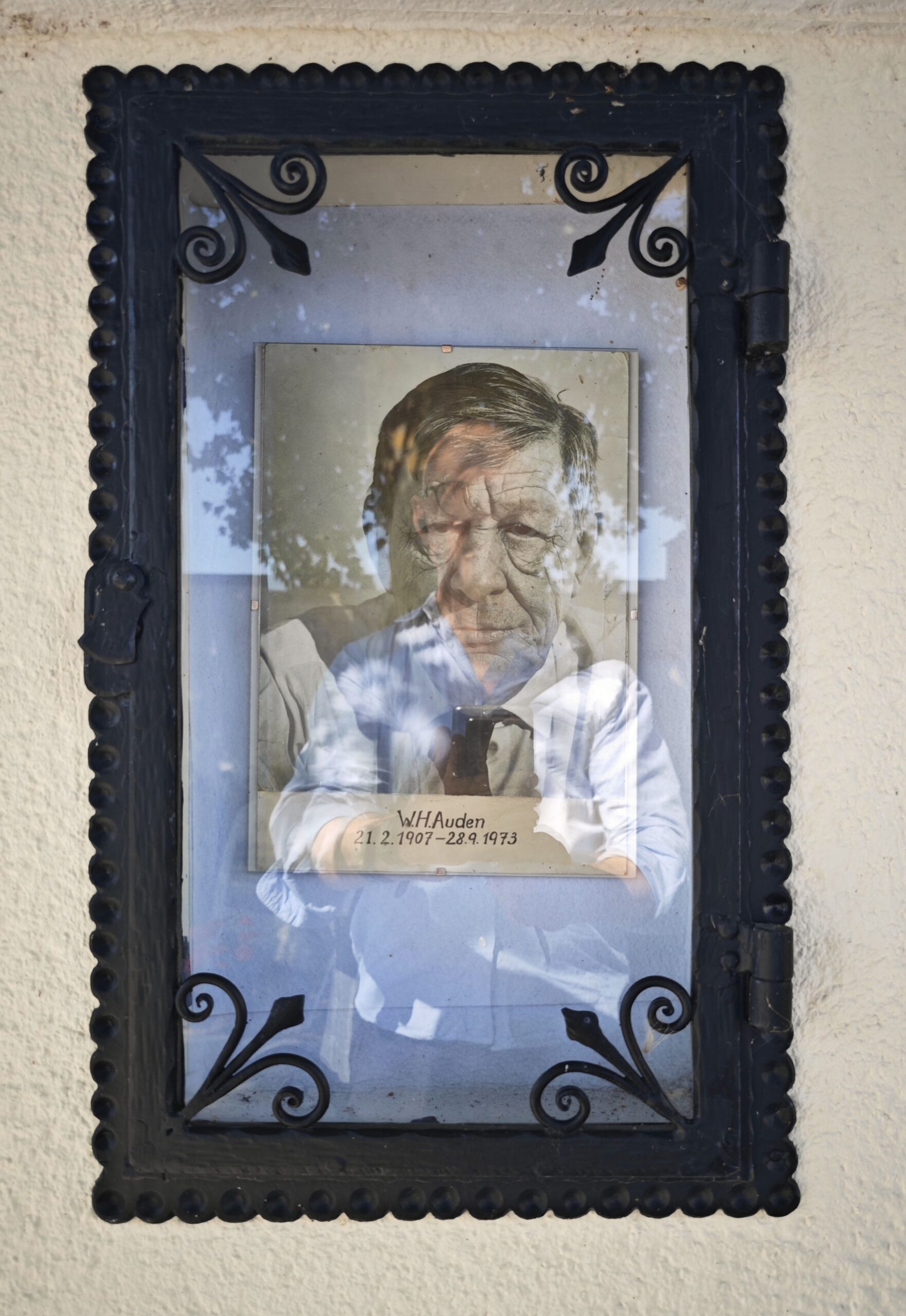
Four years ago I ordered another book online, the aphorisms of Josep Joubert, from a private seller in Barcelona, a very nice man who wrote as if he had been communicating with me from the early years of the twentieth century, with great courtesy and pomposity. He seemed, also, very absent-minded because the package I received contained W H Auden’s The Prolific and the Devourer, published in the same collection and with a cover very similar to the one requested. The seller, between elaborate apologies, asked me to keep the book as a gift, while he sent Joubert’s next. This was my initiation into what, until then, had been just another poet to me. What a wonderful accident it was that in Auden it gave me a new friend and, in his portrait, a companion to those of Wittgenstein, Kierkegaard and Gide on my mantelpiece!
When I arrive in Kirchstetten, no one is waiting at the station. Nor do any other passengers get off the train. The platform is as quiet as in a Western. Only when I step out onto the street do I hear the conversation of a few customers on the terrace of a small bar on the other side. From this village born around the station, a small, almost straight road leads south, Bahnstrasse, which connects through the cornfields to the original village of Kirchstetten, where Auden had his residence, where he still resides. The road points to this group of houses, above which the church tower stands out on the top of a small hill.
It’s a bright day in early September, with clear skies but without the oppressive heat of August. I start walking along the path beside the road. On the sides there are occasional trees laden with unpicked fruit, and apples and plums are spread around in a wide circle, crushed by cars and the few walkers, half rotten, the denser the accumulation the closer to the trunk.
I am listening to a selection of poems read by Auden himself. I only understand fragments, because of the pronunciation, the vocabulary, the complexity of the constructions. Even in the Spanish translations I find the poetry difficult, and Auden’s poetry too. Nevertheless, it is an appropriate soundtrack, if not for the content, then certainly for the sound texture, an authorised voiceover.
I have read his poetry out of sheer enthusiasm, forcing myself to do so, always with effort. The joys I have had over the years with Auden have always been triggered by his insights into art, culture and politics, and by comments and anecdotes from his life, always most humble, most compassionate and, as far as art is concerned, also uncompromising. Something similar happens to me with Ludwig Wittgenstein: the difficulty I have with his philosophy can only be compensated by my total devotion to his other writings and personal anecdotes.
Auden’s voice begins to recite Deaths’s Echo about twenty minutes after I have left Kirchstetten, by the time I reach this other town, which has the same name and also has a sign with its name on its boundary, similar to the one I passed a while ago, only this one is not crossed by a red line. As if the municipal boundary of Kirchstetten stretched across the entire planet except for those four hundred metres of cornfields about to be harvested. There is also a sign pointing to Auden’s house, and another to the house of Josef Weinheber, a local poet himself, who committed suicide at the end of the Second World War as the Red Army approached the village. Both poets have their respective house museums in the village.
The signs guide the visitor around the hill, around the church. There are houses on either side of the road, set in neat and tidy gardens that can be seen behind low wooden palisades. The decoration and design are a little clumsy and give an artificial impression, very different from the one you get when you walk through equally anonymous places in anonymous residential areas in Japan. All the gardens are planted with unharvested fruit trees, detracting from the neatness of the whole.
Auden’s house is in the Hinterholz (out-of-the-way) district, on the other side of a motorway that has to be crossed underneath through a narrow tunnel. I knew it from an Austrian television recording from 1967, when he was interviewed for his sixtieth birthday. A few metres beyond the exit is Audenstrasse, which was already called Audenstrasse when the poet lived there.
In Audenstrasse there are three other buildings. I wonder what the name of the street means to those who live in these houses. At the end of the route, on the left, you recognise the structure I have seen in documentaries and photographs, the green windows behind which the poet works in film images of the time, captured from the outside. On the balcony is a life-size photograph of Auden, taken on the same spot, so that the poet appears to be leaning on the railing, but in black and white. I find that the building is bigger than the documentaries make it seem. I can also see it through the palisade, because a reservation is necessary to visit the interior, which I didn’t want to make because it would have forced me to share this moment with the guide or guard. On the palisade, under an American post box, there are two small bronze plaques: W. H. Auden and Chester Kallman.
Behind the house you can see the acoustic panels that protect this side of the highway from the noise of cars and which only partially fulfil their function. The highway already existed in those days, but for Auden and Kallman the rumble of traffic may have been just a reminder that New York still existed beyond it.
The road ends in an unpaved path that leads into a forest of oaks and hornbeams. Along the way I saw firs, pines and Virginia creeper, a plant that spreads rapidly wherever it falls. Vegetation very similar to what I find around my home in the mountains, an hour’s train ride from Madrid. I’ve lived there for seven years, and it occurs to me on the walk that I may have been looking for a retreat like this when I moved, years before Auden kept me company: a quiet, separate place, in a town whose name until then meant nothing and around which an urgent reality is generated, in the middle of somewhere. Waiting there for death, always with work to do, with some things to write and review. Then to be buried some three hundred metres from the house.
Three kinds of people: three roads to salvation.
Those who seek it
(1) through the manipulation of non-human things: the farmer, the engineer, the scientist
(2) through the manipulation of other human beings: the politician, the teacher, the doctor
(3) through the manipulation of their own phantasies: the artist, the saint
You could say that Auden died very young, at the age of sixty-six, the same age at which my father died. Auden lived exactly seven months longer than he did. I am still three months short of that age now, as I make my way to the village cemetery. Not to be born is the best for men, I hear then over the headphones. I’m meeting Robert, a friend of mine who is driving from the Alps, where he lives. «The appointment is at twelve o’clock at Auden’s grave» is a phrase that, in this land so close to the setting of The Third Man, seems to be taken from a Graham Greene novel. I arrive in time for a leisurely stroll and some time alone in front of the grave. But after walking around the gravestones a few times, I can’t find his. I compare every corner of the cemetery with the images on the Internet, and they don’t match. Finally it turns out to be in a small enclosure next to the church, separate from the main cemetery. Fir trees grow on the grave. Until my friend arrives, there is no one around.
Although the buildings still exist, the two taverns Auden used to go to have closed. Robert has found an eating house in a nearby village that Auden probably visited on more than one occasion. We eat a Viennese schnitzel in the garden, under a century-old lime tree, while we talk about dead poets, about cinema and political correctness, about life in art. He takes me back to Vienna in his car, among many other cars.
A thousand pardons and good night.
I have just arrived at the flat and read your message.
Keep the book I sent you by mistake.
Tomorrow without fail I will send you the one you have requested
By registered mail and free of charge, that’s all it takes.
As quick and diligent as you have been in your task
and I go and mess up.
Well, seriously keep the mis-sent volume
I will send you a message with the post office number.
Está visto que, habiendo fallado todos los intentos, por más que bienintencionados siempre parciales, por resolver la crisis medioambiental, la única esperanza que queda es conseguir que más gente se haga poeta. Los poetas destruyen el mundo mucho menos que los banqueros, que los empleados de gasolineras, que los publicistas, que los activistas de Greenpeace, que los constructores de petroleros, o de viviendas. Cualquiera que deje su profesión y se haga poeta, ayuda al planeta. Los poetas pueden ayudar a resolver esta crisis climática, que es resultado, exclusivamente, de que hay demasiada gente útil en el mundo. Un nuevo poeta es un individuo más que ha sido arrebatado al mundo de la producción y del consumo. Un nuevo poeta es alguien que quizá hubiera acabado siendo promotor inmobiliario, o gestor financiero, o padre de familia.
More Poets
It is clear that having failed in all attempts, however well-intentioned always partial, to solve the environmental crisis, the only hope left is to get more people to become poets. Poets destroy the world far less than bankers, petrol station attendants, advertisers, Greenpeace activists, oil tanker builders, or house developers. Anyone who leaves their profession and becomes a poet helps the planet. Poets help to solve this climate crisis, which is a result, exclusively, of there being too many useful people in the world. A new poet is one more individual who has been taken away from the world of production and consumption. A new poet is someone who might have ended up as a property developer, or a financial manager, or a parent.
Suicídate. Si eso no es posible: evita tener hijos, y déjate morir, como tarde, en sesenta años. ¡El planeta se salvará!
Parece que el problema más acuciante en el mundo contemporáneo, con respecto a la especie humana en su conjunto y de acuerdo con los medios de comunicación, es el del calentamiento global. Hay muchas maneras de enunciarlo, en términos de clima, de extinción de especies, de polución, etc., casi todas catastróficas, pero en definitiva todas se refieren a la relación de los seres humanos con la naturaleza, que es donde el asunto deja de ser de actualidad para revelarse como algo intrínseco a la condición humana, es decir, no histórico. La forma en la que se enuncia, precisamente, es uno de los motivos por los que se hace difícil entenderlo: la mayor parte las formulaciones de esa relación se expresan como en el título de este artículo. Ahí, la cursiva de ese “nuestra” muestra los límites del contexto en el que se concibe el problema que son, en verdad, angostos.
La relación es nuestra, porque no es de la naturaleza, porque todo es nuestro, y “nuestro” hace referencia al grupo de los humanos. No se trata de “nosotros, los animales”, ni de “nosotros, los seres vivos”, ni de “nosotros, los elementos que integramos el planeta”. Establece una oposición que, evidentemente, es entre los humanos y lo demás. Son los seres humanos los que piensan y repiensan, y es su relación. No se considera en absoluto la relación que la naturaleza mantiene con los seres humanos excepto en términos defensivos, y eso establece de partida los términos de la negociación: los seres humanos son los protagonistas, el motivo y el final de esa negociación. La premisa de casi todos los libros, entrevistas, intervenciones en televisión, acciones de activistas por el clima y manifestaciones públicas sobre el tema, es este “nosotros” por los que han de pasar como por un cedazo. Todas las medidas que se recomiendan e implementan son para que nosotros podamos vivir mejor, o podamos vivir y multiplicarnos, sin más. Parafraseando a Auden, se podría decir que el mensaje de las proclamas ecologistas hegemónicas es: “Nosotros estamos aquí para salvar a la naturaleza. Lo que no sabemos es para qué está la naturaleza”.
“Nuestros ríos”, “nuestros paisajes” son de nuestra propiedad. Ese uso es peor que el que hacen las corporaciones, que muestran su avidez abiertamente. “La tierra provee lo suficiente para satisfacer las necesidades de todos, pero no tanto como para satisfacer la avaricia de cualquiera” resume, dicen, la doctrina de Mahatma Gandhi, y así se celebra por todos los que se quieren repartir el pastel equitativamente entre todos los humanos. Porque Sr Gandhi, la tierra no provee de nada, a la tierra se le arrebata todo.
“Nosotros” significa “yo”. Esta es la prioridad, y la tienen todos los humanos, y la tienen también los ecologistas, y su prioridad está por delante de su amor a la naturaleza, porque el amor a la naturaleza es un sustituto delegado del amor a uno mismo, y cuando la primacía de uno de los dos está en disputa, siempre gana el amor a uno mismo y entonces las necesidades que se busca satisfacer son las propias, no las del planeta, las de “nuestro planeta”.
Por tanto, las medidas que se toman por el momento son realmente parciales, sin ningún deseo ni posibilidad de solucionar nada. Por ejemplo, los activistas animalistas intentan conseguir un trato digno para todos los seres vivos del planeta. “Derechos para los animales”. Pero es claro que esa dignificación solo puede ser limitada. A los animales se les conceden unos derechos reducidos, suficientes para que puedan seguir sirviendo a los propósitos de los seres humanos, como se dan derechos a los inmigrantes, para que puedan atender a nuestras personas mayores y pagar las cuotas de la seguridad social. Si los animales tuvieran derechos similares a los de los humanos, nos encontraríamos ante el derecho de un tigre a comerse a todos los hombres que quiera, incluidos bebes, como hacen los hombres con todos los cerdos que quieren, incluidos los cochinillos. El lobo tiene derecho, no sólo a reproducirse, sino a atacar todos los rebaños que pueda encontrar, a atacar a todos los ganaderos que quiera, a todos los montañeros domingueros que quiera, y a sus bebés. Y también a los bebés de las ciudades, porque las ciudades no son más que espacios arrebatados hace mucho tiempo a los lobos. Los animales podrían establecer controles sobre la población humana, sobre el código genético humano.
¡Ecologistas mediáticos!, no se puede nombrar el planeta en vano, el problema medioambiental. Porque eso os iguala a tantos desconsiderados de todos los tipos que hablan de los productos que representan y en un momento dado dicen: “ah, y también es sostenible”.
Esta consigna –“repensar nuestra relación con la naturaleza”— es formulada por los más comprometidos con la causa de la naturaleza, habida cuenta de que hay mucha gente que no quiere repensar nada, y ni siquiera pensarlo, y para los que la naturaleza es sólo un repositorio de materiales que hay que usar antes de que otros se apoderen de ellos. Se puede decir que quienes animan a repensar la relación, por lo menos quieren denunciar los abusos que han sido cometidos y los que todavía se cometen, buscan soluciones ingeniosas, hablan de homeóstasis y de Gaia, y urgen a “hacer las paces con la naturaleza”.
Sin embargo, esta oferta de paz es “Das Friedensangebot”, según Walter Trier la define en la primera lección de su libro alemán nazi en 22 lecciones: “Una invitación a dejar de luchar y dar al agresor lo que quiere, respaldada por la promesa de que el agresor no volverá a atacar, hasta que quiera alguna otra cosa”. Se anima a hacer las paces con la naturaleza como se animaba a firmar tratados con los indios americanos, que igual algunos proponían con buena intención, pero siempre a sabiendas de que el séptimo de caballería estaba preparado para proteger en cualquier momento a quienes se los saltaran desde ese lado y a la mínima resistencia de los indios.
¿Cuáles son las cláusulas que respaldan esta oferta de paz? ¿Qué se le ofrece a la naturaleza a cambio? ¿La promesa del reciclado de plásticos? ¿El anuncio de nuevos territorios plantados con postes de energías renovables o con plantas de cultivo ecológico? ¿La palabra de honor de que no se explotarán más los recursos naturales, hasta que suba el precio de las materias primas?
Estas ofertas de paz están dichas con la boca pequeña, desde espacios confortables para los humanos y que han sido arrebatados a vegetales y animales, a las aves y a los insectos. Así se cubren las apariencias y se puede seguir haciendo una vida más o menos igual, con algún cambio puntual aquí y allá. Se diría, más bien, que estos activistas se quejan de la naturaleza —y a la naturaleza—, por dejar, egoístamente, de proporcionar todos los recursos que hasta el momento estaba entregando sin resistencia. Debería ser enunciado de otra manera más realista: “vamos a renegociar el contrato con la naturaleza”, o “vamos a establecer marcos en los que la empresa sea todavía viable, es decir, que podamos seguir explotando la naturaleza de la misma manera, consideradas las actuales circunstancias”. Las circunstancias actuales, para quien quiera entender, son la cantidad de humanos en el planeta, el aumento exponencial de seres humanos en relación con un planeta que se mantiene en las mismas dimensiones.
No puede haber negociación, solo un derroche ilimitado de recursos naturales -el único límite es su extenuación-. En todas las negociaciones que se establecen con la naturaleza, la naturaleza es la que pierde, como perdían los países invadidos por las potencias occidentales cuando éstas les proponían tratados, todos legales y soportados por gunboat diplomacy. Aunque la negociación sea de buena fe, aunque los buenos consigan lo que buscan, luego están los que se saltan la negociación, y los que interpretan la ley a su gusto, y los jueces corruptos, y los que retrasan los juicios para que se siga explotando la naturaleza mientras tanto, los que falsean las cifras… Y nunca es de buena fe, en realidad, sino que sólo parece de buena fe porque se diferencia un poquito de esa mala fe convencional y convencida con la que uno se topa todos los días en la vida cotidiana.
Para hacer las paces con algo o alguien, de buena fe, hay que preparar alguna demostración inequívoca de buena voluntad. La película Fail Safe, de 1964, proporciona una buena metáfora mediante la que pensar esta relación. La trama de la película se desarrolla en el contexto de la guerra fría, donde hay dos potencias que no confían la una en la otra. Por un error informático en ordenadores sofisticadísimos —esos que cometen los errores más graves—, una escuadrilla de aviones cargados con armas nucleares recibe la orden de bombardear la Unión Soviética. Los americanos intentan detenerlos, primero revocando las órdenes, después mediante intervención directa del presidente, o súplicas de sus familiares. Todo es inútil, porque han de seguir un protocolo estricto que impide toda contraorden, en previsión de que sea un intento del enemigo de interferir en la misión. Por lo tanto, los altos mandos americanos, con gran dolor, empiezan a derribar sus propios aviones. Sólo pueden alcanzar a algunos de ellos, y entonces se acuerda suministrar a los militares soviéticos toda la información posible que facilite el derribo de los restantes. A pesar de todos los esfuerzos de unos y otros, un avión consigue atravesar toda frontera y se dirige hacia Moscú que, inevitablemente, quedará destruida bajo la bomba. La lógica respuesta soviética será la de la guerra total, su fuerza nuclear enviada de una vez y con contundencia, independientemente de que tengan la certeza de que el conflicto ha sido producto de un error, y de que eso acarreará la destrucción completa del planeta (la respuesta americana será también de bombardeo masivo). Entonces el presidente americano propone a su homólogo soviético un acuerdo sorprendente y comprometido: si el avión llega a Moscú, si descarga la bomba, si millones de rusos mueren al instante, a cambio de que el gobierno soviético no envíe sus bombarderos, un avión del ejército americano arrojará una bomba sobre el Empire State Building en Nueva York, y causará la muerte instantánea de un número similar de americanos. Esa será su manera de demostrar al mundo que todo ha sido un error y que su ánimo no era criminal.
Una oferta similar sería necesaria para que la naturaleza aceptara la oferta de paz que tiende el género humano. Por lo menos dos terceras partes de la humanidad deberían perecer para que se viera la buena voluntad, para que fuera evidente que no se trata únicamente de palabras. Eso sería una contrapartida -en realidad, pobre- a la extinción de especies que tiene lugar, a la contaminación de plásticos en los océanos y a la radiactiva o de gases invernadero en el ambiente. Pero no hay que preocuparse, porque se trata solo de una película, y nada de eso puede suceder. Estarían en oposición frontal a la implementación de una medida parecida, especialmente, los que exigen ese tratado de paz con la naturaleza porque son, en su mayoría, humanistas bien nacidos y educados, con las mejores intenciones y con principios que rechazan en firme la violencia.
Con mucha resistencia, en cualquier caso, como solución a largo plazo, y con la esperanza de que el problema no se abisme antes de que los efectos de las medidas empiecen a afectar al planeta, se podría adoptar esa medida de la forma menos traumática posible, es decir, reduciendo la población sin tener que ejecutar a nadie, es decir, reduciendo el número de los posible ejecutados, reduciendo el número de la población por el simple medio de evitar traer nuevos seres humanos al mundo. Una moratoria completa sería aconsejable, pero seguro que eso también despertaba todo tipo de resistencia. ¿Quizá una campaña de anuncios en televisión pidiendo a la gente, por favor, que no tenga tantos hijos? ¿Sería eso aceptable? De momento, hasta una medida de esa ligereza es impensable, tal es el tabú que representa la procreación para la sociedad contemporánea. Es un tabú porque por él se accede directamente a la muerte personal de cada individuo, al miedo que esta despierta, al sinsentido que presenta. Eso establece las prioridades, las jerarquías del valor. Sólo hay una manera de salvar la naturaleza, pero es suicida para quien la quiera implementar.
La única manera de mejorar la vida de los animales es empeorar la vida de los humanos. La única de conservar el planeta, es conservar menos lo humano. Quien no entienda esto -quien, quizá, no quiera entenderlo-, no mejora la vida de los animales ni la condición del planeta en absoluto. No se trata de ayudar al tercer mundo, sino de atacar al primero. No se trata de dar derechos a los animales, sino de quitárselos a los humanos.
Reducir lo humano, la proporción de lo humano con respecto a lo no humano, sería posible si no hubiera toda una sucesión de negacionismos, de los cuales, el de la realidad del cambio climático es sólo el primero, el más simple e inocente. De hecho, se puede decir, “bienaventurados los negacionistas del cambio climático” porque ponen sus cartas sobre la mesa, mientras que los negacionistas de todo lo demás se las guardan en la manga. Todas las demás negaciones lo son por exclusión, por enmudecimiento y represión. Son la pura expresión del tabú, de lo que no se habla, del elefante en la habitación que nadie mira. ¿Cómo deberíamos llamar a esta actitud siniestra y sibilina? ¿Desestimacionismo, oidosordismo, o simplemente “miedo a la verdad”?
Las varias verdades que se ocultan están en capas superpuestas, y cada vez que se quita una, la siguiente se hace más difícil de abordar, hay más resistencias pasivas y activas, de sectores más amplios de la población, las medidas que se toman para evitar la revelación son más agresivas y amenazadoras. Para empezar, por supuesto, el problema de la superpoblación, que oculta el de la procreación, que oculta el dogma humanista del valor de lo humano sobre todo lo demás… El negacionismo definitivo es el de la muerte, y por eso, si la muerte se enfrentase directamente, todos los demás problemas se difuminarían. Quizá cambiaría todo el sentido de la humanidad y se produciría un cambio en la historia, o la historia como tal desaparecería…
Hasta que se adopte alguna medida en esa dirección, hasta que la catástrofe ecológica y social llegue a un punto en el que las cabezas tengan que sacarse de la tierra desértica y la opción de reducir la población pueda considerarse como una salida honrosa, mientras tanto, el mundo se entretiene en echar la culpa al capitalismo. No son los humanos los culpables, sino ese sistema económico que todo lo devora. Las prácticas capitalistas, con su explotación intensiva, con su derroche de recursos, destruyen lo que a los ciudadanos les gustaría preservar. Pero, habría que mirar, ¿quién no es capitalista? Todos lo somos, tanto activos como pasivos, capitalizados y capitalizadores. Gracias a Karl Marx todos los humanos conectados entendemos nuestra fuerza de trabajo como un bien con el que podemos negociar, que tenemos que invertir bien, que tenemos que usar como herramienta de presión —también somos dueños y patrones de nuestro tiempo—. La gente asume que el cuerpo es suyo, que la vida es suya, que son bienes que tiene que gestionar, así como los padres creen que los hijos son de su propiedad. Se defiende la propiedad de todo lo que nos rodea y hasta la del asiento del autobús que hemos trabajado (en términos de John Locke) porque hemos llegado antes y lo hemos ocupado. Los humanos también somos accionistas de los ríos y los valles, de los paisajes y de los acuíferos, que son de nuestra propiedad colectiva. Ya no pertenecen a los dioses, sino a las comunidades (por supuesto que, de todas formas, cuando pertenecían a los dioses el único interés de éstos era darles gusto a sus criaturas humanas). “Ser humano” significa “ser capitalista”, lo mismo que “ser tecnológico”. El paisano que vive en una aldea y calienta su comida en la estufa de leña es tan capitalista y tan tecnológico como el que recorre Silicon Valley en un coche autodirigido. Los dos son tecnológicos en la medida en la que son algo. Así que no hay que echarle la culpa a la tecnología, ni alabarla. Todo es tecnológico, en la medida que es humano. Todo lo que no es naturaleza es tecnología. Ya el hecho de poner nombre a un árbol hace del árbol tecnología.
Sin embargo, no toda la humanidad es así, porque todavía hay actitudes humanas que son, por así decirlo, inhumanas. Hay sociedades magníficas cuyos miembros piensan que todo lo que tienen es un regalo, o un privilegio, que están agradecidos y avergonzados, y que siempre ceden el asiento en el autobús, porque saben que no es suyo.
Rethinking our relationship with nature
To save the planet:
Commit suicide. If that is not possible: avoid having children, and let yourself die, at the latest, in sixty years. The planet will be saved!
It seems that the most pressing problem in the contemporary world, with respect to the human species as a whole and according to the media, is that of global warming. There are many ways of stating it, in terms of climate, extinction of species, pollution, etc., almost all of them catastrophic, but ultimately they all refer to the relationship of human beings with nature, which is where the issue ceases to be topical and is revealed as something intrinsic to the human condition, i.e. non-historical. The way in which it is stated is precisely one of the reasons why it is difficult to understand: most of the formulations of this relationship are expressed as in the title of this article. There, the italicisation of the «our» shows the limits of the context in which the problem is conceived, which are indeed narrow.
The relationship is ours, because it is not of nature, because everything is ours, and «ours» refers to the group of humans. It is not «us, the animals», nor «us, the living beings», nor «us, the elements that make up the planet». It establishes an opposition that is obviously between humans and the rest. It is human beings who think and rethink, and it is their relationship. The relationship that nature has with humans is not considered at all except in defensive terms, and that sets the terms of the negotiation from the outset: humans are the protagonists, the motive and the end of that negotiation. The premise of almost all books, interviews, TV interventions, climate activists’ actions and public demonstrations on the subject is this «we», through which all they have to pass as if through a sieve. All the measures that are recommended and implemented are so that we can live better, or we can live and multiply, just like that. To paraphrase Auden, one could say that the message of hegemonic environmentalist proclamations is: «We are here to save nature. What we don’t know is what nature is for».
«Our rivers», «our landscapes» are our property. Such use of the world is worse than that corporations do, which openly display their greed. «The earth provides enough to satisfy everyone’s needs, but not enough to satisfy anyone’s greed» sums up, they say, Mahatma Gandhi’s doctrine, and so it is celebrated by all those who want to share the pie equally among all humans. Because, Mr Gandhi, the earth provides nothing, everything is taken from the earth.
«We» means «I». This is the priority, and all humans have it, and so do environmentalists, and their own priority comes before their love of nature, because love of nature is a proxy for love of self, and when the primacy of one of the two is in dispute, love of self always wins, and then the needs they seek to satisfy are their own, not those of the planet, of «our planet».
Therefore, the measures taken at the moment are partial, without any desire or possibility to solve anything. For example, animal activists are trying to achieve a dignified treatment of all living beings on the planet. «Rights for animals». But it is clear that this dignification can only be limited. Animals are given reduced rights, sufficient to allow them to continue to serve the purposes of human beings, just as immigrants are given rights, so that they can care for our elderly and pay social security contributions. If animals had similar rights to humans, we would be faced with the right of a tiger to eat all the men it wants, including babies, as men do with all the pigs they want, including piglets. The wolf has the right, not only to reproduce, but to attack all the herds it can find, to attack all the farmers it wants, all the Sunday mountaineers it wants, and their babies. And also the babies in the cities, because cities are nothing more than spaces taken from the wolves a long time ago. Animals could establish controls over the human population, over the human genetic code.
Media ecologists, you cannot name the planet in vain, the environmental problem. Because that puts you on a par with so many inconsiderate people of all kinds who talk about the products they represent and at a certain point say: «Oh, and it’s sustainable too».
This slogan – «rethink our relationship with nature» – is formulated precisely by those most committed to the cause of nature, given that there are many people who do not want to rethink anything, or even think about it, and for whom nature is only a repository of materials to be used before others get hold of them. It can be said that those who encourage rethinking the relationship, at least want to denounce the abuses that have been committed and those that are still being committed, look for ingenious solutions, talk about homeostasis and Gaia, and urge to «make peace with nature».
However, this peace offer is «Das Friedensangebot», as Walter Trier defines it in the first lesson of his book Nazi German in 22 Lessons: «An invitation to stop fighting and give the aggressor what he wants, backed by the promise that the aggressor will not attack again, until he wants something else». He encourages making peace with nature as he encouraged signing treaties with the American Indians, which some may have proposed with good intentions, but always in the knowledge that the 7th Cavalry was ready to protect at any moment those who jumped them from that side and at the slightest resistance from the Indians.
What are the clauses behind this peace offer? What is nature being offered in return? The promise of plastic recycling? The announcement of new territories planted with renewable energy poles or organically grown plants? The word of honour that natural resources will no longer be exploited until the price of raw materials rises?
These offers of peace are made with small mouths, from spaces that are comfortable for humans and that have been taken away from plants and animals, birds and insects. This way, appearances are covered up and life can go on more or less unchanged, with the occasional adjustments here and there. One might say, rather, that these activists are complaining about nature – and to nature – for selfishly ceasing to provide all the resources it has so far been giving without resistance. It should be phrased in a more realistic way: «Let’s renegotiate the contract with nature», or «Let’s establish frameworks in which the business is still viable, i.e. that we can continue to exploit nature in the same way, considering the current circumstances». The current circumstances, for those who want to understand, are the number of humans on the planet, the exponential increase of human beings in relation to a planet that remains the same size.
There can be no negotiation, only unlimited squandering of natural resources – the only limit is their exhaustion. In all negotiations with nature, nature is the loser, just as the countries invaded by Western powers lost when the latter proposed treaties, all legal and supported by gunboat diplomacy. Even if the negotiation is in good faith, even if the good guys get what they want, then there are those who skip the negotiation, and those who interpret the law to their liking, and corrupt judges, and those who delay trials so that nature can continue to be exploited in the meantime, those who cook the books… And it is never in good faith, really, but only seems to be in good faith because it differs a little from the conventional and convinced bad faith that one encounters every day in everyday life.
To make peace with something or someone, in good faith, some unequivocal demonstration of goodwill must be provided. The 1964 film Fail Safe provides a good metaphor through which to think about this relationship. The film’s plot is set in the context of the Cold War, where two powers do not trust each other. Because of a computer error in the most sophisticated computers – the ones that make the most serious mistakes – a squadron of planes loaded with nuclear weapons is ordered to bomb the Soviet Union. The Americans try to stop them, first by revoking the orders, then by direct intervention by the president, or pleas from their families. All to no avail, because they have to follow a strict protocol that prevents any counter-orders, in anticipation of it being an attempt by the enemy to interfere with the mission. So the American commanders, with great pain, begin to shoot down their own planes. They could only hit a few of them, and it is then agreed to supply the Soviet military with as much information as possible to facilitate the shooting down of the remainder. Despite all their efforts, one plane manages to cross all borders and head towards Moscow, which will inevitably be destroyed under the bomb. The logical Soviet response would be total war, their nuclear force sent in once and for all, regardless of their certainty that the conflict was a mistake, and that it would lead to the complete destruction of the planet (the American response would also be massive bombing). The American president then proposes to his Soviet counterpart a surprising and compromised deal: if the plane reaches Moscow, if he drops the bomb, if millions of Russians are killed instantly, in exchange for the Soviet government not sending its bombers, a US army plane will drop a bomb on the Empire State Building in New York, and cause the instant death of a similar number of Americans. This will be their way of proving to the world that it was all a sincere mistake and that their motive was not criminal.
A similar kind of action would be necessary for nature to accept mankind’s offer of peace. At least two-thirds of humanity would have to perish for the goodwill to be expressed, for it to be evident that it is not just words. That would be a poor counterpart to the species extinction that is taking place, to the plastic pollution in the oceans and the radioactive or greenhouse gas pollution in the environment. But not to worry, because it is just a film, and none of that can happen. Especially those who call for such a peace treaty with nature would be strongly opposed to the implementation of this kind of measure because they are, for the most part, well-born and educated humanists with the best of intentions and principles who firmly reject violence.
With a lot of resistance, in any case, as a long-term solution, and in the hope that the problem does not abyss before the effects of the amendments begin to affect the planet, such a measure could be taken in the least traumatic way possible, i.e. reducing the population without having to execute anyone, i.e. reducing the number of those possibly executed, reducing the number of the population by the simple means of avoiding bringing new human beings into the world. A complete moratorium would be advisable, but surely that would also arouse all kinds of resistance. Perhaps a TV ad campaign asking people to please not have so many children? Would that be acceptable? At the moment, even such a light-hearted measure is unthinkable, such is the taboo that procreation represents for contemporary society. It is a taboo because it gives direct access to the personal death of each individual, to the fear it arouses, to the meaninglessness it presents. It establishes priorities, hierarchies of value. There is only one way to save nature, but it is suicidal for those who want to implement it.
The only way to make life better for animals is to make life worse for humans. The only way to conserve the planet is to conserve less of the human. Whoever does not understand this – whoever, perhaps, does not want to understand it – does not improve the lives of animals or the condition of the planet at all. It is not about helping the Third World, it is about attacking the First World. It is not about giving rights to animals, but about taking them away from humans.
Reducing the human, the ratio of the human to the non-human, would be possible if there were not a whole succession of denialisms, of which that of the reality of climate change is only the first, the simplest and most innocent. In fact, one can say, «Blessed are the climate change deniers» because they lay their cards on the table, while the deniers of everything else keep them up their sleeves. All other denials are exclusionary, muted and repressive. They are the pure expression of the taboo, the unspoken, the elephant in the room that no one looks at. What should we call this sinister and sibylline attitude: dismissalism, tone-deafness, or simply «fear of the truth»?
The various hidden and denied truths are layered on top of each other, and each time one is removed, the next becomes more difficult to deal with, there is more passive and active resistance, from wider sections of the population, the measures taken to prevent disclosure are more aggressive and threatening. To begin with, of course, the problem of overpopulation, which hides the problem of procreation, which hides the humanist dogma of the value of the human above all else… The ultimate negationism is that of death, and so, if death were to be confronted directly, all other problems would fade away. Perhaps the whole meaning of humanity would change and a change in history would take place, or history as such would disappear…
Until some action is taken in that direction, until the ecological and social catastrophe reaches a point where heads have to be removed from the desert land and the option of reducing the population can be considered as an honourable way out, in the meantime, the world is busy blaming capitalism. It is not humans who are to blame, but this all-devouring economic system. Capitalist practices, with their intensive exploitation, with their waste of resources, destroy what citizens would like to preserve. But who is not a capitalist? We all are, both active and passive, capitalised and capitalisers. Thanks to Karl Marx all connected humans understand our labour power as a commodity that we can trade, that we have to invest well, that we have to use as a tool of pressure – we are also masters and owners of our time. People assume that the body is theirs, that life is theirs, that these are assets they have to manage, just as parents believe that their children are their property. Ownership is defended for everything around us and even for the seat on the bus that we have worked (in John Locke’s terms) because we have arrived earlier and occupied it. Humans are also shareholders in the rivers and valleys, landscapes and aquifers, which are our collective property. They no longer belong to the gods, but to communities (of course, when they belonged to the gods, the gods’ only interest was in pleasing their human creatures anyway). «To be human» means «to be capitalist», the same as «to be technological». The peasant who lives in a village and heats his food on a wood cooker is as much a capitalist and as technological as the one who drives around Silicon Valley in a self-driving car. They are both technological to the extent that they are something. So technology is not to be blamed, nor is it to be praised. Everything is technological, insofar as it is human. Everything that is not nature is technology. Already the fact of naming a tree makes the tree a technology.
However, not all humanity is like this, because there are still human attitudes that are, so to speak, inhuman. There are magnificent societies whose members think that everything they have is a gift, or a privilege, who are grateful and ashamed, and who always give up their seat on the bus because they know it is not theirs.
Una de las principales habilidades del filósofo es no ocuparse de cuestiones que no le conciernen. Entrada del diario (1 de mayo de 1915) Wittgenstein.
Escribe Camus en junio de 1947: “Miseria de este siglo. No hace mucho tiempo había que justificar las malas acciones; ahora hay que justificar las buenas”. La miseria de este nuevo siglo XXI consiste en que ni siquiera existe espacio para una posible justificación de las acciones, en que es imposible ocuparse de los problemas esenciales. Toda especulación acaba encontrándose con el muro que constituyen las dificultades para concebir, para pensar y para comunicar lo que importa social, ética y filosóficamente. Ése llega a ser el único problema, ni el cambio climático, ni la explotación exhaustiva de los individuos y los sistemas, ni la alienación, ni el capitalismo ni, por supuesto, el que está en el origen de todos ellos, el sentido de la existencia. Al final, el problema de comunicar, de pensar y de concebir los problemas es la argamasa que hace de todos los problemas uno solo, ya que no hay manera de abordar ningún otro sin antes toparse con la imposibilidad de solucionar este. Llega a ser también el problema del pensador para consigo mismo, porque pensar no es otra cosa que convencerse a uno mismo, es decir, conseguir crearse uno mismo los problemas que ha de resolver: sólo así pueden ser comprendidos. Al intentar ahora enunciar públicamente lo esencial, lo evidente, uno se siente ahogado, desplazado, ridículo y, más que ninguna otra cosa, vano.
Es fácil entender por qué la gente con mala voluntad no quiere ver los problemas. [1]Detenerse un momento a mirar los problemas les obligaría a transigir, ya que son sus privilegios, muy a menudo, la causa de muchos de esos problemas —y, si no es así, es el deseo de adquirir esos privilegios—. No quieren entenderlos, no hacen ningún esfuerzo por entenderlos, no pueden entenderlos y no los entienden.
Hay otros individuos, también con mala voluntad, que puede que no sean privilegiados, pero que tampoco pueden ver los problemas porque se sienten atacados a la mínima insinuación, se ponen a la defensiva y no llegan a escuchar lo que se les dice. Estos no entienden los problemas porque no son sus problemas, y sólo entienden los suyos.
Si hay algo bueno en estas actitudes es que son cínicas. Es claro que quieren unos defender sus derechos, y que no quieren ocuparse de lo que consideran problemas ajenos, los otros; entonces, por lo menos, es posible actuar con respecto a ellos tal y como corresponda.
También hay mucha gente con buena voluntad que quiere entender, que hace gran esfuerzo por ponerse en el lugar del que habla. Por desgracia muchos de ellos son víctimas de un sesgo de disponibilidad y da igual la atención que pongan que no llegan entender los problemas. Por bien que se les expliquen, solo alcanzan a ver aquello que ya veían antes de la explicación, acaban estando de acuerdo solo con aquellas explicaciones con las que ya contaban.
Las gentes de buena voluntad no se diferencian en nada de los otros si no cambian los criterios por los que se rige su vida –su propia mala voluntad estructural consiste en no cambiarlos-. Para entender no es suficiente con buena voluntad, sino que hace falta también valentía, entrenamiento (es decir, disciplina), despojamiento de uno mismo y resiliencia a la soledad. La disposición de buena voluntad que muestran estas gentes los mantiene siempre lejos de la verdad, de la esencia de los problemas, porque consiste en la aplicación, frente a cualquier asunto que se les presente, de una fórmula ética establecida, una que un día dieron ya por buena. Como escribió Bertolt Brecht, “porque es difícil escribir la verdad cuando se le reprime por doquier, la mayoría cree que es un problema de convicciones el que se escriba la verdad o no. Creen que para ello sólo se requiere valor. Olvidan la segunda verdad, la del hallazgo de la verdad”. De hecho, la valentía necesaria para decir la verdad es relativamente poca, si se piensa toda la que antes ha sido ya necesaria para hallarla, para pensarla. Muchos activistas tienen la valentía de decir la verdad, pero sin haber tenido antes la necesaria de hallarla, por lo que defienden verdades parciales, actúan conforme a ellas, y resultan ser tan malos como los que tienen mala voluntad y, en casos, peores.
Los bienintencionados parciales se presentan en una gran variedad de tipos que, ordenados, forman todo un degradado: en un polo están los inocentes y, en el otro, los culpables y mezclas de distintas proporciones se acomodan en el área intermedia. El factor que hace que una persona se encuentre en un punto u otro de la escala -más inocente o más culpable-, es el grado de consciencia que tenga de que sus consideraciones sobre lo que hace y dice han sido separadas del contexto en el que se desarrollan, hasta qué punto sepa que se dan en un ámbito restringido, cómo de consciente sea de esa restricción. Los inocentes están convencidos de honrar a la verdad en sus afirmaciones, de que sus proclamas son esenciales y de que con su actividad y su juicio contribuyen a la mejora del mundo, aunque de hecho sea lo contrario. El factor determinante para la situación de un individuo en la escala se encuentra en la razón por la que no ha prestado suficiente atención al marco establecido: bien porque no es consciente de él (es tonto) o, precisamente porque lo es (es doblemente culpable).
Cuanto más inocentes son los individuos, más descorazonador resulta presenciar sus acciones y proclamas: convencidos de estar defendiendo algo para el bien de los demás favorecen, de hecho, una opción que agrava los problemas que quieren resolver, que oscurece las verdades que quieren esclarecer. Es al hacerles partícipes de esa desazón, al argumentar en contra de sus convicciones, cuando se puede determinar cuál es su condición permanente: quienes tienen genuina buena voluntad tienen también la humildad de contemplar la posibilidad de estar equivocados, por lo que atienden a argumentos contrarios a los suyos y acaban entendiéndolos. Es entonces cuando, si esa revelación transforma su actitud, se sabe que su buena voluntad, en ese punto y para esa argumentación, es auténtica. Si, por el contrario, se ponen una venda en los ojos para aferrarse así a lo que ya pensaban, entonces se pasan definitivamente al polo de los culpables, y el hecho de que su voluntad sea buena o mala es ya irrelevante.
Los culpables saben perfectamente que sus argumentos son inconsistentes, pero su miedo o su pereza les impiden mejorarlos, e incluso recordar que son así, inconsistentes. Puede también que les resulte inconveniente por razones económicas, de prestigio o de seguridad el hallar y decir la verdad, y prefieren aparentar que la dicen, abordando los problemas de forma sesgada, parcial, como si eso realmente esencial de esos problemas no existiera, comportándose como magos en el estrado que dirigen hábilmente la atención a otro acontecimiento en la escena, allí donde no se encuentra la clave del truco. A estos agentes de secreta mala voluntad se los identifica sin lugar a duda cuando miran hacia otro lado al tropezarse con argumentos lanzados certeramente contra los suyos, y reaccionan violentamente si se alcanza una situación en la que les sea imposible esquivarlos.
Con respecto a su influencia en el mundo, la única diferencia real entre los tontos y los que se lo hacen es que los últimos son más dañinos para esas causas que parecen defender, porque son también, paradójicamente -quizá por un efecto compensatorio y un complejo de culpa-, los más activos en los medios de comunicación, los que más empeño ponen en parecer buenos, los abanderados de la ética y de las buenas costumbres -la violencia que desatan cuando se siente acorralados tiene su origen también en este efecto compensatorio-. “La forma más indigna de hacer daño a una causa es defenderla intencionadamente con malos argumentos”, escribió Nietzsche.
Como resultado de todos estos factores, ni las gentes de aparente buena voluntad ni las de mala contribuyen a la solución de los problemas porque dirigen la conversación hacia el constipado o el acné de un enfermo de cáncer, o de un herido cuya pierna está gangrenándose; sólo les preocupa cuánto estornuda el paciente, y discuten sobre cómo tratar mejor esa afección, si con aspirinas o con friegas de aceite de alcanfor. No quieren ver la gangrena porque no saben tratarla, porque dudan de si la tratarán con éxito, o quizá no la ven en absoluto. Más aún, todo eso lo discuten a gritos, y no dejan hablar al cirujano. Y los diagnósticos y los tratamientos son dictados, finalmente, por el personal de limpieza del hospital, o peor, por las empresas de seguros y sus consejos de administración.
Sobre esta dificultad contemporánea, sobre la contemporaneidad de esta dificultad, sólo queda hacer una advertencia: siempre ha sido difícil pensar la verdad y decir la verdad. Lo específico de este siglo, quizá, es que las proporciones sociales han cambiado y hay muchos más individuos liberados de las ocupaciones puramente de subsistencia y listos para opinar, de forma tal que, quienes quieren pensar los problemas en su raíz, no encuentran, como antes, o bien un terreno yermo, o bien un grupo hostil, sino que ahora naufragan en un mar de insignificancia: no llegan nunca a encontrar un eco a sus palabras porque los posibles interlocutores están sepultados entre opiniones convencionales de quienes creen que lo que creen que se les ha ocurrido a ellos ha de ser oído y que vale, por lo menos, lo mismo que lo que diga cualquier otra persona. Esta es otra manera de expresar la miseria de este siglo: el tiempo en el que las expresiones de la verdad eran reprimidas activamente era una época dorada de la elaboración del pensamiento; había que reprimir las manifestaciones de la verdad porque todavía tenían capacidad de afectar a quienes las escuchaban.
Ciertamente se puede alardear de que vivimos en el tiempo de la resistencia, pero esa resistencia no es la de los intelectuales contra la barbarie, ni la de los activistas contra las corporaciones, contra la globalización, ni la de los ecologistas contra los gobiernos y contra las empresas contaminantes. La resistencia que define nuestra era es la de la sociedad contra toda idea que se salga ligeramente del lugar común, contra toda expresión que sea ligeramente peligrosa. Se resiste a las ideas mediante un gran aparato institucional que ha ido siendo establecido durante la historia para que el empuje del sometimiento sea inexorable: los trabajos y salarios, las vacaciones, la familia, los entretenimientos, los teléfonos móviles, las redes sociales… en definitiva, la insignificancia de la vida cotidiana —y la institución “arte”, como último recurso—. La resistencia se ejerce idea por idea, pero es también el esfuerzo combinado, como sociedad, de la totalidad de los individuos particulares para poner trabas al pensamiento. Dice René Thom: “Habría que volver, como dice Habermas, a la idea de que junto a la verdad propiamente dicha de un resultado se debe considerar también su interés. Es la famosa fórmula que tantas veces he utilizado: ‘lo que limita lo verdadero no es lo falso, sino lo insignificante’”.
No es casual que haya insignificancia. Todos los seres humanos quieren resistir al pensamiento, a la verdad, en esos distintos grados de consciencia e inconsciencia acordes a cada individuo y a la relevancia de esas ideas a las que quieren resistir, y por eso se agrupan en torno a las instituciones. La cuestión no es que aquellas ideas y mecanismos con los que interactúan los humanos durante su vida sean insignificantes y entonces se olviden las cosas importantes, sino que, como la verdad es desagradable y eso la mayor parte prefiere olvidarlo -prefiere olvidar hasta el esfuerzo que realiza todos los días de su vida, de la mañana a la noche, para olvidarlo-, se ha ido creando este sistema de distracción que pueda absorber todos los intentos de pensar algo con sentido. Todo discurso nace y se desarrolla con el propósito de proteger algo, en la mayor parte de los casos en contra de los intereses conscientes de la persona que mantiene ese discurso. Las opiniones son únicamente estrategias alternativas para evitar pensar en los problemas, y para evitar que los problemas se piensen. Es normal que los seres humanos no quieran resolver los problemas, porque las soluciones son siempre dolorosas, porque contra lo que se pudiera pensar en una mirada superficial, las soluciones son siempre más dolorosas que los problemas.
Es importante señalar que los pocos que de verdad quieren revelar -y revelarse- la verdad, que buscan la raíz de los problemas, son también y siempre inocentes (tontos) en alguna medida. Esta es una condición necesaria para poder escuchar a los demás y para encontrar nuevos errores en sus propios planteamientos. Su esfuerzo va dirigido principalmente a repasar una y otra vez la fiabilidad de sus creencias y ese auto-cuestionamiento los hace especialmente débiles en la arena pública, en donde siempre ganan los argumentos inamovibles, los litigantes monolíticos e inflexibles, los sordos, aquellos para quienes expresar una verdad no es el objetivo prioritario. Sus opiniones salen favorecidas cuando son adaptadas a las circunstancias: los mensajes que dejan de lado el problema principal son más fáciles de promocionar y cuentan, por tanto, con todos los medios para hacerse públicos y populares.
Es angustioso ver cómo el mundo se hunde más y más profundamente en el lugar común, cómo este se vuelve cada día más atmosférico y poderoso. Pero, de hecho, el lugar común es el estado por defecto de los individuos y, por supuesto, de las sociedades: no es que las personas se dejen atrapar por opiniones mediocres que les integren socialmente, excepto quizá en una muy primera etapa de la existencia; por el contrario, nacemos a la consciencia en un lugar común -en él son educados los humanos- y si no hacemos un esfuerzo denodado por desembarazarnos de él, lo acunamos y alimentamos en nuestro ser, a la vez que vamos contribuyendo motu proprio a la construcción de este entramado de verdades parciales que resiste al pensamiento. Lo que se entiende por realidad es ese espacio del lugar común -donde más lugar común significa más realidad, pero de menor intensidad- y si no se ejerce ese esfuerzo continuado, la realidad te traga. La verdad es una acción y es necesario ejecutarla sin descanso si se quieren destruir progresivamente esas nociones que constituyen la realidad a la que hemos nacido.
La doxa es un espacio de verdad compartido, pero no necesariamente un campo de afirmación de actitudes o valores, porque lo que la define es la dimensión del marco que la constituye y el número y calidad de los factores a considerar que este permite. Es decir, la define, especialmente, lo que deja fuera, las variables que, mediante la imposición de ese marco, han sido activamente eliminadas.
Las posibles soluciones a los problemas se presentan a la mente en tres categorías: 1) unas consisten en explicaciones demasiado simples, que al individuo le parecen infantiles, porque no toman en consideración aspectos del problema que el que las juzga ya ha pensado; 2) otras son explicaciones que están en sintonía con lo que el individuo sabe. Esas parecen ser verdaderas y representar fidedignamente el problema; y 3) las últimas consisten en explicaciones que sobrepasan la capacidad de observación del individuo y su conocimiento del problema y, al atender a aspectos sutiles de la realidad que este no llega a percibir, a menudo dan resultados que le parecen paradójicos o equivocados. Para la mayor parte de la gente es muy difícil distinguir unas explicaciones deficientes, las primeras, de otras que son demasiado elaboradas para su capacidad, las terceras.[2] Si algunas personas identifican claramente unas y otras -esos matices sutiles-, y se comportan de forma distinta con cada explicación, suele ser por la fe que tienen en los que las emiten, en el circuito por el que se emiten o por su propia fe estructural en la sabiduría de los demás, es decir, por humildad.
La opinión ortodoxa es la que respeta el marco y juzga de acuerdo con él: aquellos que opinen dentro otro marco, interior y más reducido, que no contempla todas las variables de la doxa, son considerados tontos, y los representantes del lugar común se apresuran a educarlos, a mostrarles su error. Por otro lado, quien apunta hacia el marco en el que se circunscribe la doxa y cuestiona abiertamente el fundamento de las creencias generalizadas -revela, precisamente, su falta de fundamento-, es apartado, tratado como loco. La expresión de ese punto de vista no consensuado, en tanto que amenaza la consistencia de la realidad, se considera peligrosa. Para la expresión de la verdad, sin embargo, son peligrosos quienes aparecen como más críticos pero sin llegar a cuestionar el marco, esos representantes de la buena voluntad parcial, de la verdad parcial; contribuyen más a la solidez de la doxa en cuanto que, al satisfacer esa necesidad de arremeter contra los límites de la consciencia, dispensan de una investigación más detallada,
En el estado actual de insignificancia la verdad compartida es establecida por una mayoría que no tiene la fe, la humildad, ni la sabiduría para atender a las explicaciones de los demás y determinar su valor. Abrumados por la catarata de opiniones insignificantes que no tienen capacidad ni valor para cribar, acaban inclinándose por aquella que más apoyos encuentra en la realidad. Es decir, su conocimiento del mundo es inmediato y la expresión de ese conocimiento ocupa -abarrota- todo el espectro de su pensamiento y de la comunicación. Finalmente solo atienden, y dejan atender, a las explicaciones en sintonía con sus ideas establecidas, con los lugares comunes, eso que constituye “la doxa” y, al enfrentarse con problemas, desprecian por igual, sin distinción, los análisis más simples que los suyos y los más detallados.
El destino de la mayor parte de la población es aplaudir entusiásticamente todo lo que se proponga y que convenga al espíritu tecno-científico, al sentimiento de lo humano. Esto, en distintos niveles, supone elogiar a la democracia, a la libertad, al capitalismo, que es también muchas veces defender la opresión y la mentira, en creencia de que con ello hacen justicia, cuando en realidad están siendo instrumentalizados por esas fuerzas que aplauden. La resistencia del filósofo contra lo insignificante supone cuestionar todas esas cosas que parecen buenas, inofensivas -lo peligroso de ellas es su insignificancia-. Criticar lo que se entiende como malo es inútil, ya que ha sido puesto ahí delante para que represente ese papel, y para que, en contraste, las demás cosas malas puedan ser promocionadas como buenas. La gente con genuina buena voluntad tiende a criticar lo que está establecido como bueno, porque es eso lo que impide la solución de los problemas. Defender lo consensuado como bueno también es muy fácil. Lo que resulta difícil es analizarlo con sagacidad, y mostrar sinceramente lo que tienen de malo.
Por eso el hecho de que crezca el número de individuos que suscriben una opinión, lejos de reafirmar esa opinión como acertada, aumenta las sospechas de su falsedad. Y esa regla vale para observar las ideas propias: los aspectos de tu pensamiento que coinciden con un mayor número de personas son los más equivocados. Por otro lado, hay ideas que encuentran eco en casi nadie, y no es que la mayor parte de los individuos no participe de ellas porque son absurdas, sino que probablemente sea al contrario: se trata de expresiones exactas de alguna verdad y difíciles de entender; la precisión es inalcanzable sin gran estudio y, desde luego, el conocimiento no puede adquirirse de forma aleatoria -como mucho, los argumentos podrían ser aceptados por fe en quien los emite-. Lo absurdo, sin embargo, se escucha constantemente en todos los ámbitos, entre gestos de aprobación, esos argumentos comunes.
Uno de los conceptos que mejor definen nuestra relación con el mundo contemporáneo es el “síndrome de la línea de base cambiante”, un término acuñado por el biólogo Daniel Pauly: dentro del campo de la biología consiste en el efecto por el que las personas de cada generación perciben como normal el estado de los ecosistemas que conocieron en su infancia y es, en contraste con esa imagen de la naturaleza, como juzgan la preservación y el deterioro de los paisajes naturales. Cuando la vida silvestre se agota podemos sentir una pérdida, pero no somos conscientes de que la línea de base por la que juzgamos el declive es ya, en su inicio, un estado de agotamiento extremo. Si hacemos un esfuerzo por imaginar el estado en el que se encontraba el mundo cuando llegaron a él las generaciones previas a la nuestra, entendemos mejor el estado de cosas actual, y la pérdida que representa el deslizamiento de ese estado de cosas.
Hay desplazamiento, claramente, en la percepción de los límites de la naturaleza salvaje, o la naturaleza virgen, de su definición física y conceptual. Lo que cada generación hereda como área urbana abarca cada vez más espacio, y todo lo que gana la ciudad ya nunca lo devuelve, y a los recién llegados a este mundo les resulta muy difícil pensar las calles y plazas de las ciudades, las tiendas, los cafés, los monumentos históricos o las catedrales, como los espacios naturales que fueron en un momento. Pero el síndrome de la línea de base está presente en todos los aspectos de la realidad, afecta a todos los ámbitos de la vida, porque todo lo que refiere a lo humano está bajo el influjo de estas presiones psicológicas que constituyen la realidad de cada individuo -el sentido histórico, por ejemplo, como se verá a continuación-. Así, por ejemplo, el uso de ciertas tecnologías es un añadido a la vida cotidiana para unos, mientras que para otros recién llegados es esa la realidad del mundo; el estado de bienestar material o de derechos sociales, que para unos es una conquista de la que ahora se empieza a disfrutar es, para generaciones posteriores, una condición propia e inalienable. Y sucede con muchas otras concepciones de la relación del ser humano con su entorno. El síndrome es poderoso hasta el punto en que se puede decir que cada línea de base implica la existencia de una realidad distinta, para cada ser humano, en cada estadio de su desarrollo y para cada aspecto de esa realidad que parece compartida.
Pensar consiste en resistirse a la propia realidad, a la propia línea de base heredada, intentar concebir las cosas antes del estado que uno considera ahora “natural”. No resulta fácil, porque no se trata únicamente de que se sea consciente de que hay un árbol menos aquí, o unas especies menos allá, de mirar con atención el efecto que produce en nuestra vida el uso omnipresente de un teléfono móvil, de dudar ocasionalmente del suelo sobre el que se asientan nuestros derechos. La línea de base personal es una concepción completa de la realidad, gestáltica, adquirida de forma inconsciente en la primera etapa de crecimiento, en la primera integración con la sociedad, heredada monotéticamente con el lenguaje mediante la terminología que la constituye, y desde la que no es posible acceder a esa otra realidad anterior sino mediante un ejercicio exhaustivo de alienación y extrañamiento, de abandono, no tanto de las ideas y de los conocimientos que se poseen, sino de los que uno es, al renunciar a la propia personalidad y lenguaje. Pensar es tener esa buena voluntad, ese grado de buena voluntad necesario como para atreverse a luchar contra la realidad propia, contra unas concepciones del mundo que, si no miraras atentamente y con generosidad, te parecerían inamovibles. Pensar el pasado produce una realidad nueva, y ese es el motivo por el que la sociedad trata como locos a quienes observan y explican el mundo desde fuera de ese marco que constituye la doxa: destruyen una realidad y traen otra. Hay que deshacer las ideas que se han recibido, hay que destruir el mundo heredado, si se quiere conocer cómo era el mundo antes de que desapareciera la realidad que nos lo donó. Hay que resistirse a un sesgo histórico más participado en nuestro pensamiento y en nuestra personalidad de lo que se pudiera imaginar. Resolver los problemas, pensar, exige ver el mundo sin estos mecanismos aprendidos, que no son verdad, pero que en un primer momento lo parecen, porque hacen la vida más fácil.
La consigna se diría clara, luchar contra el mundo heredado, que es el que impide ver la verdad de las cosas, pensar y hablar los problemas, resolverlos. Pero lo heredado contiene una parte de eso que tiende a aceptar el estado de cosas y otra de lo que pone en evidencia el estado de cosas anterior, esa degradación. Es fácil confundir un mundo con el otro, y que el desplazamiento de la línea de base sea impulsado en la misma dirección que ya llevaba, en lugar de frenarlo, desarmarlo y revertirlo a un momento anterior con una perspectiva más completa de los problemas. Toda la retórica de la modernización, que conlleva la destrucción de las tradiciones y costumbres de la humanidad más inocente, las conveniencias del altruismo, es una cooptación del pasado para el beneficio de la doxa que hace uso de esa confusión. El mundo heredado contra el que hay que luchar al pensar es, precisamente, el que nos obliga a ver esos valores del pasado como despreciables.
Se puede definir la maldad como la actitud que acepta la propia línea de base como piedra de toque, para lo moral, para lo político, para lo ecológico. No se puede hablar de una actitud ética más que en estos términos, los que establece el hecho de sospechar de ella y, paulatinamente, irla rechazando. Uno es un sujeto ético cuando investiga la realidad propia, cuando no se considera a sí mismo lo suficientemente bueno. Se podría decir que la mayor parte de la población mundial es buena, pero únicamente conforme a su propio criterio. Incluso los que he dicho que tienen mala voluntad son buenos con respecto a su propio criterio. Pero el ser un sujeto ético supone, precisamente, dudar de ese criterio. Como se desprende de lo que he escrito antes, ser bueno no es fácil, no porque uno sea tentado constantemente a ser malo y se entregue, sino porque para eso hay que saber qué es ser bueno, y tal conocimiento requiere valentía. Además, nunca se llega a saber bien lo que significa ser bueno, por lo que siempre hay que estar trajinando con ello, y el ejercicio se vuelve agotador cuando extiende la incertidumbre a todos los aspectos de la vida.
En ese sentido, el sentimiento de culpa es revolucionario. Aquellas revoluciones que se desatan a causa de la convicción de los revolucionarios en la bondad de su causa acaban siempre siendo parciales. Solo van hasta el final las revoluciones de los que dudan de cada paso que dan. Gran parte de la humanidad puede estar a disgusto con el mundo que les ha tocado vivir, pero está muy satisfecha, sin embargo, de sus opiniones. Una opinión que satisface difícilmente encuentra motivos para ser abandonada. Por eso hay que atacar las ideas propias más establecidas, las que parecen mejores, porque es allí donde se aloja la doxa, la dificultad para descubrir las trampas de la realidad. Por supuesto los más no tienen interés ni necesidad de poner en cuestión sus propias ideas y, con todo el derecho, actúan en consecuencia. Pero si después de eso se erigen en paladines de la justicia, de la ecología, o de la libertad, uno se siente forzado a denunciarlo.
El sesgo histórico anida y se desarrolla en el relevo generacional y ahí está la clave de esta sucesión de líneas de base, del desplazamiento de la línea. Hay dos maneras de hablar de los problemas del ser humano, que crean dos tipos de pensadores, o dos tipos de discursos públicos de pensamiento: uno es el que se ocupa de los asuntos de actualidad, de cómo enfrentarlos, de sus ramificaciones, sutilezas y sobreentendidos; el otro apunta al origen de esos problemas y de esa manera de abordarlos, observando en ellos lo que tienen de esenciales. Gran parte de la insignificancia en la que nos movemos ha llegado a través de la continua exaltación del valor de la actualidad, que fortalece este sentido de lo histórico, que establece firmemente cada línea de base a la vez que impulsa su desplazamiento de generación en generación. La aceleración del mundo significa que más y más aspectos de la experiencia del mundo son circunstanciales. Cuanta más importancia se le da a lo que sucede en el presente, de forma más acusada se pierde la capacidad para entender lo que hay de constante en todo ser humano. Los dioses del pasado aunque, como se ha demostrado, no eran eternos tenían un ciclo de obsolescencia mucho más largo que cualquiera de las creencias contemporáneas, que anuncian su fecha de caducidad ya en su nacimiento. Ni que decir tiene que esa versión de la realidad que proponen los periódicos -su avance tecnológico y sus formas contemporáneas-, al seleccionar lo que está más de actualidad, pretende definir mejor el momento en el que nos encontramos, pero como los cambios que revela a ritmo frenético son superficiales, acaba promocionando únicamente la insignificancia. Si quieres saber poco del mundo, lee los periódicos, se puede decir y, en efecto, la obsesión por saber cuanto más mejor de lo que sucede en el presente, siempre cambiante, es un intento desesperado de olvidar lo que permanece, la verdad última de que todo ser humano va a morir, de que quien pincha aquí y allá en los enlaces de las noticias va a tener que dejar de hacerlo para siempre tarde o temprano.
Parece claro a estas alturas que no se puede hacer nada de valor intelectual, nada que capture en alguna medida el sentido de la existencia humana, si no se aprende a separar lo que es importante de lo que es accesorio y se presta menos y menos atención a lo accesorio. Si eso ha sido siempre así, desde luego ahora es la ocupación principal de quien quiere pensar y decir la verdad, ya que la presencia de lo accesorio en la vida cotidiana es constante e imponente. Si artistas e intelectuales resisten -tal y como se complacen siempre en reivindicar los de uno y otro bando- es a esa insignificancia. Se trata de mirar a través, y disipar esa niebla que impide ver la esencia de los problemas, cómo están inscritos en formas actuales que parecen compactas e inevitables pero que no lo son a poco intensamente que se analicen. Los problemas siempre empiezan dentro del ser humano, del individuo mismo que piensa. Pensar es estudiar lo histórico con el firme propósito de cancelarlo, de despojar a los problemas de sus aspectos circunstanciales, porque la actualidad es creada y recreada con el único objetivo de derivar las implicaciones personales de la verdad hacia la tierra de lo social.
Por supuesto, no hay pensamiento sin arbitrariedad, no hay pensamiento al que se le pueda extirpar toda la arbitrariedad. Siempre hay un reducto de insignificancia en cualquier discurso, y es la labor inacabable del artista y del pensador localizarlo e intentar acabar con él. Toda otra actividad, física o intelectual es narcótica, vivir lo vivible, pensar lo pensable.
*
Para quienes conciben el mundo históricamente algo pasó con la modernidad, y también después con la posmodernidad, y más tarde con la salida de Facebook a bolsa. Siempre está pasando algo transcendente. Estos filósofos aplicados, de buena voluntad, al mirar objetivamente los fenómenos, supuestamente en su forma más imparcial, lo que hacen es excluirse de la ecuación, negar el aspecto más relevante de ella, que es el sesgo que imprime el pensador a todo pensamiento. Así, los escritos teóricos se pueden dividir en dos: observaciones sobre el mundo y observaciones que el autor hace sobre sí mismo. Las observaciones que empiezan en uno mismo pueden acabar en observaciones sobre el mundo, pero no viceversa. Hay gente inteligente, que ha dedicado su vida a pensar estas cuestiones, cuyo dominio de las ideas, conocimiento de las fuentes, y de las técnicas de explicación son notables y, sin embargo, solo hacen construcciones sobre barro, porque la premisa de la que parten es equivocada ya que obvia su propia existencia, y el efecto que esta produce en su pensamiento.
Es tarea difícil y dolorosa ver el mundo de otra forma que como una sucesión de acontecimientos históricos, intentar despojarlo de su contemporaneidad para contemplarlo de una perspectiva sub species aeternitatis. Hace falta un cierto grado de heroísmo para no ver cambio en nada. Especialmente, porque la sensación de constante evolución invita a pensar que el momento que se está viviendo es único, y que la vida merece ser vivida. Por eso disfrutan del beneplácito del público los filósofos históricos -contemporáneos-: no en vano la razón de ser del sentido histórico es conectar nuestras vidas con lo anterior y con lo posterior, imprimir un sentimiento de continuidad, aunque solo pueda ser de forma simbólica.
Aquello que entendemos por realidad no es un flujo continuo desde el principio de la humanidad. Ni siquiera es una unidad dentro de cada generación, que toma el relevo de la unidad anterior, en una sucesión de realidades distintas, soportadas unas en las otras. No. La percepción de algo compartido se produce en la concomitancia y el relevo continuo de innumerables realidades distintas, de cortes entre las realidades. Gran parte de lo que se escribe en la actualidad no tiene gran valor en una perspectiva larga, pero incluso lo que escriben los pensadores más afilados quedará obsoleto necesariamente, porque la gente del futuro no lo entenderá, ya que vivirán en otra realidad radicalmente distinta, en la que los problemas que se analizan ahora, los problemas que los pensadores desarman en sus elucubraciones serán parte constituyente de los individuos, de esa su realidad. Los problemas triunfan y dejan de ser tales cuando sus condiciones se establecen como necesarias en una realidad integrada en la línea de base de la siguiente generación.
El mundo del pensamiento -y, en cierta medida, el mundo en general- vive en la certeza que le procura un conocimiento bien estructurado de porciones del mundo muy separadas las unas de las otras. La disociación de los medios y los fines se encuentra ahora en una etapa avanzada de su desarrollo en la que los medios no son, como se pretendía, acordes y respetuosos con lo que se aspira a conseguir. Tampoco sucede ya que se adopten unos medios inaceptables para los fines con el propósito de alcanzarlos más eficientemente (el policía sin ley que acaba con el crimen). Ni siquiera se puede decir que los medios traicionen a los fines, al favorecerse y perpetuarse a sí mismos. No. En la situación actual, el esfuerzo constante de los medios es hacer imposibles los fines e incluso irrelevantes, acallándolos, desplazándolos del debate, e invistiéndose ellos mismos como fines -hace ya tiempo que habían dejado de ser medios para nada-. Ese es el campo de cultivo en el que puede crecer la hipocresía que representa toda esa intelectualidad de supuesta buena voluntad que aboga por soluciones a los problemas (ecológicos, sociales, políticos) que evitan pensar -y que se piense- la verdad última de esos problemas. Y su público es receptivo a sus proclamas porque, de la misma forma, lo que le desea íntimamente todo ser humano es encontrar soluciones de compromiso que no le obliguen a renunciar a nada de lo que ya tiene, no tanto en lo que se refiere a beneficios materiales, que también, sino más bien a su biografía, su costumbre y personalidad, que es, de hecho, donde se encuentra el núcleo de los problemas. La mayor parte de la población quiere que se les diga la verdad, y quiere que la verdad se ajuste a lo que quieren oír, aunque para ello lo que se les diga deba diferir de la verdad. No hay manera de lograr eso más que con verdades parciales, y poniendo gran atención en evitar hablar al público, al electorado, a los consumidores, etcétera, como si fueran inteligentes, un trato que cada día llevan peor.
*
La complejidad aparente del mundo es lo que permite esa disociación de fines y medios y, en ella, la humanidad rejuvenece día a día. En el predominio creciente de los medios sobre unos fines obliterados se realiza un proceso de infantilización caracterizado por esta progresiva sumisión entusiasta a la propia la línea de base: hay alienación, y placer de la alienación, propaganda para la alienación, y asunción de la alienación, todo ello parte de la alienación fundamental, consumo entusiasta y pantagruélico de alienación. Alienación es delegar en otras instancias, en la tutela responsable de los padres, en la fantasía, en los amigos y benefactores imaginarios, en las soluciones mágicas. El individuo contemporáneo delega su seguridad, sus problemas económicos, su responsabilidad social y medioambiental, y hasta sus caprichos médico-sanitarios, en virtud de un triunfo absoluto del principio de placer sobre el principio de realidad. La democracia es la señora diabólica de esta delegación.
El individualismo consigue ocultar el infantilismo latente en esa delegación tras una consigna que proclama que uno ha de llevar las riendas de su propia vida, de tal manera que disfraza como derechos las obligaciones y, en otro nivel, disfraza los derechos como obligaciones: la gente común -la que vive en ese lugar- se siente explotada, incomprendida y abandonada pero, al mismo tiempo, se siente satisfecha, gracias a una soberbia inducida que le blinda de su propia miseria. Los individuos están contentos con la única condición de creer que están contentos -y por el hecho de creerlo-, y el sistema se retroalimenta, porque cuanta más soberbia tienen, más lo creen y más blindados están. La humildad, por el contrario, se boicotea a sí misma: el más humilde tiene más motivos para estar orgulloso de sus logros, para vulnerar su propio objetivo. Sobre todo, la humildad es atacada desde el exterior, por el freno que supone para esas estrategias de ocultación de la verdad. Para empezar y de forma inmediata, es una barrera para el consumismo, para la expansión de los mercados, para la explotación territorial. Si alguien no se cree merecedor de un objeto, se siente menos inclinado a comprarlo; si alguien considera sus deseos menos importantes que los recursos naturales de su área, acepta mayores penurias antes que destruir un paisaje que pertenece a los dioses, a los antepasados o a los animales, y comerciar con él; si alguien duda de sus criterios y escucha los argumentos contrarios, puede acabar abandonando el lugar común. Se busca la abolición de la humildad, que sólo era útil en un estadio del desarrollo de la esclavitud en el que los esclavos todavía no se preocupaban por cuidar la maquinaria y por producir más y mejor, ni por favorecer la marcha de la sociedad productiva e integrada. Entonces no eran todavía receptivos al orgullo y la satisfacción de haber conseguido una mejor oferta para esa fuerza de trabajo de la que ahora se sienten propietarios. En los últimos siglos de lucha obrera se ha querido hacer pensar que la humildad de los trabajadores era la herramienta principal que usaba el capital para la explotación de los seres humanos, cuando el orgullo es mucho más útil y performativo, y por eso es continuamente promocionado sin límite.
Hay que derrumbar las tradiciones porque son machistas, o porque son injustas, o porque están llenas de flecos que se desaprovechan, que no contribuyen al perfecto ajuste económico de la sociedad. Toda tradición que cae lo hace siempre para dejar un espacio abierto al capitalismo, del que este enseguida se apodera: la tradición es siempre sustituida por un nuevo comercio. Quienes se afanan por desencadenar esas revoluciones parciales en aras de la justicia y la libertad, siempre empujan la sociedad hacia algo más capitalista y, en definitiva, más totalitario, machista y racista, donde todos esos papeles los representa la primacía del beneficio económico. Toda tradición original de cada cultura local, ridícula y obsoleta, es sustituida por una fiesta ridícula y comercial de una cultura global, decidida en la mesa de marketing de una empresa multinacional. La reivindicación de la cultura popular frente a la alta cultura es parte de esa infantilización, de esa necesidad de eliminar los fines, de quererlo todo, pero sin hacer ningún esfuerzo.
*
Aparecen cada día en el entorno cotidiano nuevos dispositivos con una habilidad mayor para hacer llegar al cerebro un flujo constante de información, sin ningún órgano de conciencia mediador que, al mostrar el mecanismo desde el exterior, pueda romper la ilusión por un instante. El proceso de alienación que preocupaba a Bertolt Brecht en el teatro -y por el que definió el concepto de “efecto de extrañamiento”-, es ahora ubicuo: para desactivarlo en los usuarios de la tecnología -todos lo somos- serían necesarios mecanismos de extrañamiento de una dimensión tan enorme y enormemente compleja como los que usa diariamente el aparato de propaganda para alienar a los ciudadanos.[3] Tras varias generaciones que han crecido en entornos donde la publicidad es impositiva -son, sobre todo, nativos publicitarios-, ha quedado normalizada cualquier abyección de los mensajes, en los que todo está permitido porque solo es publicidad, las canciones de amor han de ser tontas y superficiales, y apelar a los sentimientos de adolescente estereotipado, porque no son más que canciones de amor, y la política es vista como corrupta y canalla porque, en definitiva, así es la política.
Hay rebeldes: los que quieren poner los pies en el asiento tienen sus propias razones para hacerlo. Nada que objetar. También tienen sus razones para contestar los oprimidos con alevosía, las razas que nacen pobres y no pueden salir de su pobreza a causa de las disposiciones sociales estructurales. Todos tienen motivos para odiar a sus semejantes, para aprovechar los resquicios y, con suerte, hacerse con todo el pastel, apoderarse de toda la tierra de nadie y obligar a los demás a retroceder. Lo que no es leal ni coherente es que hagan eso con el deseo, auténtico y renovado, de hacer el bien, que hayan sido convencidos hasta ese punto de la necesidad de destruir la convivencia en pos de una sociedad mejor -más rentable-, y de que el procedimiento para luchar contra el capitalismo sea comerciar con sus necesidades, con sus identidades, con las injusticias cometidas con sus antepasados, y convertirlos en activos de la empresa en la que ellos mismos se han convertido.
La miseria de este siglo es que no se pueden pensar ni comunicar los problemas, es imposible convencer a nadie de nada de lo que no esté ya convencido. El adoctrinamiento mediante la propaganda es el único instrumento válido para convencer a los no convencidos, y este, con lo primero que acaba es con la verdad, con la posibilidad de pensarla y exponerla auténticamente.
Habría que llegar, primero, a una situación en la que se pudiera discutir, en la que el posible interlocutor pudiera oír los mensajes. Habría que tener, después, un entorno amigable, una disposición a escucharlos. Habría que poder mantener esas circunstancias durante el tiempo suficiente para que el posible interlocutor tuviera la ocasión de entender argumentos que, necesariamente, han de exceder la complejidad de los habituales. Habría que exponerlos con el suficiente tacto y elocuencia para que fueran aceptados y el destinatario no se sintiera agredido por ellos.
Por el contrario, nos encontramos con ese ruido ensordecedor de la insignificancia; con ese rechazo por escuchar del que hace gala el orgullo; con esa impaciencia que impide elaborar un discurso completo y de una complejidad acorde al entramado de falsedad que se quiere desarmar; con nuestras deficiencias y orgullos, éticos e intelectuales, que socaban nuestros propios esfuerzos por comunicar. También con nuestro convencimiento de la imposibilidad última de comunicar.
Las estrategias discursivas no son argumentales, sino polémicas, y no hay intercambio porque la prioridad no es llegar a la verdad, sino poner los medios para que esta no aparezca, para acallar las voces que intenten arrojar un poco de luz sobre este estadio teatralmente iluminado. Porque aquellos que escuchan, si llegan a escuchar, viven en una realidad en la que nada se dice únicamente con la intención de comunicar una idea y objetan a lo que dices, a lo que implica lo que dices, a lo que podría implicar, a aquello que no desmiente, y a algo abstracto que no corresponde a nada de lo que haces ni dejas de hacer, pero que, en su abstracción, por un momento, puede hacerse pasar por tus palabras y ser atacado. Se usa la violencia, a veces como la respuesta del animal acorralado, y a veces únicamente como medio de intimidación, al fingir que se es atacado solo para poder dejar de escuchar y, también, al atacar para provocar algo que pueda ser interpretado como un ataque, y luego dejar de escuchar. O, simplemente, al aducir que ha sido el otro quien ha vertido odio en la conversación. El único propósito es que, después de la operación, no quede tiempo ni ánimo para otra especulación, para otro argumento.
Una inversión de energía constante, a todos los niveles sociales y personales, en el escamoteo de la verdad hace que se pierda la capacidad tan siquiera de atisbarla. Por eso los que tienen mala voluntad acaban siendo tontos, porque carecen del entrenamiento necesario para pensar lo más difícil y por eso también triunfa ese pensamiento común, que todo lo traga, que se reproduce sin cesar. La multitud de mensajes diferentes en el mundo no quiere decir que haya diversidad, ya que se trata siempre de versiones de este pensamiento común que, de hecho, quitan el espacio al único que tiene valor, el pensamiento que no es opinión, el que no se reproduce porque es uno solo. Las diferencias mínimas ocultan la diferencia fundamental.
Los intelectuales, por su parte, se protegen con herramientas deficientes, como esa ironía autosuficiente que se aplica triunfalmente con la pretensión de que revela la verdad por sí misma: gentes con buena voluntad pero sin cabeza -con cabezas reducidas-, que favorecen a los que quieren atacar, que alimentan su fuego al repetir las consignas del enemigo con una sonrisa como quien dice: “Ved!”, como si la maldad del mensaje fuera evidente para todos, como si eso ya lo dijera todo, y no hubiera más que mirar a la imagen para entender qué tipo de payaso canalla es este tipo. De hecho, la imagen del enemigo ha sido construida por especialistas para un público que solo es receptivo a esa estética de payasos y canallas, y que es una mayoría, como demuestran las elecciones. Si los argumentos de unos no son convincentes es porque no son entendidos, mientras que los argumentos de los otros no han sido concebidos para ser entendidos, aceptados racionalmente, sino abrazados de forma emotiva.
Si la marcha de la humanidad hacia una mayor complejidad del mundo es inevitable es porque el sentido de lo humano, de la construcción permanente de este edificio que es la realidad, es el de ocultar la muerte. La muerte es personal y solo en este nivel se puede hacer un análisis estricto, retroceder en la comprensión de los problemas -contemplar estos en una expresión más sencilla, reducida a factores constituyentes-. Por el contrario, toda socialización es favorable a la idea de que existe una continuidad entre unos individuos y otros, de que hay una comunidad que vive y evoluciona eternamente. Toda persona que piensa, piensa en lo mismo: no la muerte en términos abstractos, sino la propia muerte de la persona que piensa, su propio desvanecimiento. Eso el algo difícil de pensar, difícil de comunicar, y difícil encontrar a alguien que quiera compartirlo.
Post-facio
El propósito de este texto es liberarme de las tristezas y enfados que me causa asistir a las proclamas de los representantes de la ortodoxia, pero todavía mucho más, a las de los que las contestan: ecologistas, feministas, reinvidicadores de derechos, defensores de democracias asamblearias, que se comportan como agentes mesiánicos revelando verdades para la salvación del mundo pero que tienen agendas ocultas, que ocultan sus agendas, incluso o especialmente a sí mismos. Forman una ortodoxia más estricta e intolerante, y que se encuentra más cerca del abismo.
Hablar de lo contemporáneo es imposible. Este es un problema añadido de este texto. Cada vez que he intentado dar un ejemplo contemporáneo de lo que hablo, el argumento queda desleído en las particularidades. Si te enredas en lo contemporáneo no llegas a decir lo que es esencial, pero si quitas todo lo contemporáneo, la abstracción hace que no entres en el debate. Es decir: es imposible aportar nada a la discusión.
[1] Para una definición de “buena o mala voluntad” el criterio operativo que utilizo es la intención de favorecer el bienestar de los demás seres humanos o bien disminuirlo.
[2] Esta podría ser una variante más de la tercera ley de Arthur Clarke por la que “toda tecnología lo suficientemente avanzada es indistinguible de la magia”.
[3] Alienación hacia la inconsciencia, hacia ser otro; extrañamiento hacia la consciencia, hacia ser más uno mismo.
Mediocre problems and puerile solutions
It is one of the chief skills of the philosopher not to occupy himself with questions which do not concern him. Diary entry (1 May 1915) Wittgenstein.
Camus wrote in June 1947: «Misery of this century. Not so long ago one had to justify bad actions; now one has to justify good ones». The misery of this new century is that there is not even room to justify one’s actions, in the fact that it is impossible to deal with the essential problems. All speculation ends up running up against the wall of difficulties in conceiving, thinking and communicating what matters socially, ethically and philosophically. That becomes the only problem, neither climate change, nor the exhaustive exploitation of individuals and systems, nor alienation, nor capitalism, nor, of course, that which is at the origin of them all, the meaning of existence. In the end, the problem of communicating, thinking and conceiving problems is the mortar that makes all problems into one, since there is no way to tackle any other problem without first coming up against the impossibility of solving this one. It also becomes the thinker’s problem for himself, because thinking is nothing other than convincing oneself, that is, succeeding in creating for oneself the problems to be solved: only in this way can they be understood. In trying now to state publicly the essential, the self-evident, one feels stifled, displaced, ridiculous and, more than anything else, vain.
It is easy to understand why people with ill will do not want to look at the problems. [1]To stop for a moment and look at the problems would force them to compromise, for it is their privileges, very often, that are the cause of many of those problems – and, if they are not, it is the desire to acquire those privileges. They don’t want to understand the problems, they don’t make any effort to understand them, they can’t understand them and they do not understand them.
There are other individuals, also with ill will, who may not be privileged, but who also cannot see the problems because they feel attacked at the slightest hint, become defensive and do not listen to what is said to them. They do not understand the problems because those are not their problems, and only understand their own.
If there is one good thing about these attitudes, it is that they are cynical. It is clear that some want to defend their rights, and that they do not want to deal with what they see as other people’s problems – the others – so at least they can be dealt with accordingly.
There are also many people with goodwill who want to understand, who make a great effort to put themselves in the place of the speaker. Unfortunately, many of them are victims of an availability bias and no matter how much attention they pay, they fail to understand the issues. However good the explanation, they can only see what they already saw before, and they end up agreeing only with those explanations they already had.
People of goodwill are no different from others if they do not change the criteria by which their lives are governed – their own structural ill will consists in not changing them. To understand is not enough with goodwill, but also requires courage, training (i.e. discipline), self-emptying and resilience to loneliness. The willing and kindly disposition they show always keeps them far from the truth, from the essence of the problems, because it consists in the application, in the face of any issue that comes their way, of an established ethical formula, one that they once took for granted. As Bertolt Brecht wrote, » Since it is hard to write the truth because truth is everywhere suppressed, it seems to most people to be a question of character whether the truth is written or not written. They believe that courage alone suffices. They forget the second obstacle: the difficulty of finding the truth. It is impossible to assert that the truth is easily ascertained.». In fact, the courage it takes to tell the truth is relatively little, if you think of all the courage it has taken first to find it, to think it. Many activists who have the courage to tell the truth, haven’t first had the courage to find it, so they defend partial truths, act according to them, and turn out to be as bad as those with ill will and, in some cases, worse.
Partial do-gooders come in a wide variety of types which, arranged in order, form a whole gradient: at one pole are the innocent and at the other the guilty, and mixtures of varying proportions are accommodated in the area in between. The factor that puts a person at one point or another on the scale, more innocent or more guilty, is the degree to which he is aware that his considerations about what he does and says have been separated from the context in which they take place, the extent to which he knows that they take place in a restricted sphere, the extent to which he is aware of this restriction. The innocent are convinced that they honour the truth in their statements, that their proclamations are essential and that by their activity and judgement they contribute to the betterment of the world, even if in fact the opposite is true. The determining factor for an individual’s status on the scale lies in the reason why he has not paid sufficient attention to the established framework: either because he is not aware of it (he is a fool) or precisely because he is aware (he is doubly guilty).
The more innocent individuals are, the more disheartening it is to witness their actions and proclamations: convinced that they are defending something for the good of others, they in fact favour a choice that aggravates the problems they want to solve, that obscures the truths they want to clarify. It is by engaging them in that discomfort, by arguing against their convictions, that one can determine what their permanent condition is: those with genuine goodwill also have the humility to contemplate the possibility of being wrong, so that they listen to arguments contrary to their own and come to understand them. It is then that, if that revelation transforms their attitude, one knows that their goodwill, at that point and for that argument, is genuine. If, on the other hand, they put on a blindfold in order to hold on to what they already thought, then they are definitively on the guilty pole, and whether their will is good or bad becomes irrelevant.
The guilty know very well that their arguments are inconsistent, but their fear or laziness prevents them from improving them, or even remembering that they are inconsistent. They may also find it inconvenient for economic, prestige or security reasons to find and tell the truth, and prefer to pretend to tell the truth by addressing the issues in a biased, one-sided way, as if the real substance of the issues does not exist, behaving like magicians on the stand who deftly direct attention to another event on the stage, where the key to the trick is not to be found. These agents of secret ill-will are unmistakably identifiable when they look the other way when stumbling over arguments that are accurately launched against their own, and react violently if a situation is reached in which it is impossible for them to avoid them.
With respect to their influence in the world, the only real difference between fools and those who pretend to be fools is that the latter are more damaging to those causes they seem to defend, because they are also, paradoxically – perhaps due to a compensatory effect and a guilt complex – the most active in the media, the ones who try hardest to appear good, the standard bearers of ethics and good manners – the violence they unleash when they feel cornered is also rooted in this compensatory effect. Nietzsche wrote: «The most unworthy way to harm a cause is to defend it intentionally with bad arguments».
As a result of all these factors, neither people of apparent goodwill nor those of bad will contribute to the solution of problems because they turn the conversation to the constipation or acne of a cancer patient, or a wounded person whose leg is gangrene; they are only concerned with how much the patient sneezes, and they argue about how best to treat the condition, whether with aspirin or with rubs of camphor oil. They don’t want to see the gangrene because they don’t know how to treat it, because they doubt whether they will treat it successfully, or maybe they don’t see it at all. What’s more, they discuss it all loudly, and don’t let the surgeon speak. And diagnoses and treatments are ultimately dictated by the hospital cleaning staff, or worse, by the insurance companies and their boards of directors.
On this contemporary difficulty, on the contemporaneity of this difficulty, there is only one caveat: it has always been difficult to think the truth and to speak the truth. What is specific to this century, perhaps, is that the social proportions have changed and there are many more individuals freed from purely subsistence occupations and ready to give their opinions, so that those who want to think about problems at their roots do not find, as before, either a barren field or a hostile group, but are now shipwrecked in a sea of insignificance: they never find an echo to their words because the possible interlocutors are buried among the conventional opinions of those who believe that what they think has occurred to them must be heard and that it is worth at least as much as what anyone else says. This is another way of expressing the misery of this century: the time when expressions of truth were actively repressed was a golden age of the elaboration of thought; manifestations of truth had to be repressed because they still had the capacity to affect those who heard them.
We can certainly boast that we live in a time of resistance, but this resistance is not that of intellectuals against barbarism, nor of activists against corporations, against globalisation, or of environmentalists against governments and polluting companies. The resistance that defines our era is that of society against any idea that is slightly out of the commonplace, against any expression that is slightly dangerous. Ideas are resisted by means of a large institutional apparatus that has been established throughout history to make the thrust of subjugation inexorable: jobs and salaries, holidays, family, entertainment, mobile phones, social networks… in short, the insignificance of everyday life – and the institution of «art», as a last resort. Resistance is exercised idea by idea, but it is also the combined effort, as a society, of the totality of private individuals to hinder thought. René Thom says: «We should return, as Habermas says, to the idea that in addition to the actual truth of a result, we should also consider its interest. It is the famous formula I have so often used: ‘what limits the true is not what is false, but what is insignificant'».
It is not by chance that there is insignificance. All human beings want to resist thought, to resist truth, in those varying degrees of consciousness and unconsciousness according to each individual and the relevance of those ideas they want to resist, and that is why they cluster around institutions. The point is not that those ideas and mechanisms with which humans interact during their lives are insignificant and so the important things are forgotten, but that, because the truth is unpleasant and most people prefer to forget it – they prefer to forget even the effort they make every day of their lives, from morning to night, to forget it – they have created this system of distraction that can absorb all attempts to think something meaningful. All discourse is born and developed for the purpose of protecting something, in most cases against the conscious interests of the person who maintains that discourse. Opinions are only alternative strategies to avoid thinking about problems, and to avoid problems to be thought. It is normal that human beings do not want to solve problems, because solutions are always painful, because contrary to what one might think at a superficial glance, solutions are always more painful than problems.
It is important to note that the few who really want to reveal – and reveal themselves – the truth, who look for the root of the problems, are also and always innocent (fools) to some extent. This is a necessary condition for them to be able to listen to others and to find new errors in their own approaches. Their effort is mainly directed at reviewing again and again the reliability of their beliefs and this self-questioning makes them especially weak in the public arena, where the immovable arguments, the monolithic and inflexible litigants, the deaf, those for whom expressing a truth is not the priority objective, always win. Opinions are favoured when are adapted to the circumstances: messages that leave aside the main issue are easier to promote and therefore have all the means to become public and popular.
It is distressing to see how the world is sinking deeper and deeper into the commonplace, how the commonplace is becoming more atmospheric and powerful by the day. But, in fact, the commonplace is the default state of individuals and, indeed, of societies: it is not that people allow themselves to be trapped by mediocre opinions that integrate them socially, except perhaps at a very early stage of existence; on the contrary, we are born into consciousness in a commonplace – in it, humans are educated – and if we do not make a strenuous effort to rid ourselves of it, we cradle and nourish it in our being, while contributing by own initiative to the construction of this web of partial truths that resists thought. What is understood by “reality” is that space of the commonplace – where more commonplace means more reality, but of less intensity – and if this continuous effort is not made, reality swallows you up. Truth is an action and it is necessary to carry it out relentlessly if one wants to progressively destroy those notions that constitute the reality to which we have been born.
Doxa is a space of shared truth, but not necessarily a field of affirmation of attitudes or values, because what defines it is the dimension of the framework that constitutes it and the number and quality of the factors to be considered that this allows. That is to say, it is defined, especially, by what it leaves out, the variables that, through the imposition of that framework, have been actively eliminated.
Possible solutions to problems are presented to the mind in three categories: 1) some consist of overly simple explanations, which seem childish to the individual, because they do not take into account aspects of the problem that the person who is judging has already thought of; 2) others are explanations that are in tune with what the individual knows. These appear to be true and accurately represent the problem; and 3) the last ones are explanations that go beyond the individual’s powers of observation and knowledge of the problem and, by attending to subtle aspects of reality that the individual does not perceive, often give results that seem paradoxical or wrong to the individual. For most people it is very difficult to distinguish poor explanations, the former, from others that are too elaborate for their capacity, the latter.[2] If some people clearly identify one or the other – those subtle nuances – and behave differently with each explanation, it is usually because of the faith they have in those who give them, in the circuit through which they are given, or because of their own structural faith in the wisdom of others, i.e. due to humility.
The orthodox opinion is that which respects the framework and judges according to it: those who give their opinion within another, inner, narrower framework, which does not take into account all the variables of the doxa, are considered fools, and the representatives of the commonplace hasten to educate them, to show them their error. On the other hand, those who point to the framework in which the doxa is circumscribed and openly question the foundation of the generalised beliefs – precisely revealing their lack of foundation – are pushed aside, and treated as madmen. The expression of this non-consensual point of view, insofar as it threatens the consistency of reality, is considered dangerous. For the expression of truth, however, those who appear to be more critical but without actually questioning the framework, those representatives of partial goodwill, of partial truth, are the ones more dangerous; they contribute more to the solidity of the doxa in that, by satisfying this need to attack the limits of consciousness, they dispense with further investigation,
In the current state of insignificance, the shared truth is established by a majority who do not have the faith, humility or wisdom to listen to the explanations of others and determine their value. Overwhelmed by the cataract of insignificant opinions that they have neither the capacity nor the courage to sift through, many end up leaning towards the one that finds the most support in reality. That is to say, their knowledge of the world is immediate and the expression of that knowledge occupies – or fills – the whole spectrum of their thinking and communication. In the end, they only attend, and allow themselves to attend, to explanations in tune with their established ideas, with commonplaces, that which constitutes «the doxa» and, when confronted with problems, they despise equally, without distinction, simpler analyses than their own and the most detailed ones.
The fate of the majority of the population is to enthusiastically applaud everything that is proposed and that suits the techno-scientific spirit, the feeling of the human. This, at different levels, involves praising democracy, freedom, capitalism, which is also often a defence of oppression and lies, they believe that they are doing justice, when in reality they are being instrumentalised by the forces they applaud. The philosopher’s resistance against the insignificant involves questioning all those things that seem good, harmless – the dangerous thing about them is their insignificance. Criticising that what is understood as bad is useless, since it has been put there to play that role, and in doing so, in contrast, other things can be promoted as good. People with genuine good will tend to criticise what is established as good, because that is what prevents the solution of problems. Defending what is agreed as good is also very easy. What is difficult is to analyse it shrewdly, and to show honestly what is wrong with it.
That is why the fact that the number of individuals who subscribe to an opinion grows, far from reaffirming that opinion as correct, increases suspicions of its falsity. And the same rule applies to one’s own ideas: the aspects of one’s thinking that agree with the greatest number of people are probably the most mistaken. On the other hand, there are ideas that are echoed by almost no one, and it is not that most individuals do not participate in them because they are absurd but probably the opposite: they are exact expressions of some truth, and difficult to understand; precision is unattainable without great study and, of course, knowledge cannot be acquired randomly – at most, the arguments might be accepted on faith in the one who makes them. The absurd, however, is constantly heard in all spheres, amidst gestures of approval, these common arguments.
One of the concepts that best defines our relationship with the contemporary world is the «shifting baseline syndrome», a term coined by biologist Daniel Pauly: within the field of biology it is the effect by which people of each generation perceive the state of the ecosystems they knew in their childhood as normal, and it is in contrast to that image of nature that they judge the preservation and deterioration of natural landscapes. When wildlife is depleted we may sense a loss, but we are unaware that the baseline by which we judge decline is already, at its inception, a state of extreme depletion. If we make an effort to imagine the state the world was in when generations before us arrived in it, we better understand the current state of affairs, and the loss that the slippage from that state of affairs represents.
There is displacement, clearly, in the perception of the boundaries of wilderness, or untouched nature, of its physical and conceptual definition. What each generation inherits as an urban area takes up more and more space, and whatever the city gains, it never gives back, and newcomers to this world find it very difficult to think of city streets and squares, shops, cafés, historical monuments or cathedrals, as the natural spaces they once were. But the baseline syndrome is present in all aspects of reality, it affects all areas of life, because everything that concerns the human is under the influence of these psychological pressures that constitute the reality of each individual – the historical sense, for example, as will be seen below. Thus, for example, the use of certain technologies is an addition to everyday life for some, while for other newcomers it is the reality of the world; the state of material well-being or social rights, which for some is a conquest that is now beginning to be enjoyed, is, for later generations, an inalienable condition of their own. And so it is with many other conceptions of the relationship between human beings and their environment. The syndrome is powerful to the extent that it can be said that each baseline implies the existence of a different reality, for each human being, at each stage of his or her development and for each aspect of that reality that seems to be shared.
Thinking is about resisting one’s own reality, one’s own inherited baseline, trying to conceive the world before the state one now considers «natural». It is not easy, because it is not just a matter of being aware that there is one less tree here, or one less species there, of looking carefully at the effect on our lives of the omnipresent use of a mobile phone, of occasionally doubting the ground on which our rights stand. The personal baseline is a complete, gestalt conception of reality, acquired unconsciously in the first stage of growth, in the first integration with society, inherited monothematically with language through the terminology that constitutes it, and from which it is not possible to access this other, earlier reality except through an exhaustive exercise of alienation and estrangement, of abandonment, not so much of the ideas and knowledge one possesses, but of what one is, by renouncing one’s own personality and language. To think is to have that goodwill, that degree of goodwill necessary to dare to fight against one’s own reality, against conceptions of the world that, if you did not look carefully and generously, would seem immovable. Thinking about the past produces a new reality, and that is why society treats those who observe and explain the world from outside the framework of doxa like madmen: they destroy one reality and bring in another. One has to undo the ideas one has received, one has to destroy the inherited world, if one wants to know what the world was like before the reality that gave it to us disappeared. We must resist a historical bias that has a greater part in our thinking and in our personality than we might imagine. Solving problems, thinking, requires seeing the world without these learned mechanisms, which are not true, but which at first appear to be so, because they make life easier.
The slogan would seem to be clear, to fight against the inherited world, which is what prevents us from seeing the truth of things, from thinking and talking about problems, from solving them. But the inherited world contains a part of that which tends to accept the state of things and another part of that which highlights the previous state of things, that degradation. It is easy to confuse one world with the other, it is easy to push the baseline in the same direction, instead of slowing it down, disarming it and reverting it to an earlier moment with a more complete perspective of the problems. All the rhetoric of modernisation, which entails the destruction of the traditions and customs of the most innocent humanity, the conveniences of altruism, is a co-opting of the past for the benefit of the doxa that makes use of that confusion. The inherited world that must be fought against in thinking is precisely the one that forces us to see those values of the past as contemptible.
Evil can be defined as the attitude that accepts one’s own baseline as a touchstone, morally, politically, ecologically. On the other hand, one can only speak of an ethical attitude in these terms, which are established by the fact of suspecting and gradually rejecting that baseline. One is an ethical subject when one investigates one’s own reality, when one does not consider oneself good enough. One could say that most of the world’s population is good, but only according to their own criteria. Even those whom I have said are bad-willed are good with respect to their own judgement. But being an ethical subject entails, precisely, doubting that judgement. As is clear from what I have written above, being good is not easy, not because one is constantly tempted to give oneself away, but because for that one has to know what it is to be good, and the process to acquire such knowledge requires courage. Moreover, one never quite knows what it means to be good, so one is always grappling with it, and the exercise becomes exhausting when it extends uncertainty to all aspects of life.
In that sense, guilt is revolutionary. Those revolutions that are triggered by the revolutionaries’ conviction in the goodness of their cause always end up being partial. Only the revolutions of those who doubt every step they take go all the way. A large part of mankind may be dissatisfied with the world in which they live, but they are nevertheless very satisfied with their opinions. An opinion that satisfies hardly finds any reason to be abandoned. That is why it is necessary to attack one’s most established ideas, the ones that seem the best, because that is where doxa, the difficulty in discovering the traps of reality, is lodged. Of course, most people have no interest or need to question their own ideas and, rightfully so, act accordingly. But if they then set themselves up as champions of justice, ecology or freedom, one feels obliged to denounce them.
The historical bias nests and develops in the generational shift, and therein lies the key to this succession of baselines, to the shifting of the line. There are two ways of talking about the problems of being human, which create two types of thinkers, or two types of public discourses of thought: one is that which deals with current affairs, how to deal with them, their ramifications, subtleties and over-understandings; the other points to the origin of those problems and of that way of dealing with them, looking at what is essential in them. Much of the insignificance in which we move has come through the continual exaltation of the value of contemporaneity, which strengthens this sense of the historical and firmly establishes each baseline while driving its displacement from generation to generation. The acceleration of the world means that more and more aspects of the experience of the world are circumstantial. The more importance is given to what is happening in the present, the more markedly the ability to understand what is constant in every human being is lost. The gods of the past, though demonstrably not eternal, had a much longer cycle of obsolescence than any of the contemporary faiths, which announce their expiry date at birth. It goes without saying that this version of reality proposed by newspapers -their technological advance and contemporary forms-, by selecting what is most topical, aims to better define the moment in which we find ourselves, but as the changes it reveals at a frenetic pace are superficial, it ends up promoting only insignificance. If you want to know little about the world, read the newspapers, one might say, and indeed, the obsession with knowing the more the better about what is happening in the ever-changing present is a desperate attempt to forget what remains, the ultimate truth that every human being is going to die, that whoever clicks here and there on news links is going to have to stop doing so forever sooner or later.
It seems clear at this point that nothing of intellectual value can be done, nothing that captures in any way the meaning of human existence, unless one learns to separate what is important from what is incidental and pays less and less attention to the incidental. If this has always been the case, it is certainly now the main occupation of those who want to think and speak the truth, since the presence of the accessory in everyday life is now constant and imposing. If artists and intellectuals resist – as those on both sides are always happy to claim – it is this insignificance. It is a matter of looking through, and dispelling that fog that prevents us from seeing the essence of the problems, how they are inscribed in current forms that seem compact and inevitable but are not, no matter how intensely they are analysed. Problems always begin within the human being, within the individual who thinks. To think is to study the historical with the firm purpose of cancelling it, of stripping problems of their circumstantial aspects, because actuality is created and recreated with the sole aim of deriving the personal implications of truth into the land of the social.
Of course, there is no thought without arbitrariness, there is no thought from which all arbitrariness can be removed. There is always a redoubt of insignificance in any discourse, and it is the unending task of the artist and the thinker to locate it and try to do away with it. All other activity, physical or intellectual, is narcotic, to live what is liveable, to think what is thinkable.
*
For those who conceive the world historically, something happened with modernity, and then also with postmodernity, and later with the Facebook IPO. Something transcendent is always happening. These applied philosophers, in goodwill, by looking objectively at phenomena, supposedly in their most impartial way, what they do is to exclude themselves from the equation, to deny the most relevant aspect of it, which is the bias that the thinker imprints on all thought. Theoretical writings can thus be divided into two: observations about the world and observations that the author makes about himself. Observations that begin with oneself may end up as observations about the world, but not vice versa. There are intelligent people, who have devoted their lives to thinking about these questions, whose mastery of ideas, knowledge of sources, and techniques of explanation are remarkable, and yet they only make constructions about mud, because the premise from which they start is wrong as it obviates their own existence, and the effect it has on their thinking.
It is a difficult and painful task to see the world other than as a succession of historical events, to try to strip it of its contemporaneity in order to contemplate it from a sub species aeternitatis perspective. It takes a certain degree of heroism not to see change in anything. Especially because the sensation of constant evolution invites one to think that the moment one is living is unique, and that life is worth living. This is why historical – contemporary – philosophers enjoy the public’s approval: it is not for nothing that the raison d’être of the historical sense is to connect our lives with what came before and with what came after, to impress a sense of continuity, even if only in a symbolic way.
That which we understand by reality is not a continuous flow from the beginning of humanity. It is not even a unity within each generation, taking over from the previous unity, in a succession of distinct realities, supported by one another. No. The perception of something shared occurs in the concomitance and continuous relay of countless different realities, of cuts between realities. Much of what is written today is of no great value in the long perspective, but even what the sharpest thinkers write will necessarily become obsolete, because the people of the future will not understand it, because they will live in another, radically different reality, in which the problems that are analysed now, the problems that thinkers dismantle in their lucubrations will be a constituent part of individuals, of that reality of theirs. Problems triumph and cease to be problems when their conditions are established as necessary in a reality integrated into the baseline of the next generation.
The world of thought – and, to some extent, the world in general – lives in the certainty that comes from a well-structured knowledge of portions of the world that are quite separate from one another. The dissociation of means and ends is now at an advanced stage of its development in which the means are not, as they were intended to be, commensurate and respectful of what they are intended to achieve. Nor is it the case that unacceptable means are adopted for the ends in order to achieve them more efficiently (the lawless policeman who puts an end to crime). Nor can it even be said that the means betray the ends by favouring and perpetuating themselves. No. In the current situation, the constant effort of the means is to make the ends impossible or even irrelevant, silencing them, displacing them from the debate, and investing themselves as ends – they had long since ceased to be means to anything. This is the breeding ground in which the hypocrisy of all those intellectuals of supposed goodwill who advocate solutions to problems (ecological, social, political) that avoid thinking about – and being thought about – the ultimate truth of those problems can grow. And their audience is receptive to their proclamations because, in the same way, what every human being intimately desires is to find compromise solutions that do not force him to give up anything he already has, not so much in terms of material benefits, which is also true, but rather in terms of his biography, his habits and personality, which is, in fact, where the core of the problems lie. Most of the population wants to be told the truth, and they want the truth to conform to what they want to hear, even if what they are told must differ from the truth. There is no way to achieve that except by partial truths, and by taking great care to avoid talking to the public, the electorate, the consumers, and so on, as if they were intelligent, a treatment they are getting worse at every day.
*
It is the apparent complexity of the world that allows for this dissociation of ends and means, and in it, humanity rejuvenates itself day by day. In the growing predominance of the means over obliterated ends, a process of infantilisation takes place, characterised by this progressive enthusiastic submission to one’s own baseline: there is alienation, and pleasure in alienation, propaganda for alienation, and assumption of alienation, all part of the fundamental alienation, enthusiastic and pantagruelic consumption of alienation. Alienation is delegating to others, to responsible parental guardianship, to fantasy, to imaginary friends and benefactors, to magical solutions. The contemporary individual delegates his security, his economic problems, his social and environmental responsibility, and even his medical-health whims, by virtue of an absolute triumph of the pleasure principle over the reality principle. Democracy is the diabolical mistress of this delegation.
Individualism manages to hide the infantilism latent in this delegation behind a slogan proclaiming that one must be in charge of one’s own life, in such a way that it disguises obligations as rights and, on another level, disguises rights as obligations: ordinary people – those who live in that commonplace – feel exploited, misunderstood and abandoned but, at the same time, they feel satisfied, thanks to an induced pride that shields them from their own misery. Individuals are happy on the sole condition that they believe they are happy – and because they believe it – and the system feeds them back. The more arrogant they are, the more they believe they are happy and the more shielded they are. Humility, on the other hand, boycotts itself: the more humble they are, the more reason they have to be proud of their achievements, to violate their own goal. Above all, humility is attacked from the outside, because of the brake it puts on these strategies of concealing the truth. To begin with, and immediately, it is a barrier to consumerism, to the expansion of markets, to territorial exploitation. If someone does not feel worthy of an object, he is less inclined to buy it; if someone considers his desires less important than the natural resources of his area, he accepts greater hardship before destroying a landscape that belongs to gods, ancestors or animals, and trade with it; if someone doubts his criteria and listens to counter-arguments, he may end up abandoning the commonplace. It seeks the abolition of humility, which was only useful at a stage in the development of slavery when slaves were not yet concerned with looking after the machinery and producing more and better, nor with furthering the progress of a productive and integrated society. Then they were not yet receptive to the pride and satisfaction of having got a better deal for the labour power they now feel they own. In the last centuries of workers’ struggle, people have tried to make people think that the humility of the workers was the main tool used by capital for the exploitation of human beings, when pride is much more useful and performative, and that is why it is continually promoted without limit.
Traditions have to be torn down because they are sexist, or because they are unjust, or because they are full of unused leftovers that do not contribute to the perfect economic adjustment of society. Every tradition that falls always does so in order to leave a space open to capitalism, which then takes over: tradition is always replaced by a new trade. Those who strive to trigger these partial revolutions for the sake of justice and freedom always push society towards something more capitalist and ultimately more totalitarian, sexist and racist, where all these roles are played by the primacy of economic profit. Any original tradition of each local culture, ridiculous and obsolete, is replaced by a ridiculous and commercial festival of global culture, decided at the marketing table of a multinational company. The vindication of popular culture against high culture is part of this infantilisation, of this need to eliminate the ends, to request to have everything, but without making any effort.
*
New devices are appearing every day in the everyday environment with a greater ability to deliver a constant flow of information to the brain, without any mediating organ of consciousness that, by showing the mechanism from the outside, can break the illusion for an instant. The process of alienation that concerned Bertolt Brecht in the theatre – and for which he defined the concept of the «estrangement effect» – is now ubiquitous: to deactivate it in the users of technology – we all are – would require estrangement mechanisms of a dimension as enormous and enormously complex as those used daily by the propaganda apparatus to alienate the citizenry.[3] After several generations that have grown up in environments where advertising is imposed – they are, above all, advertising natives – any abjection of messages has been normalised, where everything is permitted because it is only advertising, love songs have to be silly and superficial, and appeal to the feelings of stereotypical teenagers, because they are nothing more than love songs, and politics is seen as corrupt and rogue because, in short, that is what politics is.
There are rebels: those who want to put their feet on the seat have their own reasons for doing so. Nothing to object to. Those who are oppressed with malice aforethought, the races who are born poor and cannot escape their poverty because of structural social arrangements, also have their reasons to fight back. They all have reasons to hate their fellow human beings, to exploit loopholes and, if they are lucky, to grab the whole pie, to take over the whole no-man’s land and force others to retreat. What is neither loyal nor coherent is that they do this with a genuine and renewed desire to do good, that they have been convinced to this extent of the need to destroy coexistence for the sake of a better – more profitable – society, and that the way to fight capitalism is to trade their needs, their identities, the injustices done to their ancestors, and turn them into assets of the company they themselves have become.
The misery of this century is that problems cannot be thought about or communicated, it is impossible to convince anyone of anything they are not already convinced of. Indoctrination through propaganda is the only valid instrument for convincing the unconvinced, and this, the first thing it does away with is the truth, the possibility of thinking it through and presenting it authentically.
First, you would have to get into a situation where you could discuss, where the potential interlocutor could hear the messages. Then you would have to have a friendly environment, a willingness to listen to them. You should be able to maintain these circumstances long enough for the potential interlocutor to have the opportunity to understand arguments that must necessarily exceed the complexity of the usual ones. They should be presented with sufficient tact and eloquence so that they are accepted and the addressee does not feel assaulted by them.
On the contrary, we are confronted with the deafening noise of insignificance; with the same refusal to listen that is shown by pride; with the impatience that prevents us from elaborating a complete discourse of a complexity commensurate with the web of falsehood that we want to dismantle; with our shortcomings and pride, ethical and intellectual, that undermine our own efforts to communicate. Also with our conviction of the ultimate impossibility of communicating.
The discursive strategies are not argumentative, but polemical, and there is no exchange because the priority is not to arrive at the truth, but to provide the means to prevent it from appearing, to silence the voices that try to shed a little light on this theatrically illuminated stage. Because those who listen, if they listen at all, live in a reality in which nothing is said solely with the intention of communicating an idea and object to what you say, to what what what you say implies, to what it could imply, to what it does not disprove, and to something abstract that does not correspond to anything you do or fail to do, but which, in its abstraction, for a moment, can pass itself off as your words and be attacked. Violence is used, sometimes as the response of the cornered animal, and sometimes solely as a means of intimidation, by pretending to be attacked just so you can stop listening, and also by attacking to provoke something that can be interpreted as an attack, and then stop listening. Or simply by pretending that it is the other person who has poured hatred into the conversation. The only purpose is that, after the operation, there is no time and no mood left for another speculation, another argument.
A constant investment of energy, at all social and personal levels, in the concealment of truth leads to the loss of the ability to even glimpse it. That is why those with ill will end up being fools, because they lack the necessary training to think difficult questions, and that is also why common, all-consuming, endlessly reproduced thinking triumphs. The multitude of different messages in the world does not mean that there is diversity, because there are always versions of this common thought that, in fact, take away the space of the only one that has value, the thought that is not opinion, the one that does not reproduce itself because it is only one. Minimal differences conceal the fundamental difference.
Intellectuals, for their part, protect themselves with deficient tools, such as that self-sufficient irony that is triumphantly applied with the pretence that it reveals the truth on its own: people with good will but no brains, who favour those they want to attack, those who feed their fire by repeating the enemy’s slogans with a smile as if to say: «See!», as if the evil of the message were evident to all, as if that already said it all, and one only had to look at the image to understand what kind of scoundrel clown this guy is. In fact, the image of the enemy has been constructed by specialists for an audience that is only receptive to this aesthetic of clowns and scoundrels, and that is a majority, as the elections show. If the arguments of some are not convincing, it is because they are not understood, while the arguments of others are not designed to be understood, rationally accepted, but emotionally embraced.
If humanity’s march towards a greater complexity of the world is inevitable, it is because the meaning of what is human, of the permanent construction of this edifice that is reality, is to conceal death. Death is personal and only at this level is it possible to make a strict analysis, to regress in the understanding of problems – to contemplate them in a simpler expression, reduced to constituent factors. On the contrary, all socialisation is favourable to the idea that there is a continuity between individuals and others, that there is a community that lives and evolves eternally. Every thinking person thinks of the same thing: not death in abstract terms, but the thinking person’s own death, his or her own fading away. That is a difficult thing to think about, difficult to communicate, and difficult to find someone who wants to share it.
Post-face
The purpose of this text is to free me from the sadness and anger I feel when I witness the proclamations of the representatives of orthodoxy, but even more so, those who contest them: ecologists, feminists, rights advocates, defenders of assembly democracies, who behave like messianic agents revealing truths for the salvation of the world but who have hidden agendas, who conceal their agendas, even or especially from themselves. They form a stricter and more intolerant orthodoxy, which is closer to the abyss. To speak of the contemporary is impossible. This is an added problem of this text. Every time I’ve tried to give a contemporary example of what I’m talking about, the argument gets lost in the particularities. If you get caught up in the contemporary, you don’t get to say what is essential, but if you take away everything contemporary, the abstraction means that you don’t enter the debate. In other words, it is impossible to contribute anything to the discussion.
[1] For a definition of «good or bad will» the operative criterion I use is the intention to promote the well-being of other human beings or to diminish it.
[2] This could be a further variant of Arthur Clarke’s third law that «any sufficiently advanced technology is indistinguishable from magic».
[3] Alienation towards unconsciousness, towards being other; estrangement towards consciousness, towards being more oneself.